

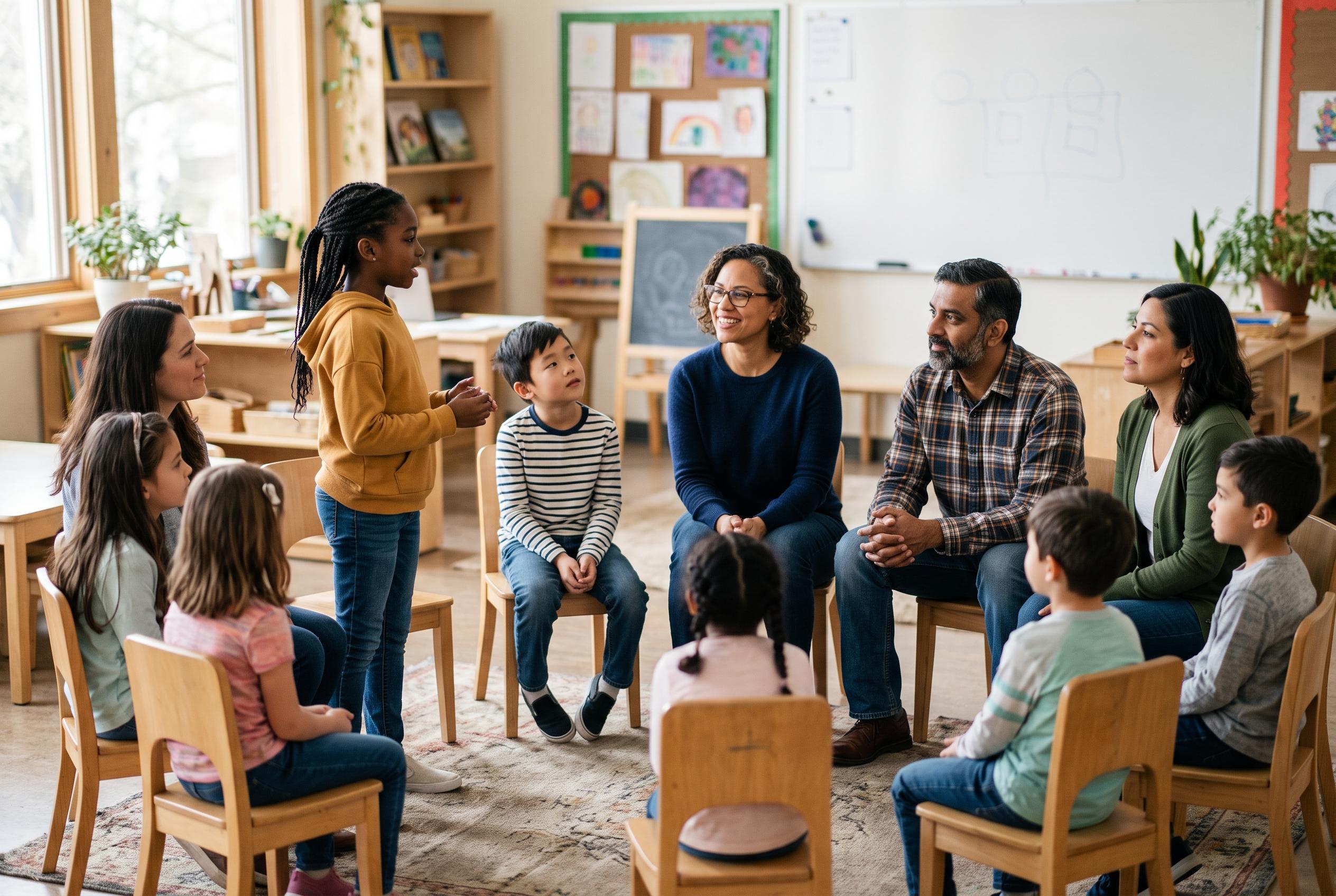

Meaningful participation means more than asking children for their views: adults must listen, explain their limits and allow children’s responses to shape what happens next.
Children in yoga classes, classrooms and family settings are often told to listen closely to their bodies, notice what they feel and speak up when something does not work for them. Yet the harder question is whether adults are prepared to let that response alter the plan. A child who says the music is too loud, the activity feels uncomfortable or they want to do something differently is not being difficult; they are offering information. The issue is whether adults treat that information as meaningful or merely as an interruption to the programme.
That distinction matters because children’s participation is not a courtesy. The United Nations Convention on the Rights of the Child says children have the right to express views on matters affecting them, and those views should be given due weight in line with age and maturity. The Council of Europe has also stressed that children should be heard at home, in school and in other settings where decisions are made about their lives. In practice, that means listening cannot stop at a token invitation to speak. It has to leave room for a child’s answer to influence what happens next.
One useful guide is Professor Laura Lundy’s model of child participation, which focuses on space, voice, audience and influence. In plain terms, children need a safe way to speak, a method that suits them, an adult who actually listens and a response they can recognise as real. That framework is especially helpful in children’s yoga, where adults often control the room, the sequence and the tone of the session. A class can be full of questions and still offer very little genuine participation if the adults collect views but never act on them.
The practical challenge is to separate the decisions adults must hold from the ones that can be shared. Safety, supervision and fairness remain adult responsibilities. Children do not get to decide whether they are put at risk or whether a group activity becomes humiliating. But many other choices are flexible: the music, the volume, the order of activities, the length of a game, whether a child wants to demonstrate, or whether they prefer a seated version. A simple way to frame this is to say: “I am responsible for keeping this space safe.You can help decide how we use it.”
That kind of honesty becomes even more important when children communicate in ways other than speech. Some children answer quickly; others need time, drawing, movement, signing or a trusted adult to support them. Some will pass altogether. The point is not to turn every session into a vote or to let the loudest voices prevail. It is to make sure that a child who is quiet, cautious or communication-different is not treated as invisible. A class can offer choice without pretending that every request is automatically possible.
The same principle applies at home. Families often ask children for opinions while keeping all the real power for adults, then wonder why the child resists. A better question is not, “Do you want to do this?” when the decision has already been made, but, “What would make this easier to do together?” That approach does not give children control over safety or adult stress, but it does make room for them to influence timing, order, tone and shared routines. Research on the Tuning in to Kids programme suggests that adult responses to children’s feelings can shape behaviour in meaningful ways, reinforcing the value of how adults listen and respond.
Listening also has limits. Children’s voice should never be used as a substitute for safeguarding. Adults should not ask children to disclose painful experiences for the sake of a lesson, and they should never promise secrecy if a child raises a concern. If a child says something worrying, the adult’s job is to stay calm, avoid probing questions, follow safeguarding procedures and seek urgent help if there is immediate danger. Participation matters, but protection matters more.
The deeper lesson is that children learn from how power is used around them. If adults want children to become thoughtful, resilient and fair-minded, then children need to see those values practised now, not postponed until adulthood. When a child says the class is too loud, the game feels unfair or a suggestion has not been heard, that is not a nuisance to manage away. It is the moment when listening becomes real, and when adults show that children’s voices can carry weight without taking over the room.
Disclaimer: This content is for informational purposes only and is not intended to be a substitute for professional medical judgment, advice, diagnosis, or treatment.



