

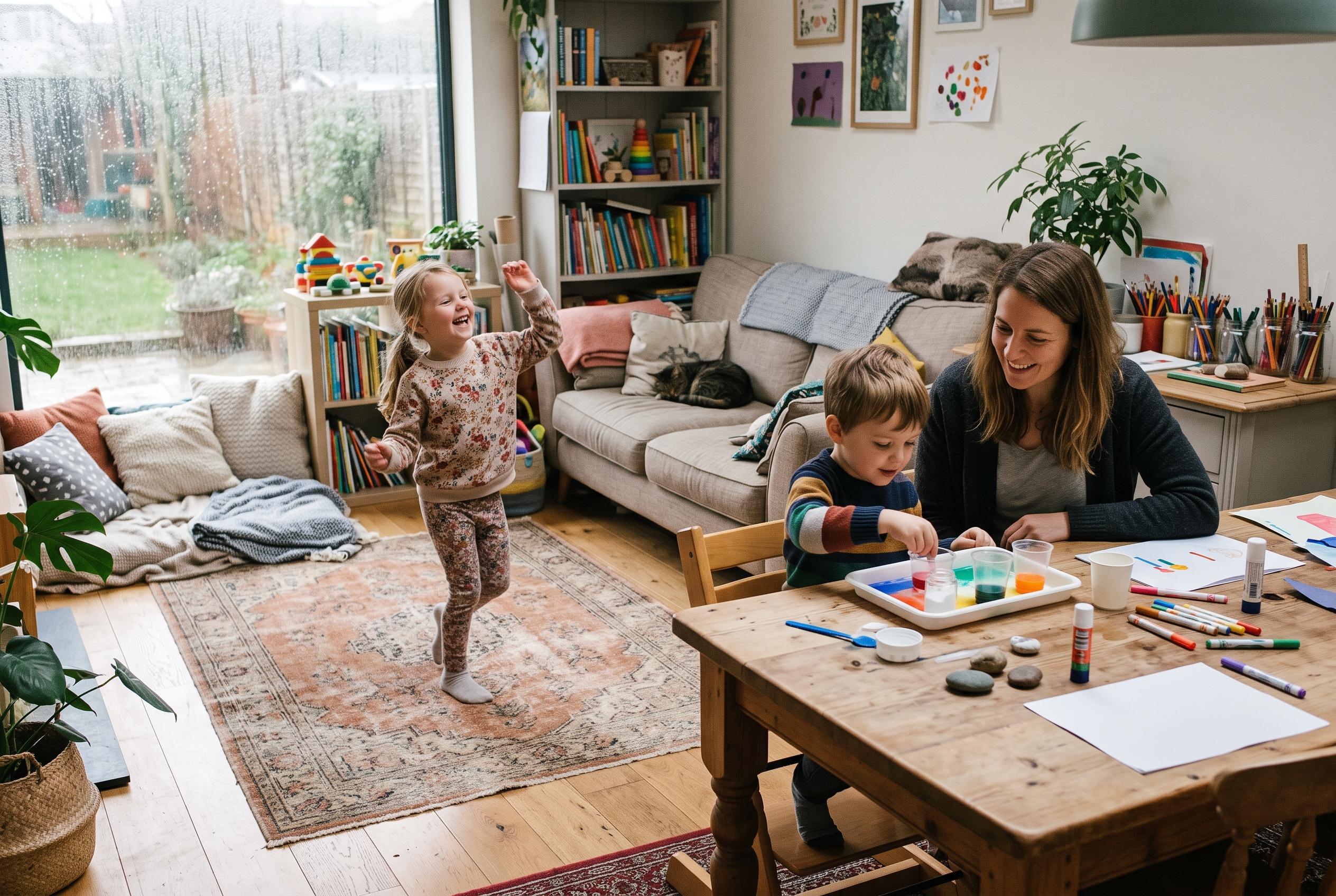

From dance games and kitchen-table science to crafts and calming exercises, flexible indoor activities can help children release energy while building skills.
When parents are stuck indoors with children who have more energy than the room can comfortably hold, the best solution is often not a complicated schedule but a few simple activities that feel like play and still support learning. Sara Bailey’s guide focuses on low-pressure ideas that can be set up quickly at home, from flashcard games and kitchen-table science to art projects, pretend play and short calming exercises. The approach reflects a wider principle noted by child-focused education resources: children tend to learn best when the activity is enjoyable, not when it feels like a lesson.
A useful place to begin is with activities that channel movement, curiosity and repetition without creating chaos. Public Broadcasting Service parenting guidance on indoor play highlights the value of movement-based games, such as dancing, because children need regular opportunities to release energy even when they cannot go outside. At the same time, indoor settings can offer the calm, predictable environment that supports concentration, language development and routine. In practice, that means a living room can become a reading corner, a dance floor or a science station, depending on what children need that day.
Bailey’s suggestions lean heavily on that flexibility. Flashcards can be turned into quick word games, memory challenges or maths practice. A simple recipe can become a reading exercise, a fractions lesson and a chance to learn kitchen vocabulary. Craft projects can be narrowed to one skill, such as weaving, stamping or collage, so children are not overwhelmed by too many choices. A one-page play script can build writing and storytelling skills while still giving children room to be silly. These kinds of activities are useful because they can be adjusted for age, energy level and attention span without requiring expensive materials.
Other family-oriented learning resources make a similar case for mixing activity types throughout the day. Guides aimed at parents and childcare providers often recommend board games, puzzles, blocks, karaoke, reading games and pretend play because they support problem-solving, social skills, fine motor control and emotional development. Health experts also stress that play helps children understand cause and effect, strengthens memory and encourages exploration. Taken together, those ideas help explain why a child might benefit from a short science experiment one hour, a movement break the next and a quiet craft before dinner.
The strongest version of an indoor routine, then, is not a rigid timetable but a loose rhythm. A simple materials bin, a timer and one clear goal can be enough to get started. A short breathing exercise can help reset the mood between louder activities and calmer ones. And a few minutes spent writing down what worked can make the next rainy afternoon easier to manage. The larger point is that indoor time does not have to feel like a fallback. With a little preparation, it can become a space for creativity, learning and calmer family time.
Disclaimer: This content is for informational purposes only and is not intended to be a substitute for professional medical judgment, advice, diagnosis, or treatment.



