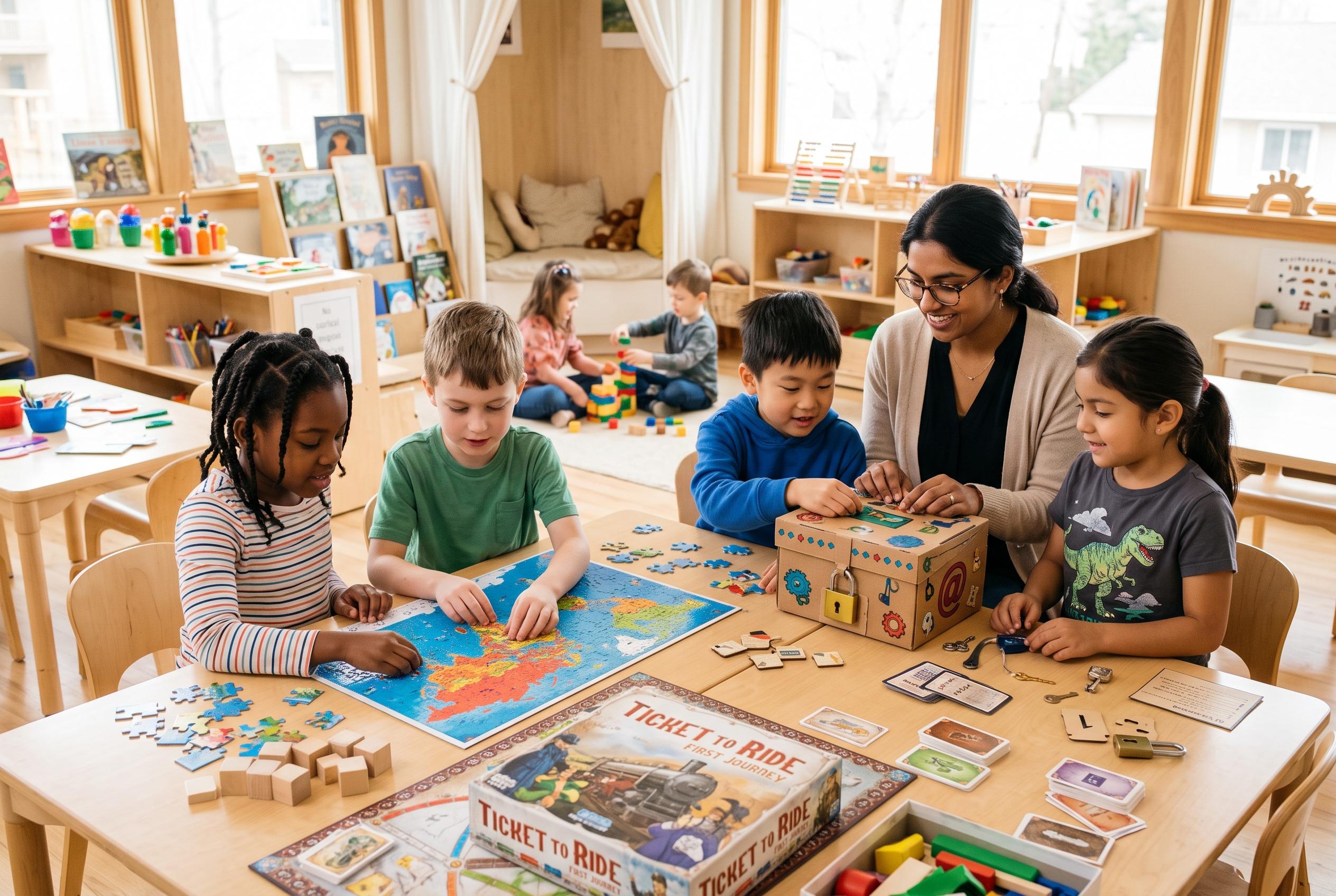

With children increasingly immersed in screens, educators promote hands-on and creative alternatives like board games, puzzles, and DIY escape rooms to foster engagement and development outside digital devices.
Children’s screens have become so embedded in daily life that many parents now treat them as background noise rather than an exception. Healthline says excessive screen use can be linked with sleep disruption, reduced physical activity and other harms, while recent screen-time data suggest children aged 5 to 8 spend well over 3 hours a day on devices. That reality helps explain why teachers are pushing for activities that can hold a child’s attention without a tablet in sight.
The educators featured in the original report all return to the same idea: children do not necessarily want less stimulation, they want different stimulation. Brandon Jenkins, a fourth-grade teacher in Houston, said children who lean towards screens often still want creativity and imagination, but need something immersive enough to compete. His classroom favourites include familiar board games such as Battleship, Jenga, Uno and Guess Who?, which he said combine quick rules with enough strategy to keep children engaged. Adrian Neibauer, a Denver elementary teacher, pointed to Ticket to Ride and similar games as a way to turn play into a lesson in planning and spatial reasoning.
Hands-on activities also feature prominently. Chyna Delk-Bratcher, a kindergarten teacher, said building with blocks, Unifix cubes and magnetic tiles gives children the tactile challenge many of them crave, while Noemi Hernandez, a first-grade dual-language teacher, recommended Operation because it encourages fine-motor control and careful hand placement. Puzzles offer a quieter option, and the same reporting highlighted 100-piece jigsaws as an accessible alternative for younger children. The broader message is that open-ended play often works best when children can manipulate materials rather than simply watch a screen.
Several teachers also suggested borrowing the logic of video games without the device. Jenkins said parents can build simple home escape rooms with clues, hidden objects and riddles, giving children the feeling of progress they often get from gaming. Neibauer noted that world-building games can appeal to children who spend much of their time online, because they echo the creativity of digital play. Reyes Andon, a physical education teacher in New York City, argued that the best activities are often those children help invent themselves, whether that means turning a pool noodle into an obstacle or using sidewalk chalk to map out a course. For parents who still want a screen-based option, Delk-Bratcher recommended Epic!, a reading platform that rewards progress and keeps children working towards goals.
Disclaimer: This content is for informational purposes only and is not intended to be a substitute for professional medical judgment, advice, diagnosis, or treatment.