

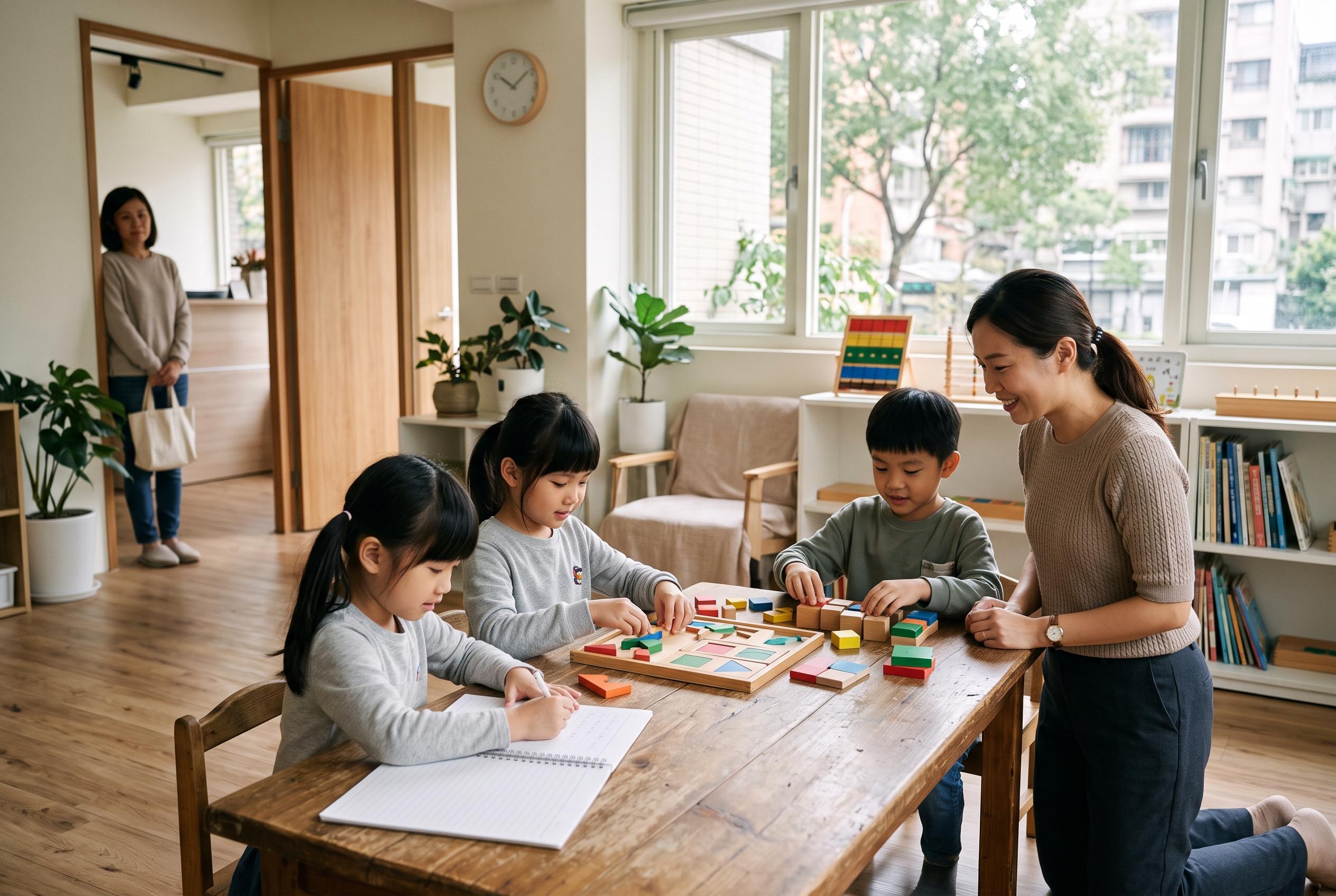

A new survey reveals that over half of seven-year-olds in Taiwan participate in extracurricular lessons, with practices varying widely across regions and echoing broader East Asian trends.
Many Taiwanese parents are enrolling young children in lessons beyond the classroom in the hope of giving them an early advantage. New data from the National Science and Technology Council’s Child Development Survey Database suggest that the practice is now routine for a large share of seven-year-olds in Taiwan, with 58.5% currently learning at least one extracurricular skill.
The findings, drawn from households with seven-year-old children interviewed in 2020 and 2021, show that children who take part in these activities usually begin early. On average, the first lesson starts at around age five. Among children who do study outside school, 48.3% take only one subject, 32.4% take two, 13.4% take three and 5.8% are enrolled in four or more.
Parents appear to favour practical and developmental options first. Physical activity was the most common choice at 53.4%, followed closely by foreign languages at 47.8%. Music accounted for 25.6% and visual arts for 24.1%, while science, technology, engineering and maths subjects made up 16.7%. Far fewer children were studying strategy-related skills, Chinese language, home economics or performing arts.
The pattern is not evenly spread across the island. Central Taiwan’s Taichung, Changhua and Nantou area recorded the highest participation rate at 62.9%, ahead of the Taipei, New Taipei, Keelung and Yilan region. Cloud and Chiang area and the Taoyuan, Hsinchu and Miaoli region were slightly below the national average, while southern and eastern areas lagged behind, with Kaohsiung and Pingtung at 51.8% and Hualien and Taitung at 49.2%.
The survey’s broader context suggests Taiwan is part of a wider East Asian trend rather than an isolated case. According to the same database’s summary, a 2022 survey in Japan found that 67.5% of six-year-olds in the Tokyo metropolitan area, who were about to enter primary school, were attending out-of-home classes. In South Korea, a 2024 survey found that 81.2% of five-year-olds were taking private lessons or extracurricular classes, including academic tutoring.
Disclaimer: This content is for informational purposes only and is not intended to be a substitute for professional medical judgment, advice, diagnosis, or treatment.



