

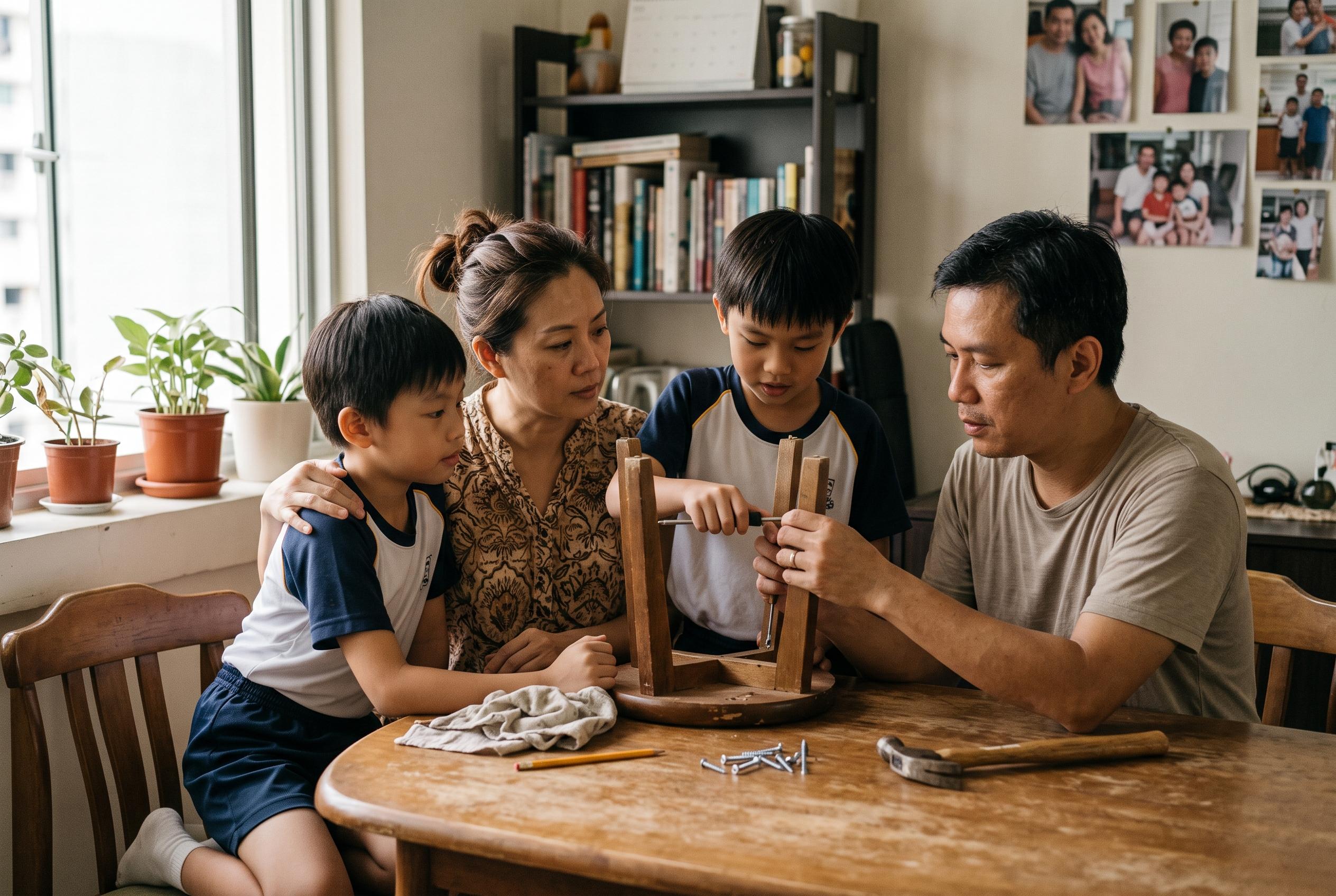

Some families are choosing rest, resilience and practical skills over relentless tuition and prestige school chases, even as anxiety about their children’s futures continues to rise.
Some Singapore parents are choosing to step away from the academic rat race, even as pressure around school choices, tuition and exam results remains intense.
Liang May is among them. In the run-up to her son’s Primary School Leaving Examination in 2024, the 44-year-old homemaker deliberately made room for rest as well as revision. She arranged a short hotel break during his study break, where the pair went rock climbing, played at an arcade and ate out, while fitting study sessions around the fun. Rather than cutting back on leisure, she increased her son’s gaming time, saying she did not want to be swept along by the anxiety of other parents. She believed her child needed to be rested to study properly and, in her view, calm and balance mattered more than relentless pressure.
Her approach also shaped earlier school decisions. Although her son had a place available at a prestigious boys’ primary school linked to her husband’s alma mater, Liang chose a neighbourhood school near home instead. She said she wanted her children to mix with classmates from different backgrounds and develop a broader outlook on life. That choice, she added, paid off in ways that were not captured by rankings or reputation: her children built strong friendships, benefited from caring teachers and, when her daughter struggled with the alphabet in Primary 2, she resisted the instinct to rush into tuition. Instead, she kept reading with her daughter and taking her to the library. Today, the girl represents her primary school in a creative writing competition.
This shift is not isolated. A 2026 Institute of Policy Studies survey found that many parents of primary school children in Singapore place greater emphasis on holistic development than they did a decade earlier. At the same time, the same study found that more parents now feel stressed and worried about their children’s futures than in 2016. More than two-thirds also said the education system, despite being widely regarded as among the world’s best, still places unnecessary strain on children. The findings suggest a tension at the heart of Singapore parenting: families increasingly value wider development, but the competition for educational advantage remains deeply embedded.
Some parents are responding by placing less emphasis on grades and more on effort, resilience and practical life skills. Tang, a parent and pre-school administrative executive, said she does not set academic targets for her children. What matters more to her is whether they understand what they are learning and whether they are making a fair effort. Her son, now in Secondary 4, entered the School of Science and Technology through the Direct School Admission route after written tests and science challenges. Her 11-year-old daughter will sit the PSLE in 2027, and Tang said the family will choose a secondary school based on results and co-curricular interests rather than pursuing a single prestigious option at all costs.
Jason Tan, a professor at the National Institute of Education, said there is still a lack of rigorous local long-term research proving that attending a so-called good school leads to greater success later in life. He noted that it remains unclear how much of the apparent advantage of students from top schools comes from what those schools offer and how much reflects advantages those students already had before entering. That uncertainty sits behind much of the debate over school choice in Singapore, where the pursuit of a place in a highly regarded institution can start years before a child even reaches primary school.
Other parents are using a broader approach to enrichment. Jasmine Sia, a former secondary school teacher who now works as a private tutor, said each of her four children is encouraged according to their own strengths. She does not believe the same academic standard can be applied evenly to every child. Instead of piling on tuition, she steers them towards activities that may become lifelong interests, such as piano, wushu, robotics and football. Yong Qiao Qing, a marketing manager, has also taken a less conventional route by involving her two daughters in her online business, Little Warriors, which makes protective clothing for children with sensitive skin. She said the girls learn to speak to customers, create social media content and think about money and enterprise in ways that schoolwork alone cannot teach.
For Shoba Agnetha Seetaram, the decision to resist pressure is bound up with her daughter’s mental health. The 46-year-old single mother said her daughter developed social anxiety during the Covid-19 pandemic, which later led to headaches, hospital stays and difficulty attending school. The teenager, now 16, has received support from KK Women’s and Children’s Hospital, started anxiety medication in June and is repeating Secondary 3 after missing much of the previous two school years. Seetaram said her priority is not academic performance but emotional stability, independence and character. Still, even parents who try to keep perspective admit they are not immune to doubt. Vanessa Ng, a marketing consultant with two young children, said conversations about school registration and competition can make her wonder whether she is being too relaxed. For now, she is limiting enrichment to a single class a term, but she acknowledged that her outlook could change once her son enters primary school and the pressure becomes more immediate.
Disclaimer: This content is for informational purposes only and is not intended to be a substitute for professional medical judgment, advice, diagnosis, or treatment.



