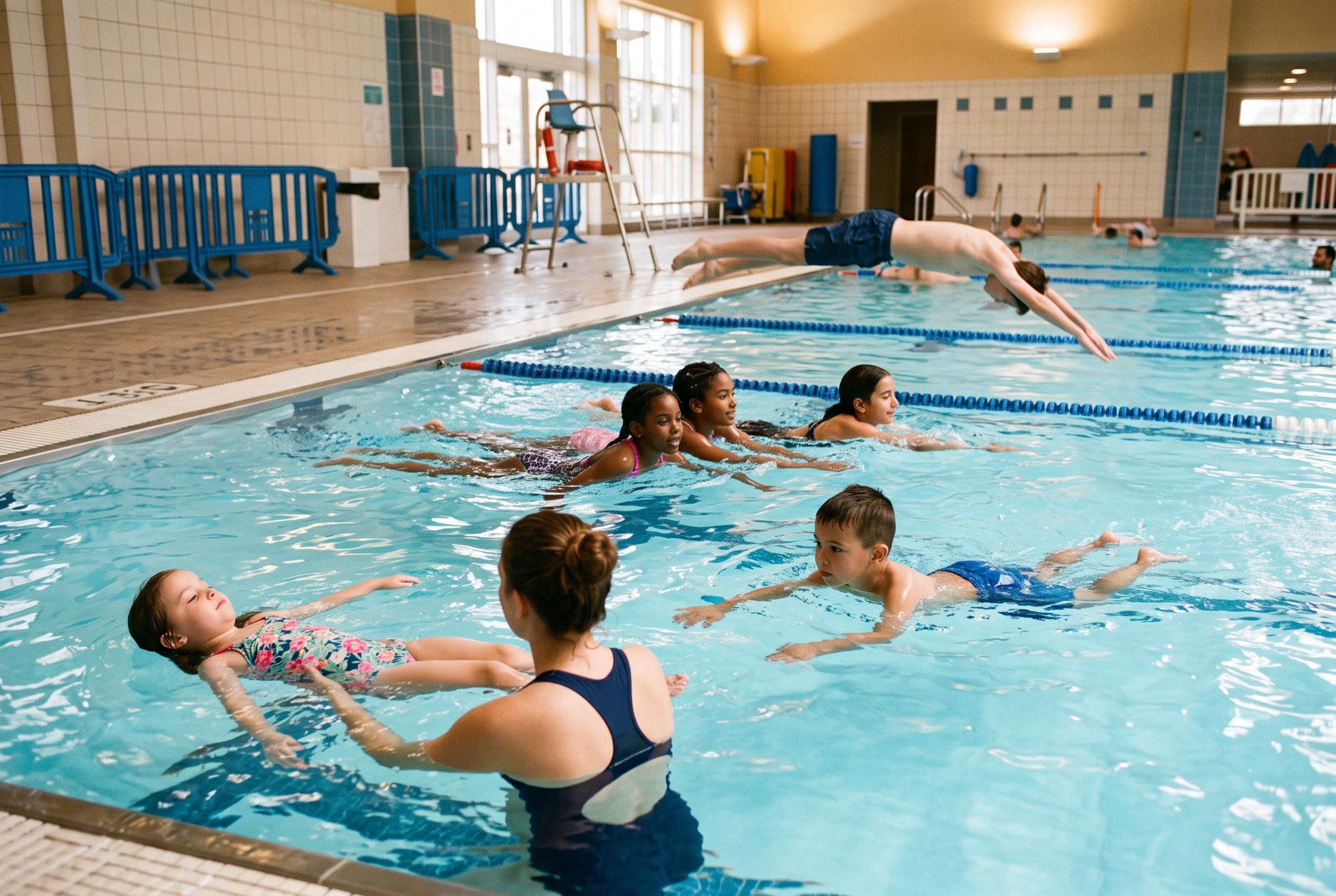

SafeSplash’s innovative lesson pathway organises swimming progress into four stages, Comfortable, Capable, Confident and Competitive, focusing on skill acquisition rather than fixed durations, with an emphasis on individual ability and safety milestones.
SafeSplash’s lesson pathway is built around a simple idea: swimmers move forward by mastering skills, not by spending a fixed number of weeks in class. The company groups progress into four broad stages: Comfortable, Capable, Confident and Competitive. Those stages help parents understand the overall journey, but placement still depends on a swimmer’s age, current ability and goals.
At the earliest end of the curriculum, the focus is on getting children at ease in the water and establishing safe habits. SafeSplash’s ParentTot classes are for children aged four to 36 months and include a parent or caregiver in the water. Toddler Transition is for developmentally ready children aged two to three who work with an instructor without a caregiver in the pool. Beginner 1 continues that early work by building trust, familiarity and the foundations for later self-rescue skills.
The next stretch, Beginner 2 through Beginner 4, is where swimmers start becoming more independent. SafeSplash describes this as the Capable phase, with lessons focused on floating, rollovers, safer entries and exits, and increasingly independent self-rescue skills. For eligible swimmers aged four and older, the S.A.F.E.R. Swimmer Promise adds a timetable: complete 10 essential water safety and self-rescue skills within one year, or receive up to two additional months of lessons free. The company says eligibility and availability can vary by location.
As swimmers move into the Intermediate levels, the emphasis shifts again. According to SafeSplash, this part of the programme is about refining stroke mechanics and building endurance so children can swim longer distances with better efficiency. That is the Confident stage in the broader framework. In practice, progress can be less dramatic at this point, but instructors track smaller gains in technique, stamina and control.
Advanced lessons are aimed at swimmers who are ready to work on technique, stamina and personal performance goals. SafeSplash describes this as the Competitive stage, but it is not presented as the only successful outcome. The company says some families may also use clinics or team-preparation options, including WAVE Swim Team Prep, which is generally designed for swimmers at Intermediate 2 and above. At the same time, SafeSplash stresses that becoming comfortable, capable and confident in the water is meaningful progress in its own right.
For parents, the practical takeaway is that a swim level tells you what a child is working on now, not what they have finished learning. SafeSplash says instructors move swimmers up only when they demonstrate the required skills for the next level, and families may also see progress through ribbons, app updates or Splash-N-Tell sessions, depending on location. The company also points parents to its Level Finder, while reminding families that lessons are only one layer of water safety. The American Academy of Pediatrics says children should still be closely supervised, homes with pools should have four-sided fencing, and open-water swimmers should use properly fitted life jackets rather than flotation toys.
Disclaimer: This content is for informational purposes only and is not intended to be a substitute for professional medical judgment, advice, diagnosis, or treatment.