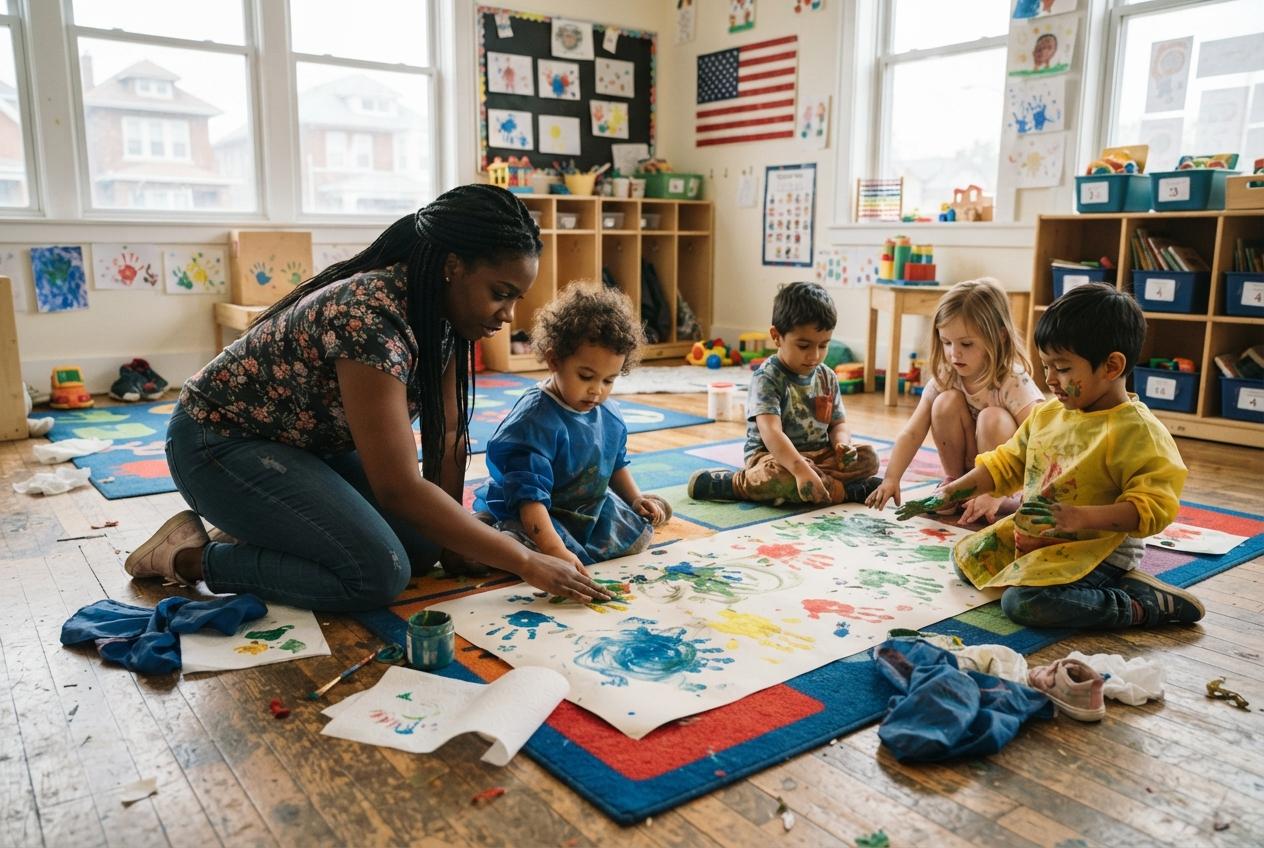

Engaging children in painting activities goes beyond tidiness, promoting physical coordination, emotional bonding, and creative exploration with safe materials and open-ended approaches.
Painting with a child is more than a tidy alternative to drawing: it opens up a richer, more physical kind of play. Brushstrokes, splashes, colour mixing and the feel of water on paper all give young children a chance to explore texture and movement as well as images, which is why many educators see painting as especially useful for developing hand control and hand-eye coordination.
For parents, the safest start is also the simplest. HealthyChildren, the American Academy of Pediatrics’ parent site, advises choosing water-based, non-toxic materials, checking for recognised safety standards such as ASTM D4236, and supervising children during art activities. Practical preparation matters too: a protective covering for the table or floor, a washable apron and large paper sheets can make the experience calmer for everyone.
Once the basics are in place, colour becomes part of the lesson. Letting a child experiment with mixing paints teaches through discovery rather than instruction, and that hands-on approach helps make early ideas about colour feel intuitive. Finger painting, sponge printing and even making patterns with string dipped in paint can broaden the child’s repertoire and show that painting does not have to rely on a brush alone.
The best subjects are often the ones a child already cares about. Family, animals, favourite stories, seasons and recent outings can all provide an easy starting point. Open-ended questions such as what an imagined garden might look like can encourage originality without forcing a fixed outcome, while paintings based on a zoo visit, a seaside trip or a birthday celebration can help children connect art with memory and emotion.
Research highlighted by the World Economic Forum has suggested that art activities can strengthen the bond between children and carers and support wider personal development, including communication and self-expression. That wider value is one reason painting can be worth bringing into family life early, whether at home or in a more structured setting.
If a child begins to show real enthusiasm, organised classes may add another layer of benefit. A well-run art school can introduce new techniques such as watercolours or canvas work, while also teaching children how to listen to another adult, share materials and take turns. After lessons, the most useful follow-up is often a simple conversation about what the child enjoyed most, rather than an assessment of how the picture looks.
In the end, the point is not to produce perfect work. Whether the painting happens at the kitchen table or in a classroom, the real value lies in keeping it playful, relaxed and open-ended.
Disclaimer: This content is for informational purposes only and is not intended to be a substitute for professional medical judgment, advice, diagnosis, or treatment.