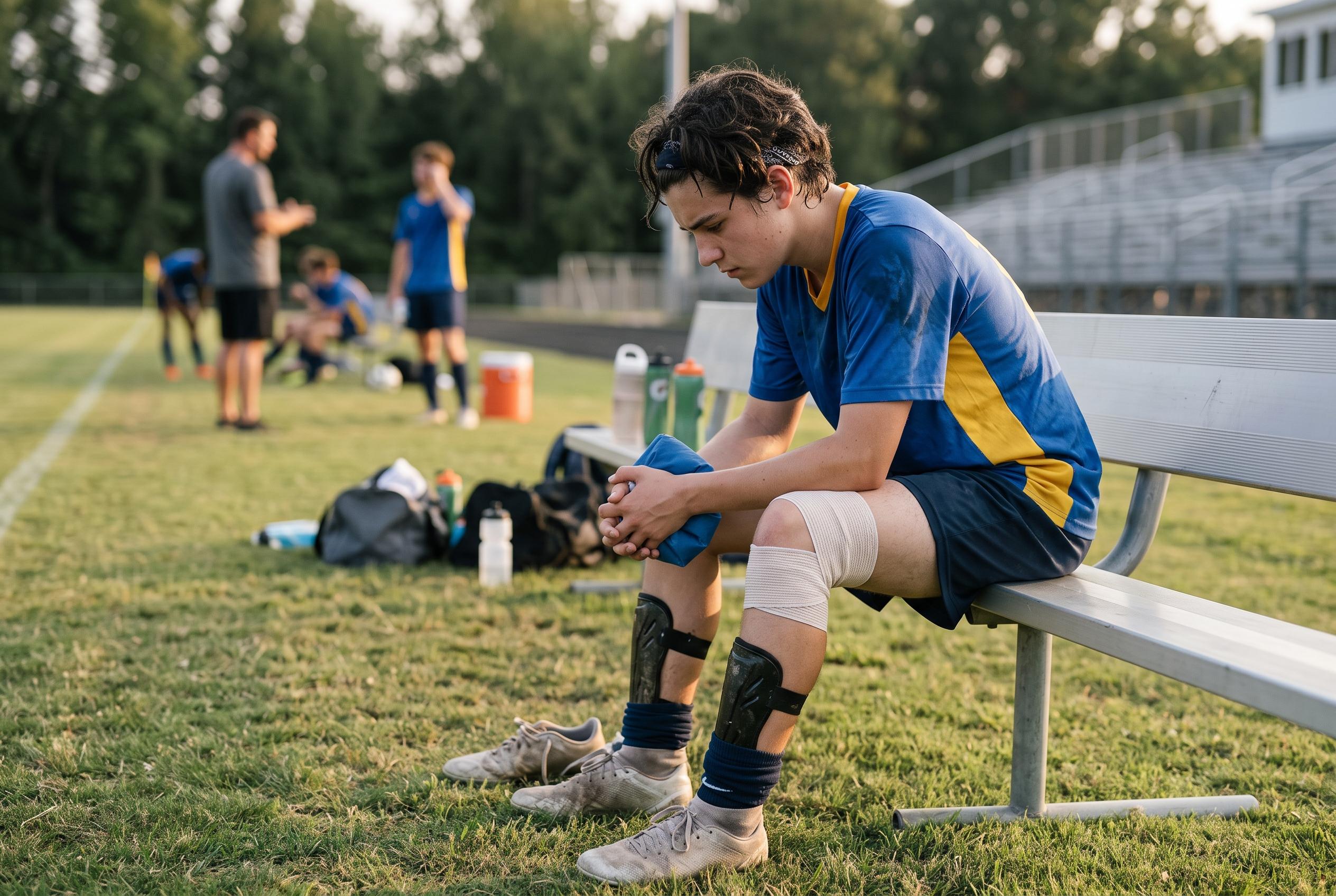

Repeated training and inadequate rest are quietly causing long-term damage in young athletes, with experts warning that overuse injuries often go unnoticed until they result in season-ending problems.
A child who comes off the pitch, out of the pool or away from the court with a season-ending problem often has not suffered one dramatic accident. More often, sports medicine groups say, the damage has been building quietly through repeated training, frequent competition and too little recovery. The American Medical Society for Sports Medicine has said the published literature putting overuse injuries at about half of all sports injuries probably understates the true burden, because many young athletes keep playing through pain rather than missing time altogether. (amssm.org)
What makes children different is not simply size. Their bones are still developing, and the growth plates and tendon-attachment sites can be more vulnerable than the ligaments or tendons around them. Writing in The Washington Post, Ian McMahan reported that Neeru Jayanthi of Emory Healthcare warns risk rises during the adolescent growth spurt, typically around ages 9 or 10 in girls and 11 or 12 in boys, because injuries tend to show up at growth plates and other immature structures. The American Academy of Pediatrics says these injuries are easily mistaken for ordinary sprains or strains, while the American Academy of Orthopaedic Surgeons notes they can also develop gradually through repetitive stress when a child overtrains. (washingtonpost.com)
Parents and coaches do have some practical rules of thumb. Stacey Schley told The Washington Post that young athletes should train for fewer hours each week than their age, so a 12-year-old regularly doing more than 12 hours would be pushing into a higher-risk zone. She also pointed to a sports-training ratio in which organised sessions outnumber free play by more than two to one as another warning sign. Those rules broadly match a 2017 study of 2,011 athletes aged 12 to 18, which found that highly specialised athletes were more likely to report both any injury and overuse injury in the previous year. The same study found higher odds of injury among children who played their main sport for more than eight months of the year or for more hours each week than their age. (washingtonpost.com)
The earliest clues are often easy to dismiss: a limp that appears after training, swelling that does not settle, a thrower who stops using one arm normally, or a swimmer whose stroke changes because something hurts. HealthyChildren.org says a youngster with a suspected sprain should always be assessed for possible growth-plate injury, and the AAOS warns that some non-displaced growth-plate fractures do not show up clearly on X-rays. Because children heal quickly, the orthopaedic body says, a potential growth-plate injury should be examined promptly before the bone starts to heal in the wrong way. (healthychildren.org)
Swimming gives a clear picture of how sport-specific these patterns can be. The American Academy of Pediatrics says most swimming-related orthopaedic injuries in competitive swimmers are overuse injuries. It lists swimmer’s shoulder, caused by repetitive overhead movement, low back pain linked to turns, rotation and extended back positions, breaststroker’s knee from the frog kick, and foot and ankle pain from repeated flutter and dolphin kicking. The same guidance says treatment may require rest, physiotherapy, strengthening work and a temporary cut in workload measured by yardage or pool time. (healthychildren.org)
When the problem is a true growth-plate fracture rather than a milder irritation, follow-up matters as much as the first diagnosis. The AAOS says these fractures are common in the long bones of the fingers and also in the radius, tibia and fibula. The long-term outlook depends on the child’s age, the bone involved, the fracture pattern and how far the bone has shifted. Rarely, a bony bridge can form across the fracture and stunt growth or cause the limb to curve, which is why the AAOS advises regular follow-up for at least a year and, in more complicated cases, until skeletal maturity. (orthoinfo.org)
The prevention advice is not to ban ambition, but to build in variety and rest. Kristin Wingfield told The Washington Post that children should not play up an age group or on several teams at once. Jayanthi argued that for committed single-sport players, “you just must embrace and work with them”, meaning families should manage workload rather than pretend the pressure does not exist. The AMSSM says early specialisation may not improve long-term success and recommends sport diversification at younger ages, with some exceptions for early-entry disciplines such as gymnastics, figure skating and swimming or diving. It also advises scheduled rest periods, close monitoring during growth spurts, attention to previous injuries and pre-season conditioning and neuromuscular training to reduce injury rates. (washingtonpost.com)
That leaves parents with a simple but important test: do not wait for a child to become unable to play before taking pain seriously. The American Academy of Pediatrics notes that broken bones account for only one in twenty sports injuries overall, and the rate is lower in young people than in adults, but that does not make vague pain harmless. If a child is limping, protecting one side, avoiding a familiar drill or describing a joint that simply feels “weird”, those are the moments when a lighter week, a proper assessment and, if needed, imaging can prevent a manageable overuse problem from becoming a longer interruption. (healthychildren.org)
Disclaimer: This content is for informational purposes only and is not intended to be a substitute for professional medical judgment, advice, diagnosis, or treatment.