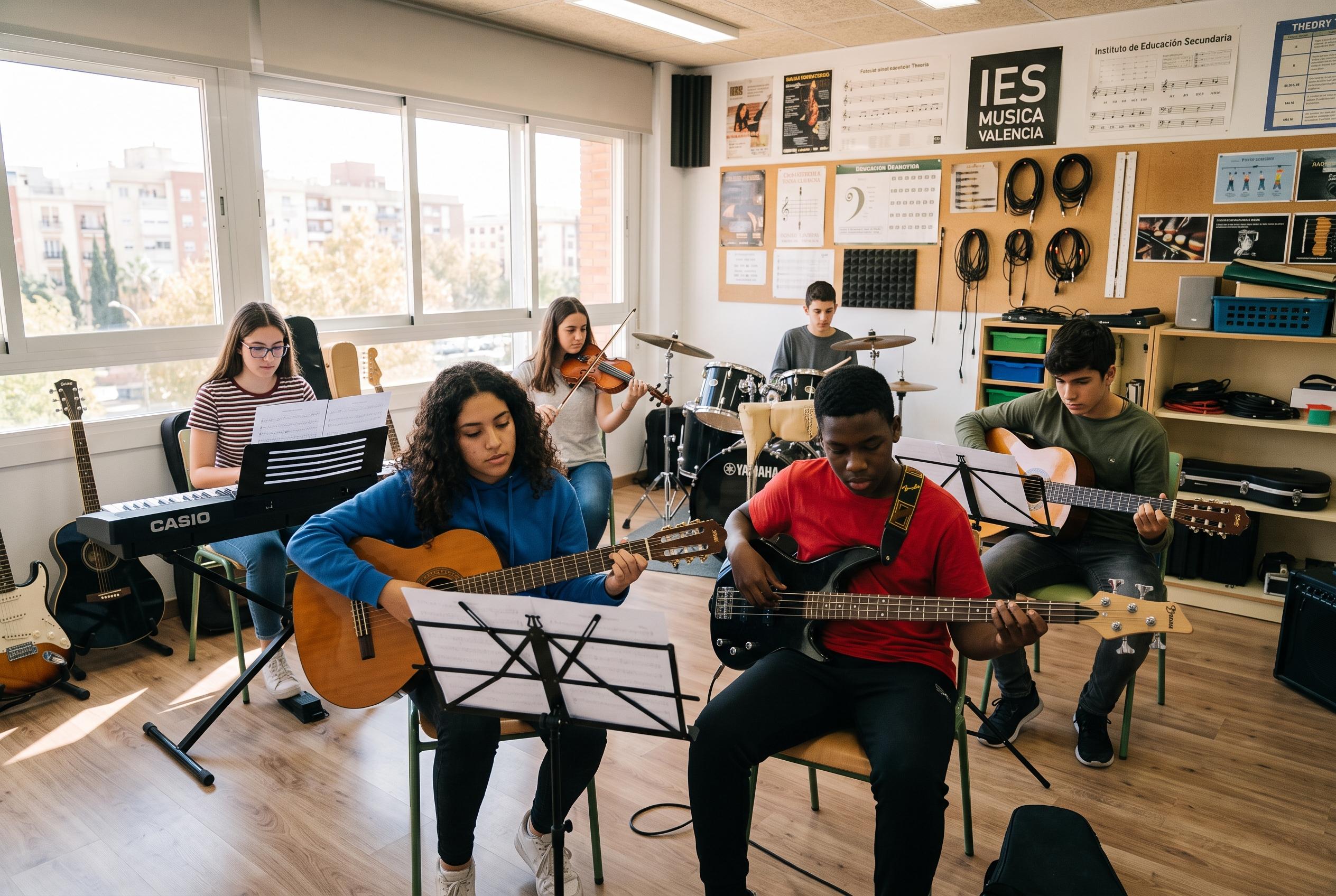

Research in Spain reveals that sustained instrumental practice and educational support play a more crucial role than background traits in shaping adolescents’ musical self-belief, emphasising the impact of learning environments.
Musical self-concept in teenagers appears to be shaped less by fixed background traits than by what they do in and around school, according to a new study in Spain that examined 980 secondary school students aged 12 to 18 in Aragon and Navarra. The researchers found notable differences in instrumental musical self-concept by sex, whether students lived in urban or rural areas, whether they played an instrument and whether they received educational support. Their analysis suggests that regular instrumental practice is the strongest predictor of how students see their own musical ability.
The study used the Instrumental Musical Self-Concept scale alongside a questionnaire on educational and contextual factors. By applying variance analysis and stepwise multiple linear regression, the authors concluded that sustained practice, both inside and outside the classroom, matters more than broad demographic categories when it comes to musical self-belief. In their view, this strengthens the case for schools treating musical confidence as something that can be developed, not simply measured.
That conclusion fits with wider research on music education. A separate study published in Education Sciences found that social support and grounded optimism are important in building a positive musical self-concept among secondary pupils. Another study from the Community of Madrid reported that participation in school ensembles can change students’ musical habits and practices, underlining the role of collective music-making in shaping engagement and motivation.
Other recent work points in the same direction. Research on digital instrument building in secondary classrooms found benefits from combining music with computing, while a cross-sectional study of ensemble classes linked self-efficacy to confidence and motivation in performance. Earlier validation studies of Spanish-language musical self-concept tools have also helped establish more reliable ways to measure the idea, including questionnaires used in conservatory settings. Taken together, the evidence suggests that musical identity at school is closely tied to practice, support and the learning environment, rather than to background alone.
Disclaimer: This content is for informational purposes only and is not intended to be a substitute for professional medical judgment, advice, diagnosis, or treatment.