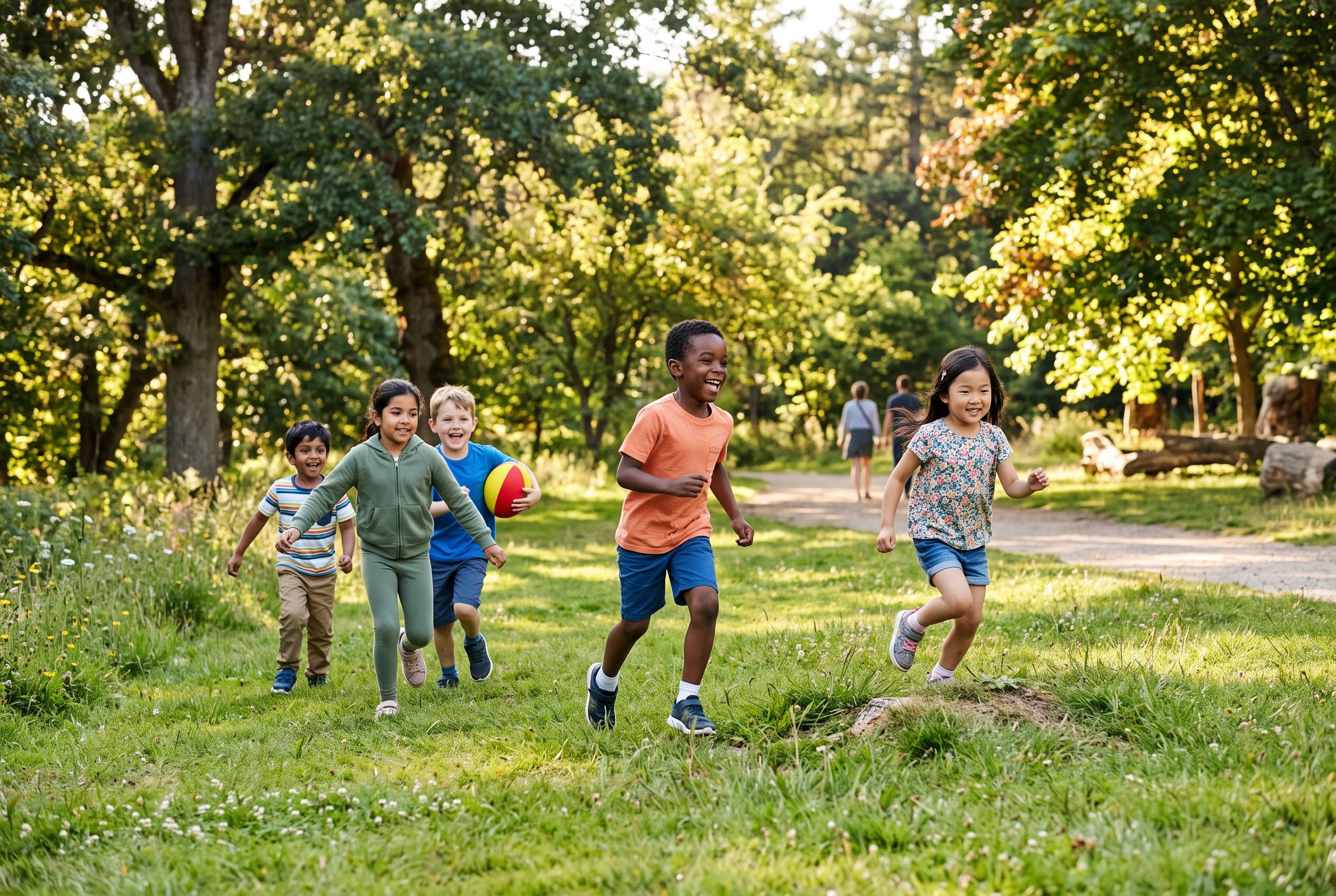

Recent research underscores the importance of outdoor activities for children’s physical, emotional, social and cognitive growth, emphasising simple, accessible ways for families to encourage outdoor play in an era dominated by screens and structured routines.
Children thrive when they have room to move, test ideas and explore without too much adult direction, and outdoor play remains one of the simplest ways to support that. Across a patch of grass, a school yard or a local park, children can run, climb, balance and invent games that build much more than fitness alone. Public health and child development guidance from the Centres for Disease Control and Prevention, UNICEF and the American Academy of Pediatrics all point to the same basic conclusion: regular time outside supports physical, mental and social development.
The physical benefits are the easiest to see. Outdoor play encourages children to jump, cycle, throw, sprint and climb, all of which strengthen muscles and bones while improving coordination, balance and endurance. Harvard Health has also noted that time outside can support bone health through sunlight exposure and vitamin D production, while UNICEF says children who spend at least 2 hours a day outdoors tend to be more active overall.
There is also a clear emotional upside. According to HealthyChildren.org, outdoor play can help improve mood, reduce anger and aggression and support better impulse control. The CDC likewise says outdoor environments offer fresh experiences that can aid learning and emotional growth, while Medical News Today reports that open-ended play outdoors often gives children a sense of freedom that indoor routines may not match.
Learning benefits follow naturally from that freedom. Purdue Global says unstructured outdoor play gives children chances to solve problems, make decisions and practise emotional regulation. Building a den, inventing rules for a game or working out how to cross uneven ground all require planning and judgement. The result is not only better physical control but also stronger concentration, curiosity and cognitive flexibility, which Harvard Health says can help learning more broadly.
Social development is another major gain. Outdoor play often brings children into contact with siblings, friends or neighbourhood peers, where they have to negotiate, take turns and settle disagreements. Purdue Global and HealthyChildren.org both highlight cooperation and communication as important outcomes, while Medical News Today notes that outdoor settings can make it easier for children to make friends and practise group play in a less structured environment.
The imaginative side of outdoor play should not be overlooked. A stick can become a telescope, a pile of leaves can become a fort and a garden path can turn into an adventure trail. UNESCO has long warned that children are spending less time outside, even though these kinds of unstructured experiences are part of what makes play so valuable. UNICEF also argues that outdoor play helps children connect with nature and understand seasonal and environmental changes in a direct, memorable way.
For parents and carers, the practical answer is usually straightforward: build outdoor time into the day and keep it simple. The CDC recommends supervision, hydration, sun protection and other basic safety measures, while the same guidance seen across child health sources suggests that families do not need elaborate equipment or long trips to make a difference. A walk after school, a game of ball in the garden, chalk drawings on the pavement or a visit to a nearby playground can all help children develop healthier routines and a lasting comfort with the outdoors.
Outdoor play matters because it blends movement, discovery, creativity and social learning in a way that few other activities can match. The evidence from child health organisations is consistent: children benefit when they have regular chances to get outside, explore and move freely. In a childhood increasingly shaped by screens and schedules, those moments of unstructured play may be among the most valuable parts of the day.
Disclaimer: This content is for informational purposes only and is not intended to be a substitute for professional medical judgment, advice, diagnosis, or treatment.