

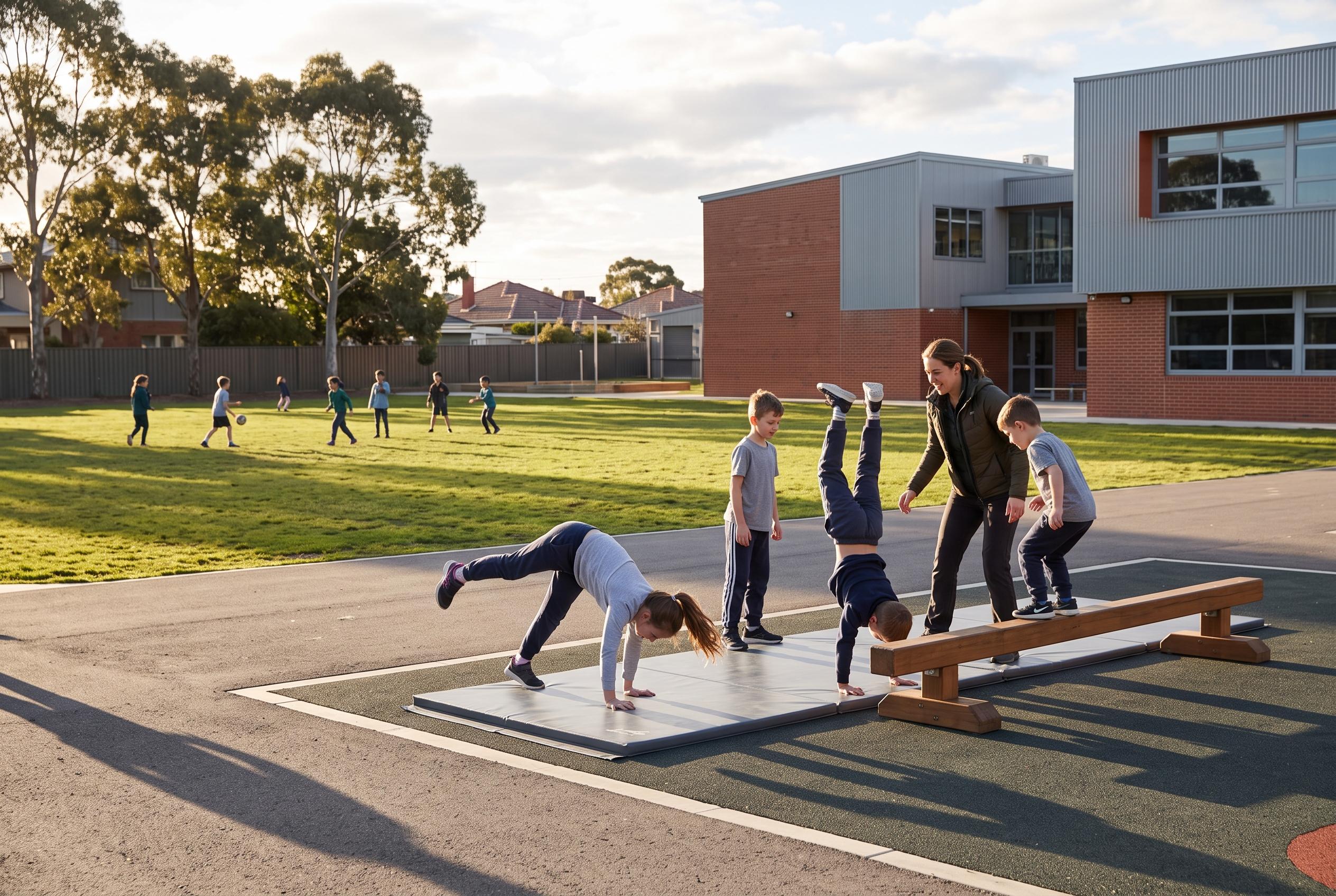

Primary schools in Melbourne are tightening rules on cartwheels and handstands following injury concerns, sparking debate over maintaining active play versus safety precautions, with experts urging practical safety measures over outright bans.
Some Melbourne primary schools are tightening rules on cartwheels and handstands after a series of playground injuries, reviving a long-running debate over how much physical risk children should be allowed to take at school. Brendon Hyndman, an associate professor of education at Charles Sturt University, argues that the issue is not simply whether such movements are safe, but whether schools are responding with proportionate measures that still allow children to learn through active play.
The concern is not new. Schools in Australia have previously moved to curb unsupervised gymnastics-style play after injury scares, including a Townsville primary school that drew international attention in 2008 after banning certain activities, a Sydney school that later required trained supervision for cartwheels and handstands, and a Bunbury school that imposed a temporary restriction after repeated wrist injuries. In each case, the trigger was a belief that children were attempting movements on surfaces or in conditions that increased the chance of harm.
Hyndman says cartwheels and handstands can be valuable forms of movement because they help children build strength, balance and confidence while learning to judge their own limits. He points to research showing that gymnastics injuries in children and teenagers commonly include wrist sprains, arm fractures and concussions, but he also notes that this evidence does not tell schools how dangerous a cartwheel is in an ordinary playground. The broader question, he suggests, is whether a ban is the right answer when better preparation, supervision or space might reduce the risk.
The research he cites also reflects a wider problem in schools: teachers often do not feel well prepared to manage risky play. In Hyndman’s 2026 study, 135 teachers in 25 countries rated their training for supporting outdoor play at just 2.3 out of 10. In a separate 2025 study, the same group described uncertainty about staffing, poor surfacing and low funding for play. A 2022 review of 25 studies also found that fears of injury, parental complaints and legal liability could push staff towards overly cautious decisions.
School rules, though, are not written to eliminate challenge altogether. Australian professional standards require teachers to create safe learning environments, while Victorian government guidance says unstructured physical activity is vital to children’s daily activity levels. That tension, Hyndman argues, should lead schools to look first at practical safeguards: level ground, enough room to avoid collisions, age-appropriate preparation and help from someone with gymnastics expertise when needed. He also says children themselves should be asked where the risks lie and what alternatives they would enjoy, especially when playground space is already dominated by fast ball games that can exclude less confident pupils.
Disclaimer: This content is for informational purposes only and is not intended to be a substitute for professional medical judgment, advice, diagnosis, or treatment.



