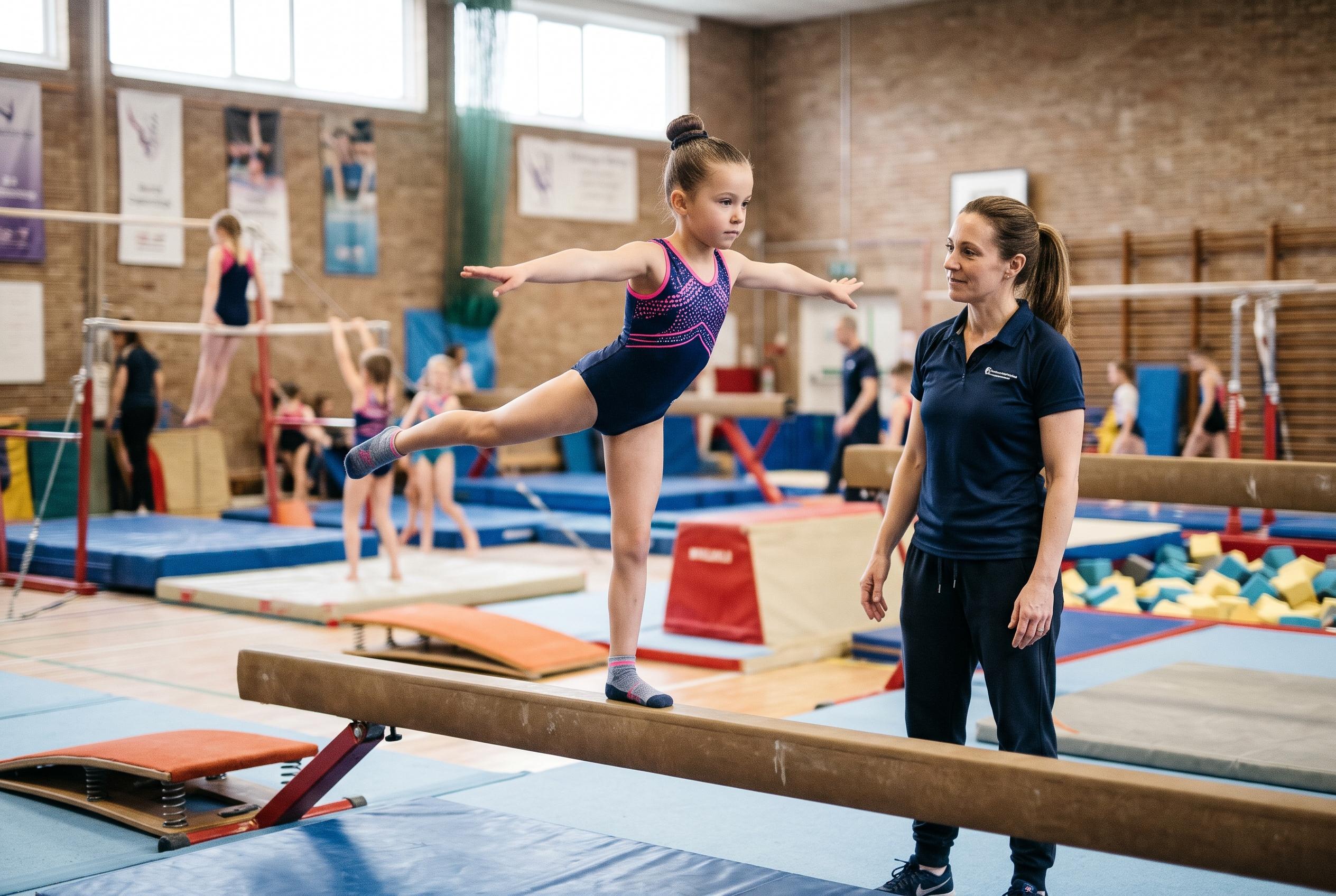

Psychologist Katie Castle says intense training in childhood should be tailored to each athlete, as research links early specialisation with injury, burnout and withdrawal from sport.
A growing debate in gymnastics is focusing less on how early a child can reach elite level and more on what that journey costs. Psychologist Katie Castle has argued that coaches should rethink the assumption that more hours in the gym automatically produce better athletes, especially when training begins to crowd out school, friendships and ordinary childhood experiences.
Castle said on Instagram that reaching elite status at 10 or 16 has no clear link to success later in life, and suggested that children may gain more from a broader childhood than from extreme early commitment. She argued that coaches have a duty to train athletes only as intensely as needed to meet their goals, rather than pushing them through what can feel like a full-time schedule during the primary school years.
Her comments tap into a wider body of sports medicine research that has been warning for years about the risks of early specialisation. In a 2016 clinical report, the American Academy of Pediatrics said specialising too early can bring both physical and psychological harms, including overuse injuries and burnout. The academy also noted that young athletes may benefit from playing more than one sport for longer, because varied activity can support motivation, leadership and healthier peer relationships. Johns Hopkins Medicine has since summarised similar guidance, saying specialisation is often better delayed until the mid-teens.
That caution is especially relevant in gymnastics, where athletes often peak young and training can begin very early. But even there, researchers have not identified one ideal formula that suits every child. The academy’s more recent report on overuse injuries, overtraining and burnout recommends that young athletes take at least one or two days off each week from competition and sport-specific training, underscoring the need for balance rather than endless repetition.
Studies of why gymnasts leave the sport help explain Castle’s concerns. A 1986 analysis of competitive, recreational and former young gymnasts found that the biggest reasons for quitting included having other interests, injuries, pressure, a lack of fun and the time commitment. More recent research published in 2022 found similar patterns, with athletes citing other priorities, negative social experiences, poor confidence, weak motivation, feeling too old and poor coaching behaviour.
The human cost of that pressure is also visible in the stories of former athletes. Rebecca Liu, writing in The Guardian in 2021 about her life as a rhythmic gymnast, described the humiliation and exhaustion she felt as a child athlete and said she retired at 12. Olympic champion Linoy Ashram has also spoken publicly about quitting gymnastics at 12 before returning. Their experiences do not prove that lighter training would have changed the outcome, but they do show why medals are not the only measure of a successful sporting childhood.
For parents and coaches, the broader lesson is not that discipline should be removed from youth sport. It is that intensity should be matched to the child, not the other way around. The challenge in gymnastics is to build excellence without turning childhood itself into something to be sacrificed for it.
Disclaimer: This content is for informational purposes only and is not intended to be a substitute for professional medical judgment, advice, diagnosis, or treatment.