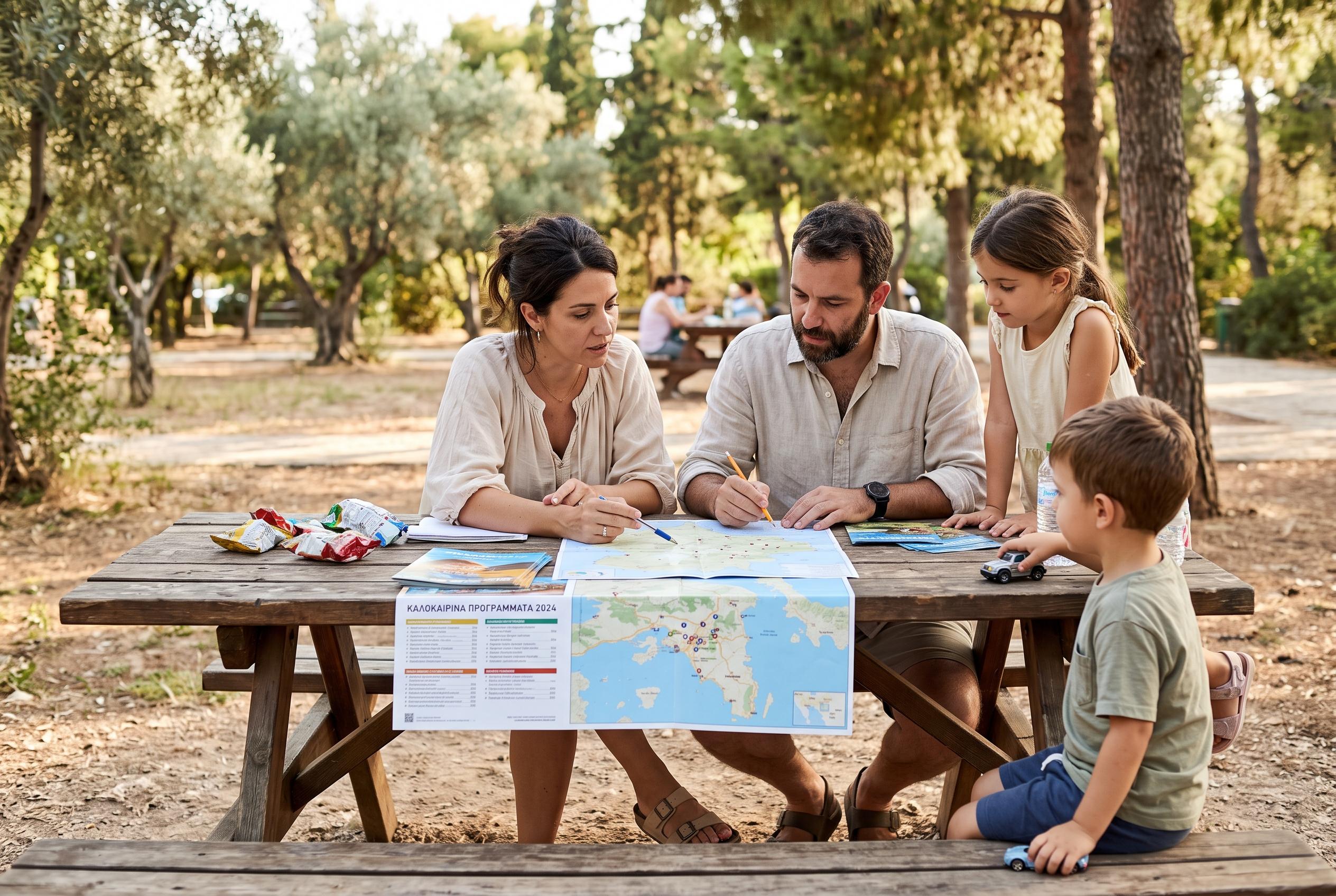

With rising summer camp prices, legal gaps in regulation, and the complexity of balancing work and family life, Greek parents face a reevaluation of traditional childcare strategies during the holiday season.
For many working parents, August is less a holiday than a logistical puzzle. Between summer camps, grandparents, office visits, split leave and the occasional stretch of empty days, the question is not simply where children should be, but where they can be safely, happily and realistically.
According to Kathimerini, the pressure begins well before school ends, when families start comparing plans and trying to cover every week of the summer. The article notes that what looks like a simple childcare decision often becomes a matter of balancing money, availability, a child’s temperament and the parents’ own capacity to keep working without burning out.
Summer camps remain one of the most common answers. As the child and family psychologist Aspa Paspali points out, they offer structure, movement, social contact and a setting that feels more secure than improvising at home. They can also give parents space to work, but only if the camp is genuinely suited to the child and properly organised. The article makes clear that not every programme with an appealing name is equally well run, and that families need to look beyond marketing to issues such as supervision, safety and communication.
Costs are another reality. One mother quoted in the piece says her 11-year-old attends more than one camp each year and that places in a major cultural organisation’s programme filled within minutes. She estimates the annual bill at about 1,000 euros. The article also notes that camps have proliferated in Greece in the absence of a clear legal framework, with everything from private nurseries to museums offering programmes of their own.
Grandparents remain a crucial part of the summer equation, but Paspali cautions against treating them as a default childcare service. Many are still working, some have health limitations and others simply want time for themselves. She argues that the best arrangements are the most specific ones: how long they can help, which days they need to rest, who handles transport and costs, and where the non-negotiable boundaries of care lie.
The article also explores the emotional value of time with grandparents. Beyond practical help, these stays can give children a different rhythm, a sense of continuity and a relationship that is not filtered entirely through the parents’ eyes. But that only works, Paspali says, if the grandparents feel they are contributing rather than being used and if parents accept that they will not control every detail.
Leaving children at home alone is another question many families face. Paspali says there is no single right age. What matters more is readiness: whether a child can follow safety rules, use a phone, ask for help and cope with an unexpected problem. For primary-school children, she says, being left alone for the length of a working day is not generally a suitable long-term solution. Independence, she argues, should be built gradually through small and safe trials.
Some parents end up bringing children to the office when childcare falls through. The article says one working couple alternates taking their daughter to their workplaces during the summer, and that this is common in their professional environment. The arrangement has helped the child understand how work functions, but Paspali says it should be treated as an occasional emergency measure rather than a normal summer routine, because offices are not designed around children’s needs and children can end up adapting to adult schedules for hours on end.
Split parental leave can be helpful, especially when both parents want meaningful time with the child, but the article stresses that summer should not become a constant relay of exhausted adults. What children remember most, Paspali says, is not the number of trips to the beach but the quality of shared time. For that reason, a calmer but more emotionally available parent may be better than a stretched one trying to squeeze in one more day of childcare.
The same logic applies to more demanding options such as summer boarding camps. According to the article, readiness matters more than age: a child should want to go, should be able to sleep away from home and should know how to raise concerns with an adult. Paspali warns against using camp as a test of toughness. One mother quoted in the piece says her two children have gone to camp since first grade and have usually returned happy, though experiences vary with staff, facilities and even the weather. The article also notes that private camp fees have risen sharply and are not always covered by insurance funds.
For single-child families, summer can require extra effort, but not because a child is doomed to loneliness. Paspali says some only children are highly capable of entertaining themselves, while others need more help from parents in building social contact. Her advice is not to turn every day into a performance, but to create steady opportunities for play with friends, cousins or other families and to allow the child room to discover how to occupy themselves.
Disclaimer: This content is for informational purposes only and is not intended to be a substitute for professional medical judgment, advice, diagnosis, or treatment.