

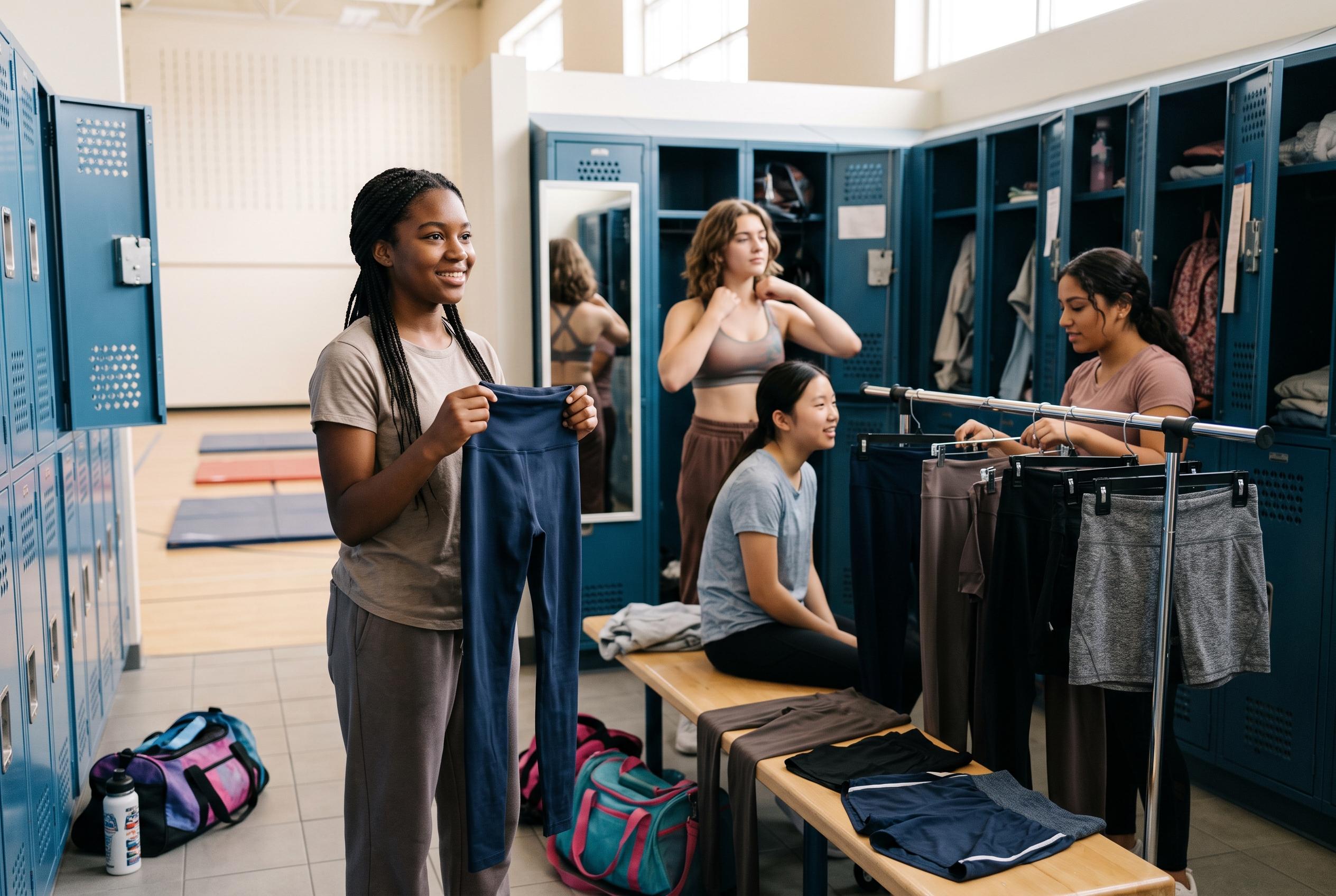

A new survey reveals a sharp decline in girls’ enjoyment of PE during adolescence, highlighting the importance of flexible sportswear and environment adjustments to keep girls active and confident through their teenage years.
Girls are far more likely to enjoy PE in primary school than in their teenage years, and education experts say schools need to look beyond the timetable if they want that to change. The latest Girls Active Survey from the Youth Sport Trust, which questioned more than 15,000 young women, found that 86% of girls aged seven and eight enjoy PE, but that figure falls to 56% by the age of 14. The charity says the drop is not simply about disinterest: many girls still want to be active, but feel held back by confidence, puberty and the practical realities of school sport.
The survey suggests that what pupils are asked to wear can be part of the problem. Only 25% of girls aged 11 to 13 said they felt confident in their PE kit, down sharply from 65% among seven- and eight-year-olds. More than half of girls, 58%, said they would like more PE kit options, compared with 29% of boys. Nearly two-thirds said they wanted to be more active at school but faced barriers, while 46% of 14- and 15-year-olds pointed to lack of confidence and 52% said periods made participation harder. The Youth Sport Trust has said the findings underline the need for schools to design PE around girls’ lived experience rather than expecting girls to adapt to existing norms.
That argument has been strengthened by research led by Tess Howard, the Great Britain hockey player, who found that kit and related body-image concerns were linked to girls dropping out of sport. Her work helped prompt a change in England Hockey’s domestic kit rules, allowing players more freedom to choose between shorts, skirts and skorts instead of requiring uniformity across a team. For schools, advocates say the lesson is straightforward: choice can reduce anxiety and make it easier for girls to focus on activity rather than on whether their clothing feels restrictive, exposes too much or causes discomfort during a period.
At the Girls’ Day School Trust, the issue is being framed as part of a broader shift towards what the organisation calls “sport for every girl”. Coutts Coutts-Wood, the trust’s consultant teacher for sport and director of sport at Wimbledon High School, said: “There are no girls’ sports, only sport. Every girl should have the opportunity to participate, enjoy it and discover what she is capable of.
“But if we are serious about keeping girls active, we must listen carefully to what they tell us about their experience of sport. That means looking not only at the activities on the timetable, but at the environment we create around them.
“PE kits might appear to be a small detail to an adult. To a teenager navigating puberty, periods and changing body confidence, it can feel anything but small.
If we are serious about keeping girls active, we must listen to what girls tell us about sport. Clothing should be designed around girls’ real experiences. Comfort and choice help girls focus on participation rather than worrying about how they look.”
The concern is not limited to kit alone. The Youth Sport Trust’s 2025 reporting said girls facing multiple forms of disadvantage, including those from low-income families and those with special educational needs and disabilities, are less active, less confident and less engaged in PE. Across all girls aged five to 18, only 45% were meeting recommended activity levels, compared with 51% of boys. The charity has also said the proportion of secondary school girls in England and Wales who look forward to PE has fallen in recent years, with confidence, periods and the feeling of being watched all cited as factors shaping participation.
For schools, the message is increasingly about listening as much as instructing. Coutts-Wood argued that lasting change will not come from telling girls to be more active, but from removing avoidable barriers and treating pupil voice as central to decisions about PE and sportswear. “Keeping girls in sport isn’t achieved by simply telling them to be more active,” she said. “We need to understand why some girls are stepping away and be prepared to change the things that are getting in their way.” If a different kit policy helps a girl feel able to walk into a sports hall, onto a pitch or out on to a track, schools are being urged to treat that not as a minor adjustment, but as part of the work of keeping her active for life.
Disclaimer: This content is for informational purposes only and is not intended to be a substitute for professional medical judgment, advice, diagnosis, or treatment.



