

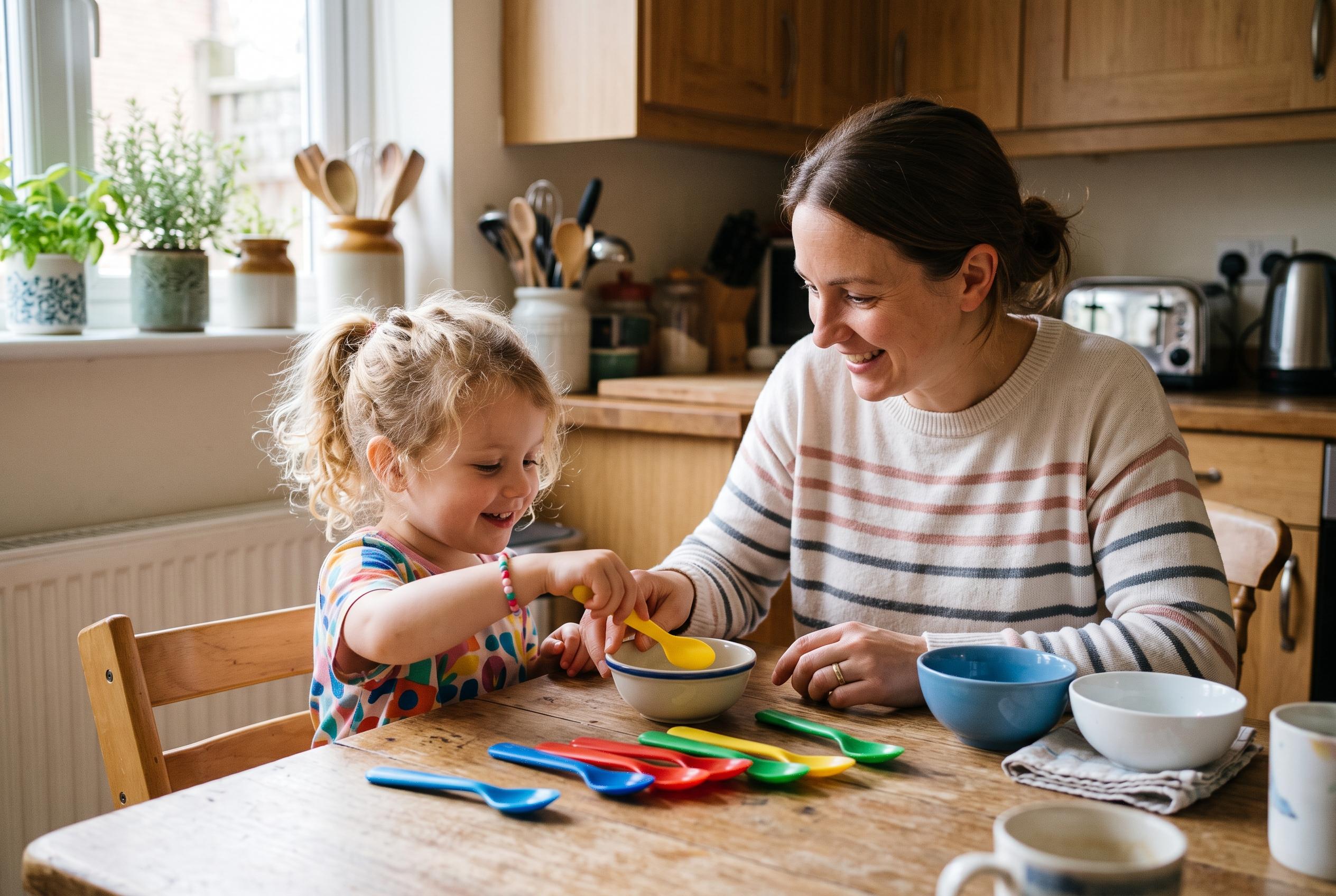

From counting spoons to retelling stories, simple games and daily tasks can help preschoolers develop language, maths, coordination and confidence without expensive toys or formal lessons.
Play-based learning can do far more than keep preschool children occupied. It can help them build language, practise early maths, strengthen coordination and begin making sense of the world around them. Parents do not need costly toys or formal lessons to support that growth. As the Cleveland Clinic notes in its guidance on sensory play, simple hands-on activities can encourage language development, motor skills, curiosity and experimentation.
One of the easiest places to start is with letters. A child is often more engaged when the alphabet is tied to something familiar, such as a ball, a banana or a book. Tracing letters with a finger, pointing out shapes in picture cards and introducing only a few letters at a time can make early literacy feel less like memorisation and more like discovery. Short sessions work best, especially when adults praise effort rather than perfection.
Counting can be built into the day just as easily. A preschooler can count spoons at the table, blocks on the floor or steps on the stairs. The point is not speed, but recognition: matching the written numeral to a real number of objects. Childcare.gov says this kind of guided play helps children follow their own ideas while building intellectual skills, and simple counting games do exactly that by turning ordinary household items into learning tools.
The same approach works for colours and shapes. A child might be asked to find something red, spot a circle in the kitchen or compare which object is bigger. These small challenges sharpen observation and vocabulary at the same time. They also create natural chances to describe everyday surroundings, which helps children begin to use more precise words in conversation.
Books are also more effective when they become a dialogue rather than a performance. The American Academy of Pediatrics’ HealthyChildren.org says play can support language, cognitive growth and self-regulation, and interactive story time fits that idea well. Pausing to ask what a character is doing, what might happen next or how an illustration makes the child feel encourages attention and comprehension. Children can also retell stories with toys, which gives them a low-pressure way to practise speaking.
Creative play matters for the same reasons. Drawing, painting and simple craft work give preschoolers an outlet for emotion while helping build fine motor control, according to Rasmussen University. A child does not need to produce a neat picture to benefit from the activity. What matters is the process: choosing colours, making marks, talking about what has been drawn and gaining confidence from creating something of their own.
Even routine chores can become lessons. Sorting socks, putting toys away or helping identify vegetables in the kitchen teaches independence, language and classification skills. The American Academy of Pediatrics says play is also important for resilience and emotional health, and that is part of why these low-key activities matter so much. When children are invited to take part in daily life, they learn that they can contribute, solve small problems and practise new skills in a setting that feels safe and familiar.
Disclaimer: This content is for informational purposes only and is not intended to be a substitute for professional medical judgment, advice, diagnosis, or treatment.



