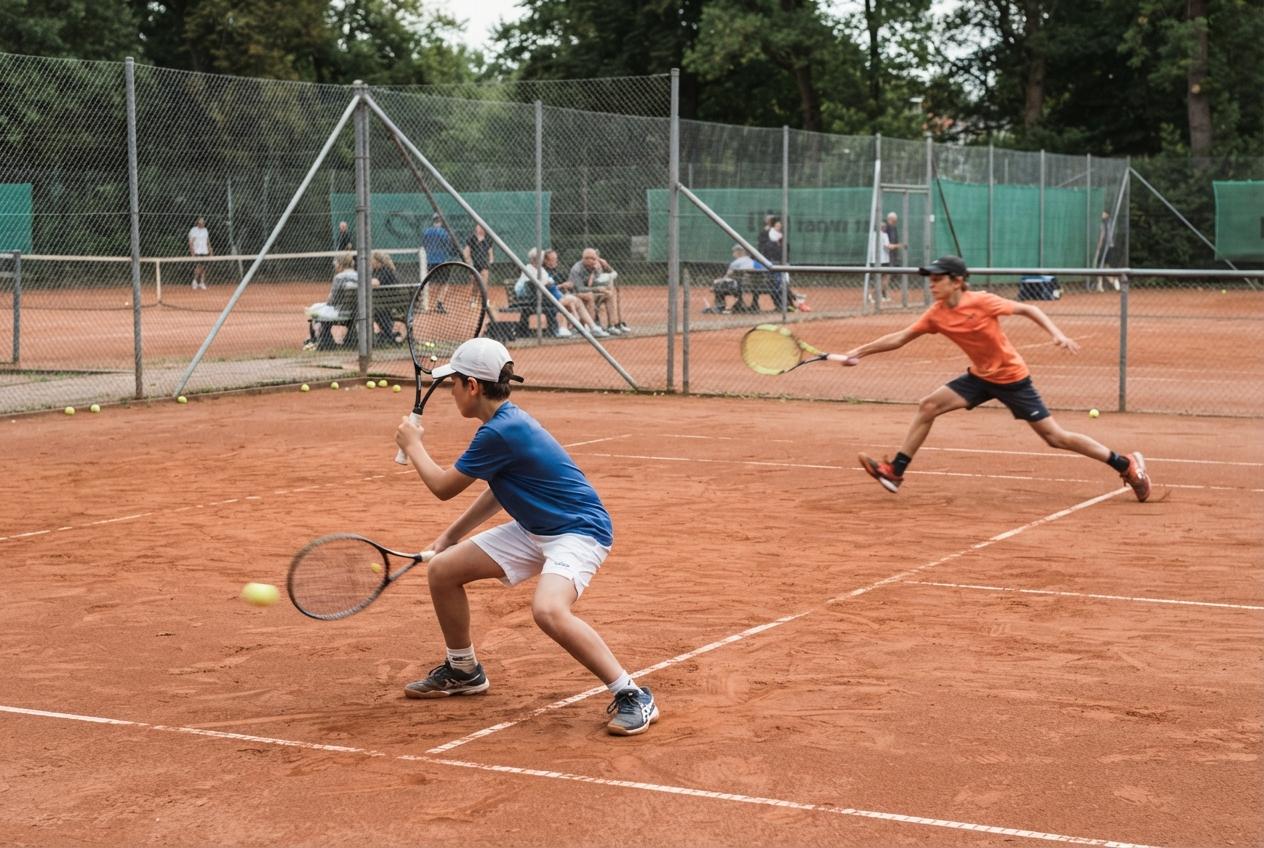

New research using wearable sensors reveals that defensive tennis strategies may be more physically demanding and psychologically stressful for young players than aggressive tactics, challenging traditional assumptions and prompting a rethink in coaching approaches.
Péter János Tóth’s research into youth tennis suggests that the hardest workload is not always created by the most forceful style of play, but by the one that forces players to react, brake and recover under pressure. Drawing on controlled match simulations and an open tournament format, the Hungarian University of Sports Science lecturer and former Piatti Tennis Centre coach set out to compare external and internal load across offensive and defensive match situations, as well as between different playing styles and winning and losing outcomes. His findings point to a sport in which deceleration, spin generation and psychological strain may matter more than raw hitting power.
The work reflects a wider shift in tennis science towards wearable monitoring and data-led coaching. Studies on racket-mounted sensors and inertial measurement units have shown that hitting volume, shot speed and technical actions can be tracked with useful accuracy, while broader reviews of junior tennis monitoring recommend combining GPS, RPE and other simple tools to build a clearer picture of workload. Tóth’s studies sit squarely in that movement, using sensors and video to capture both what players did and how hard it felt.
In the first phase, six elite Hungarian junior players were asked to play short simulated matches under strict tactical instructions. One condition required them to attack, take risks and finish points quickly; the other asked them to defend, extend rallies and keep the ball in court. The results challenged the familiar assumption that offence is always more demanding. Defensive play produced the greater mechanical burden, with PlayerLoad showing a clear difference between the two approaches. On clay, where sliding, chasing and repeated changes of direction are unavoidable, the cost of survival tennis appears to fall heavily on the body.
The racket data added another layer. Shot velocity did not differ meaningfully between attack and defence, but topspin did. Defensive players generated more spin, using it to clear the net safely and buy time to recover, while attacking players flattened the ball in search of outright winners. That distinction matters because it suggests tactical intent changes the biomechanics of the stroke more than the speed of contact itself.
The second phase moved closer to real match conditions. Sixteen elite academy players took part in a three-day indoor clay round robin, with playing style assessed in advance and no tactical constraints imposed. Across 24 official matches, the data showed how condensed modern tennis has become: most rallies were short, effective playing time occupied only a fraction of the match, and recovery periods were far longer than many casual observers might expect. Even on clay, the sport was characterised by brief bursts of intense action rather than extended baseline exchanges.
Style still influenced the workload, but not always in the most obvious way. Tóth found no meaningful difference in total tennis load between aggressive and defensive baseliners. The clear separation came in high-intensity decelerations, which were more frequent among attacking players. That fits the demands of stepping into court to punish short balls, where a player must sprint forward and then brake sharply before striking. The eccentric stress from those movements is likely to be one of the hidden costs of offensive tennis.
The most striking psychological finding came after the final point. Players who lost matches reported higher perceived exertion than winners, even though their external workload was broadly similar. In other words, the same physical effort felt more punishing when paired with disappointment and stress. That has practical implications for coaching, particularly in youth environments where emotional recovery can be as important as muscle recovery after competition.
Tóth argues that this kind of evidence should reshape tennis preparation. Defensive players may need more work on lateral sliding, adductor control and hip stability, while attacking players may benefit from stronger braking capacity and knee-extensor resilience. He also points to repeated sprint ability, rotational strength from unstable positions and recovery protocols that take account of the emotional drag of defeat. Simple tools, such as video analysis and RPE, can already help coaches quantify load without expensive systems, but his broader message is that coaching intuition is stronger when it is paired with objective match data.
Disclaimer: This content is for informational purposes only and is not intended to be a substitute for professional medical judgment, advice, diagnosis, or treatment.