

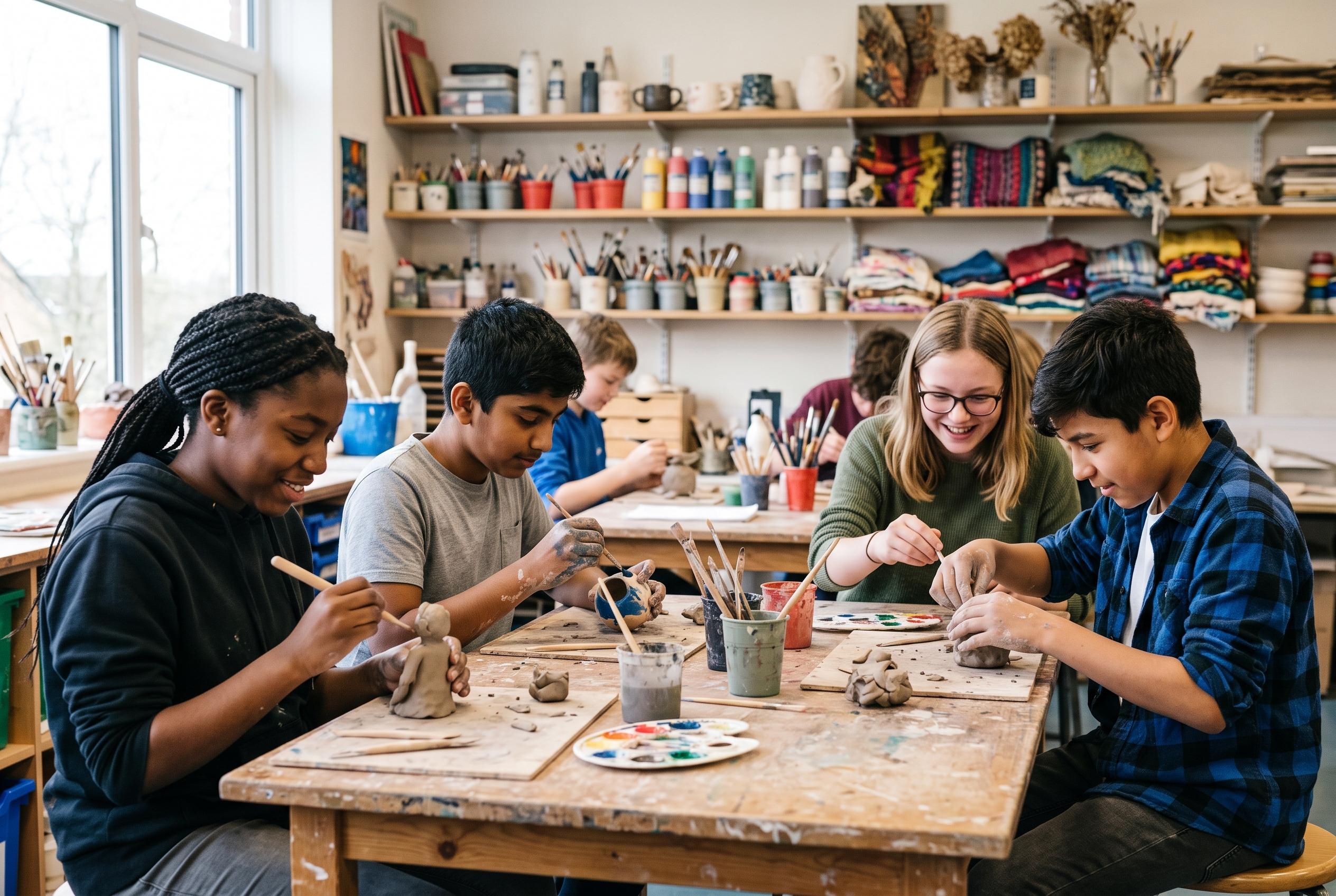

Removing Bild and form from lower secondary education would mean more than a timetable change, limiting opportunities for pupils who learn best through making, experimenting and creative expression.
Removing a creative profile from lower secondary school is not simply a timetable change. It can also strip away part of a school’s character and reduce the chances for pupils who do not thrive in a purely academic setting to find their footing. Research cited by Gallup and Cambridge International has repeatedly pointed to the value of creative teaching, with gains in engagement, concentration and problem-solving when pupils are given more than one way to learn.
After 14 years working on a Bild and form profile at middle-school level, the writer says she has seen hundreds of children arrive tense and discouraged, including pupils who had already decided by Year 4 that “jag är inte bra i skolan”. That experience fits with what schools such as Ryvers describe in their own arts-and-design teaching: practical work with materials such as clay, card and paint can help children express themselves, build confidence and approach learning through making rather than memorising alone.
The case for keeping arts-based learning in the curriculum goes beyond self-expression. Cambridge International says early art and design teaching can support perseverance, concentration and a more positive attitude towards learning, while broader arts-integration guidance notes that creative work can help pupils retain ideas, understand difficult concepts and connect knowledge across subjects. Seneca Academy likewise argues that art can strengthen language, motor and social skills, especially for children who may not fully engage through conventional lessons.
That matters for parents and carers because school is not only about grades; it is also about whether children feel they belong. Gallup’s findings suggest most teachers and parents believe creative approaches deliver a bigger payoff for pupils, and Arts Council research has found that children themselves often see creative learning as more enjoyable and easier to remember. In that sense, retaining a Bild and form profile is not a niche preference but a way of recognising that different talents deserve space in school.
Disclaimer: This content is for informational purposes only and is not intended to be a substitute for professional medical judgment, advice, diagnosis, or treatment.



