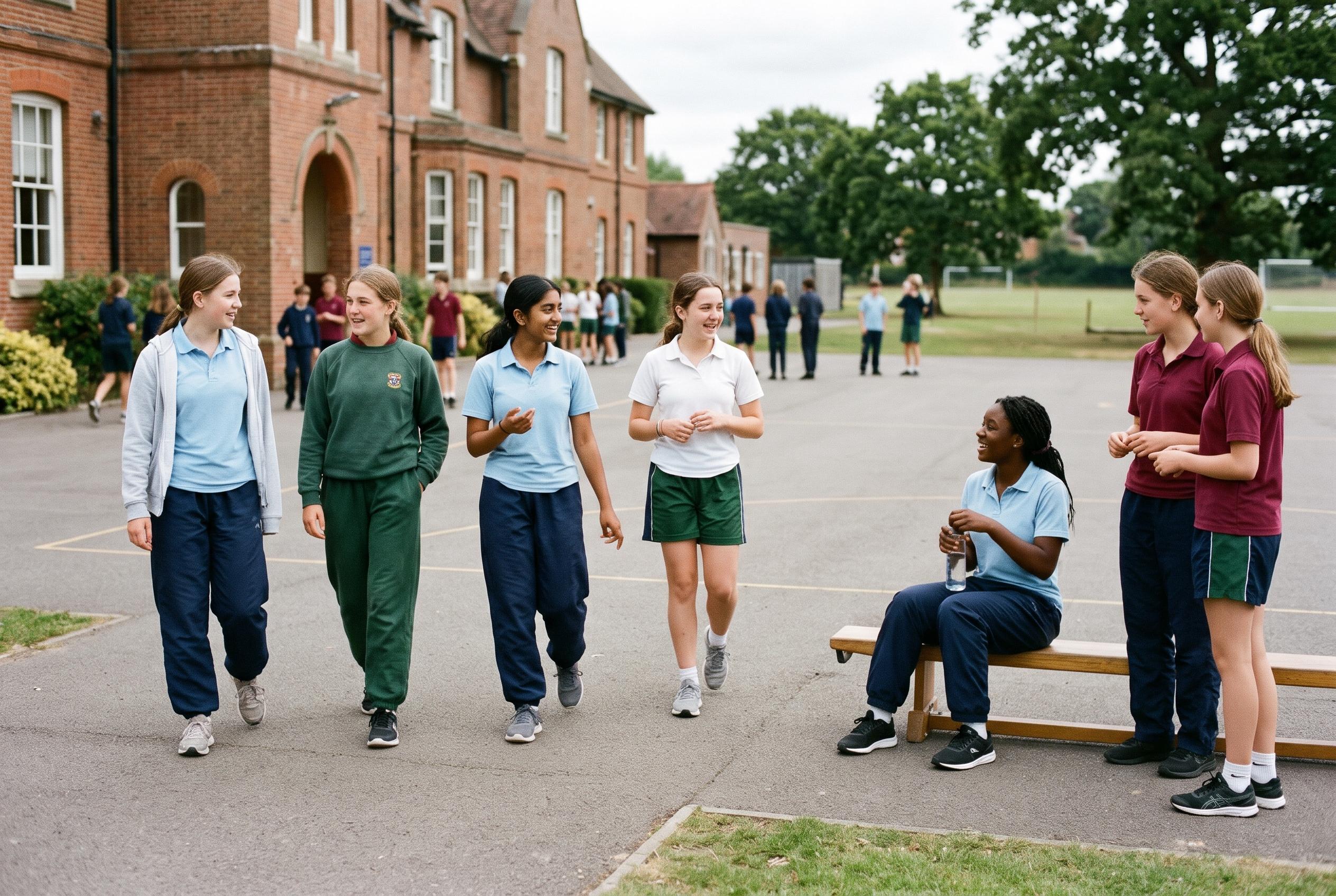

Evidence from schools suggests allowing girls to wear PE kit throughout the day could improve participation, comfort and wellbeing, prompting calls to rethink uniform rules in Wales.
Professor Leigh Robinson, chair of Cymru Women’s Sport, has argued that schools can do more to keep girls active by removing a barrier that is often overlooked: what they are asked to wear. In a commentary published by WalesOnline, Robinson said girls should not have to choose between comfort and taking part in sport, especially as many begin to disengage from physical activity during their secondary school years.
Her case is backed by growing evidence that small changes to school uniform policy can have a measurable effect. Women in Sport’s “Fit to Learn, Free to Play” pilot across 12 schools found that 60% of girls felt more active during the school day when they were allowed to wear PE kit all day, while 63% said it made it easier to join in during menstruation. The same project reported that 45% became more active on the journey to and from school, and 30% said they felt less stressed and anxious. Teachers also said the policy saved time, with 88% reporting they had more time available for teaching.
The broader research suggests that Robinson’s concern is not merely anecdotal. A qualitative study published on medRxiv found that many adolescent girls feel self-conscious in PE uniforms that do not fit well, particularly in communal changing spaces, and that discomfort can reduce participation. The authors said allowing girls more flexibility over what they wear, including the option to keep PE kit on throughout the day, may improve comfort and inclusion.
Still, the evidence is not entirely one-sided. A randomised trial in New South Wales, Australia, found no significant overall increase in moderate-to-vigorous physical activity after introducing a more active uniform in primary schools, although it did identify small benefits, including less sedentary time at schools in the intervention group. Separately, a review in Public Health Reviews concluded that uniform design and policy can shape movement, particularly for girls, and cited evidence that some pupils are more active on sports-uniform days.
Robinson’s argument also sits within a wider policy debate in Wales, where a parent-led petition has called on the Senedd to review school uniform guidance and support more active clothing for pupils up to 16. That campaign reflects a practical point increasingly made by researchers and advocates: if schools want girls to participate fully in PE and daily play, they may need to rethink rules that make movement harder rather than easier. The aim, Robinson argues, is not simply to improve sport participation, but to create school environments where confidence, health and learning are all supported by the same simple policy.
Disclaimer: This content is for informational purposes only and is not intended to be a substitute for professional medical judgment, advice, diagnosis, or treatment.