

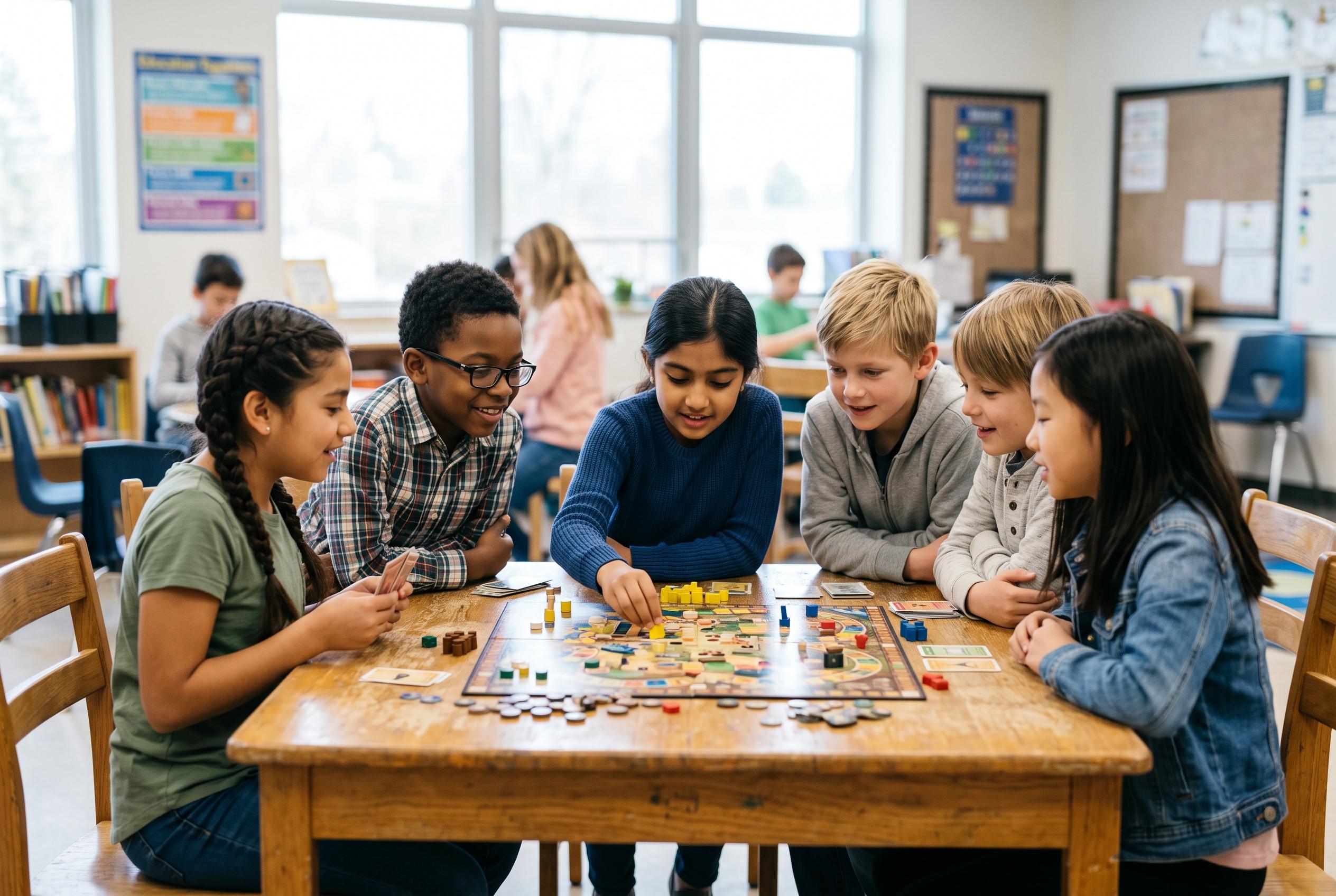

Six weeks of replacing two hours of conventional teaching each week with board-game play did not harm pupils’ academic progress, though evidence of wider cognitive benefits remains mixed.
A classroom swap of reading, maths or other traditional lesson time for board games may sound, at first glance, like a gimmick. But a study published in Trends in Neuroscience and Education suggests the trade-off may not be as costly as teachers might fear. In that trial, researchers gave pupils in rural schools two hours a week of board-game play for six weeks and found that the children still made broadly similar academic progress to classmates who spent the same time on regular instruction. The finding adds to a growing body of work challenging the assumption that simply increasing lesson minutes automatically produces better results.
The Spanish research team designed the intervention around a simple idea: games might exercise executive functions, the mental skills that help children hold information in mind, resist distractions and shift between tasks. Those functions, which include working-memory updating, inhibition and cognitive flexibility, are often linked to classroom performance. The study involved nearly 100 children aged six to 12, with 51 in the game-playing group and 48 in the control group. Teachers encouraged play with commercially available age-appropriate games, but the children largely worked independently. Before and after the six-week period, researchers measured executive functions as well as reading fluency, maths fluency and calculation.
The results were mixed, but not without interest. According to the paper, the game-playing group showed some gains in cognitive flexibility and in calculation skills, although the evidence was not strong enough to prove that the improvements were clearly greater than those seen in the control group. The authors also did not find support for a common claim that board games boost working memory. Even so, the study did not show that giving up 12 hours of conventional class time for games caused pupils to fall behind academically.
That broader point matters because it fits with other recent research. A cluster randomised trial published in Learning and Instruction in October 2024 found that a much larger group of primary school pupils who played modern board games during lessons improved more in updating, a type of working-memory skill, and in academic outcomes than peers in regular classes. A separate study published in 2021 also suggested that board-game play, along with other kinds of game play, could predict later gains in executive functions among young children. More recently, a systematic review and meta-analysis published in August 2026 found some positive effects across 24 studies, but concluded that the evidence is still not strong enough to recommend board games as a firm cognitive intervention.
For teachers and parents, the practical takeaway may be less about turning board games into a cure-all and more about recognising that learning time and learning quality are not identical. The latest classroom study suggests that replacing some direct instruction with structured play does not necessarily damage progress, and it may bring added benefits that standard tests do not capture, such as enjoyment, motivation and a more welcoming classroom atmosphere. The researchers themselves could not measure every possible outcome, but their findings add weight to a more nuanced view: children do not always need more minutes at a desk to keep moving forward. According to the article, that challenge to the old “more time on task means more learning” belief may be the real lesson.
Disclaimer: This content is for informational purposes only and is not intended to be a substitute for professional medical judgment, advice, diagnosis, or treatment.



