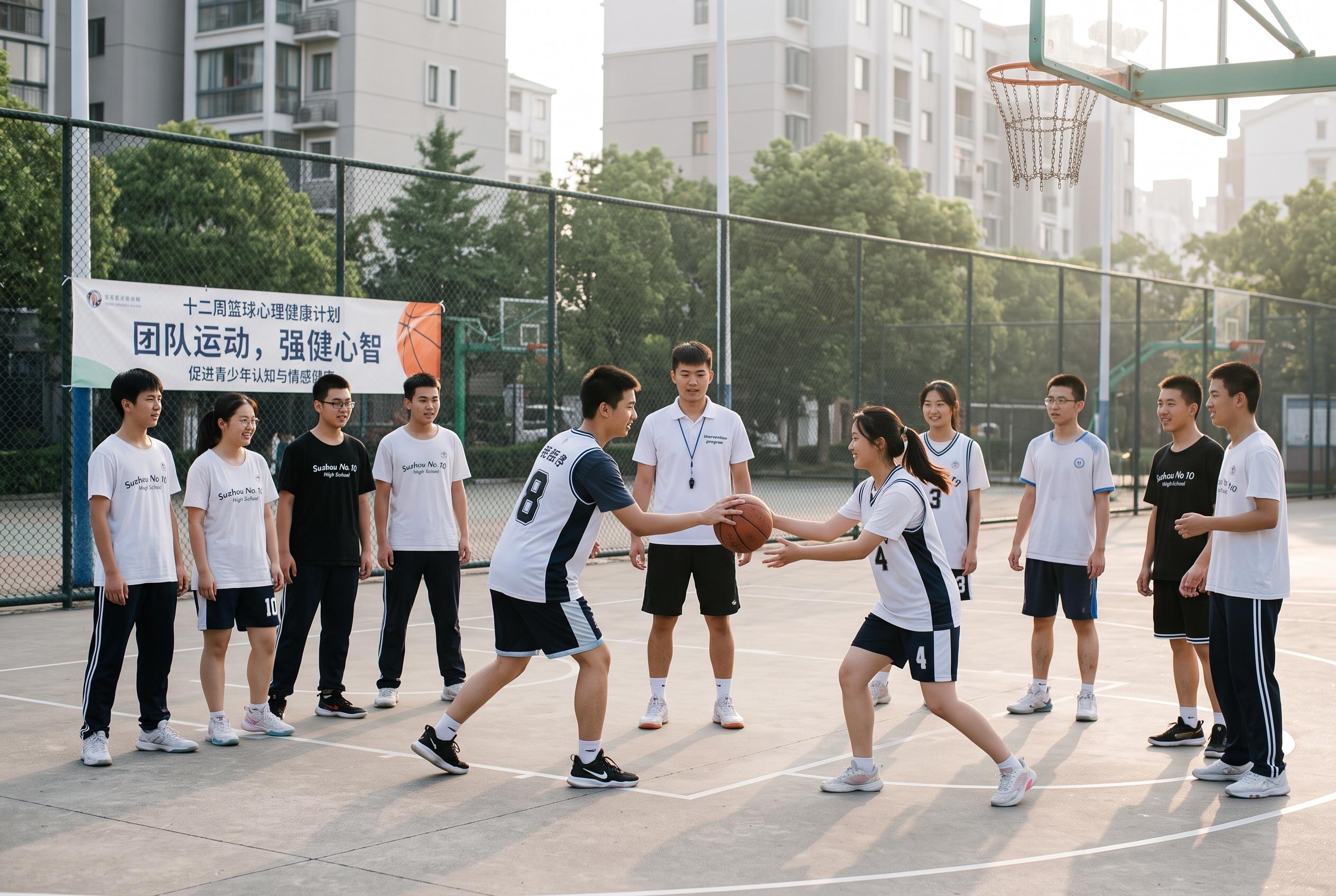

A 12-week basketball intervention in Chinese high-school students enhances executive function and psychological capital, resulting in improved subjective well-being, suggesting team sports may support adolescent mental health beyond physical activity.
A 12-week basketball programme may do more than improve fitness in teenagers. According to a study in Frontiers in Psychology, the intervention was associated with higher subjective well-being in adolescents, alongside gains in executive function and psychological capital, a cluster of traits that includes self-efficacy, resilience, hope and optimism.
The researchers worked with 64 high-school students at a public school in China, randomly assigning them to either a basketball group or a control group that kept to ordinary physical education lessons. The basketball sessions ran three times a week for 30 minutes at moderate intensity, with heart-rate monitors used to keep participants within the target range. Attendance was high and no adverse effects were reported. The study found that the basketball group improved across several measures, while the control group showed little change.
The strongest gains were seen in executive function, which refers to the mental skills used for focus, self-control and flexible thinking. The study reported better inhibitory control, working-memory updating and cognitive flexibility after the intervention. Psychological capital also rose, and the same was true for several elements of subjective well-being, including school, environmental, freedom and friendship satisfaction. Family satisfaction and academic satisfaction did not change significantly.
The authors argued that the benefits were not just direct but also indirect. Their mediation analysis suggested that better executive function and stronger psychological capital helped explain the link between basketball participation and well-being. In practical terms, the findings support the idea that team sport may work through both cognitive and emotional routes, not merely by keeping adolescents active.
The result fits with earlier research. A 2023 Scientific Reports study found that basketball training improved executive function more than a combined endurance and resistance programme in adolescents, while a 2025 school-based basketball intervention in adolescents with depression also reported executive-function gains. Separate studies of sport-education programmes have likewise linked structured physical activity with better subjective well-being and psychosocial adjustment in young people.
Even so, the new paper has limits. The sample was small and drawn from one school, the control group was not active, and the key outcomes were measured at the same post-intervention point, which makes it harder to prove a strict causal sequence. The authors said future studies should use larger samples, longer follow-up and more rigorous comparison groups before drawing firmer conclusions about basketball’s unique contribution to adolescent mental health.
Disclaimer: This content is for informational purposes only and is not intended to be a substitute for professional medical judgment, advice, diagnosis, or treatment.