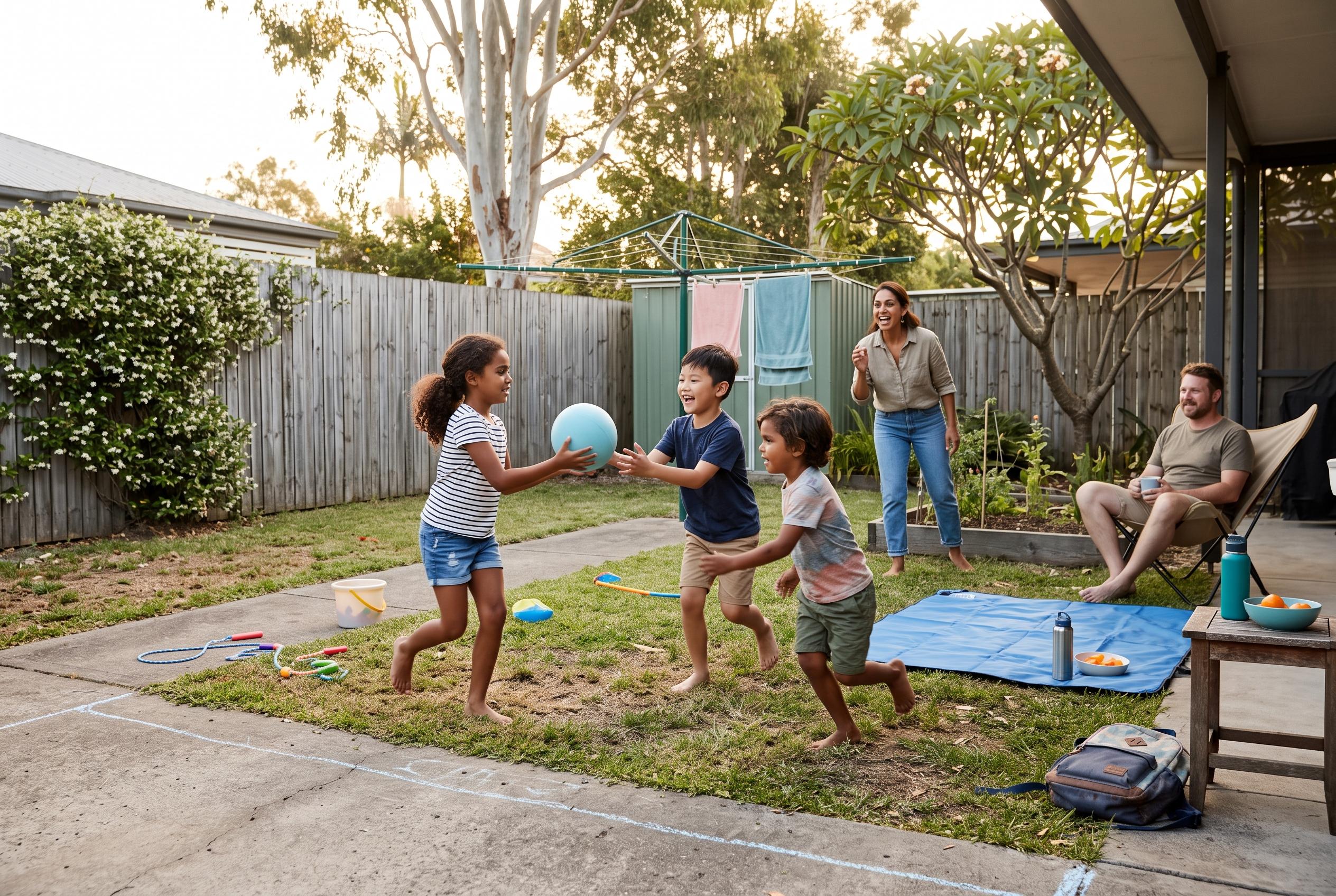

Simple, flexible backyard games are emerging as a key way to boost children’s daily movement, offering a practical, fun, and inclusive approach to meet health guidelines amid busy family life.
Backyard play can be one of the simplest ways to keep children moving without turning exercise into a chore. A small patch of grass, a paved courtyard or even a driveway can become a place for running, balancing, throwing and gentle competition, especially when the activities are chosen to suit a child’s age, interests and ability. The Australian Government’s physical activity guidance says children and young people aged 5 to 17 should aim for at least 60 minutes of moderate to vigorous activity a day, with muscle-strengthening exercise on at least three days a week. Healthdirect Australia says even unstructured movement has clear benefits for fitness, confidence, coordination and social development.
What makes backyard games so useful is their flexibility. Families do not need a large garden or expensive equipment to get started. Healthdirect Australia and the Better Health Channel both note that physical activity supports stronger bones and muscles, better balance, improved sleep and concentration, and a healthier body weight. For many households, the real advantage is convenience: children can play close to home, under supervision, and in short bursts that are easier to fit around school, homework and family life.
Simple games can be adapted to almost any space. An obstacle course made with chairs, rope, cones or hula hoops can be changed for different ages and skill levels, while target games such as bocce, lawn bowls or disc golf bring movement together with focus and strategy. The Better Health Channel advises keeping play age-appropriate and safe, with suitable surfaces and active supervision, while also allowing children room to explore creative ways of moving. That makes backyard sport a practical option for mixed-age families, where younger children can join in alongside older siblings or adults.
Families can also build variety into a session by setting up simple kicking, throwing and catching stations. A child might practise soccer shots, take turns at a portable hoop, or work on accuracy with a flying disc before moving on to the next task. According to the Better Health Channel, exposing children to different kinds of physical activity can help them develop a lasting interest in being active. That variety matters because enjoyment is often the difference between an occasional game and a habit that sticks.
The broader message from public health guidance is that active play does not need to be formal to matter. Australian recommendations for children with disabilities also mirror the 60-minute daily activity target, underlining that movement should be part of life for as many children as possible. Building a regular routine, even if it is only 20 minutes after school, can help children see activity as normal family time rather than a special event. In practice, the most effective backyard games are usually the ones children want to repeat.
Disclaimer: This content is for informational purposes only and is not intended to be a substitute for professional medical judgment, advice, diagnosis, or treatment.