

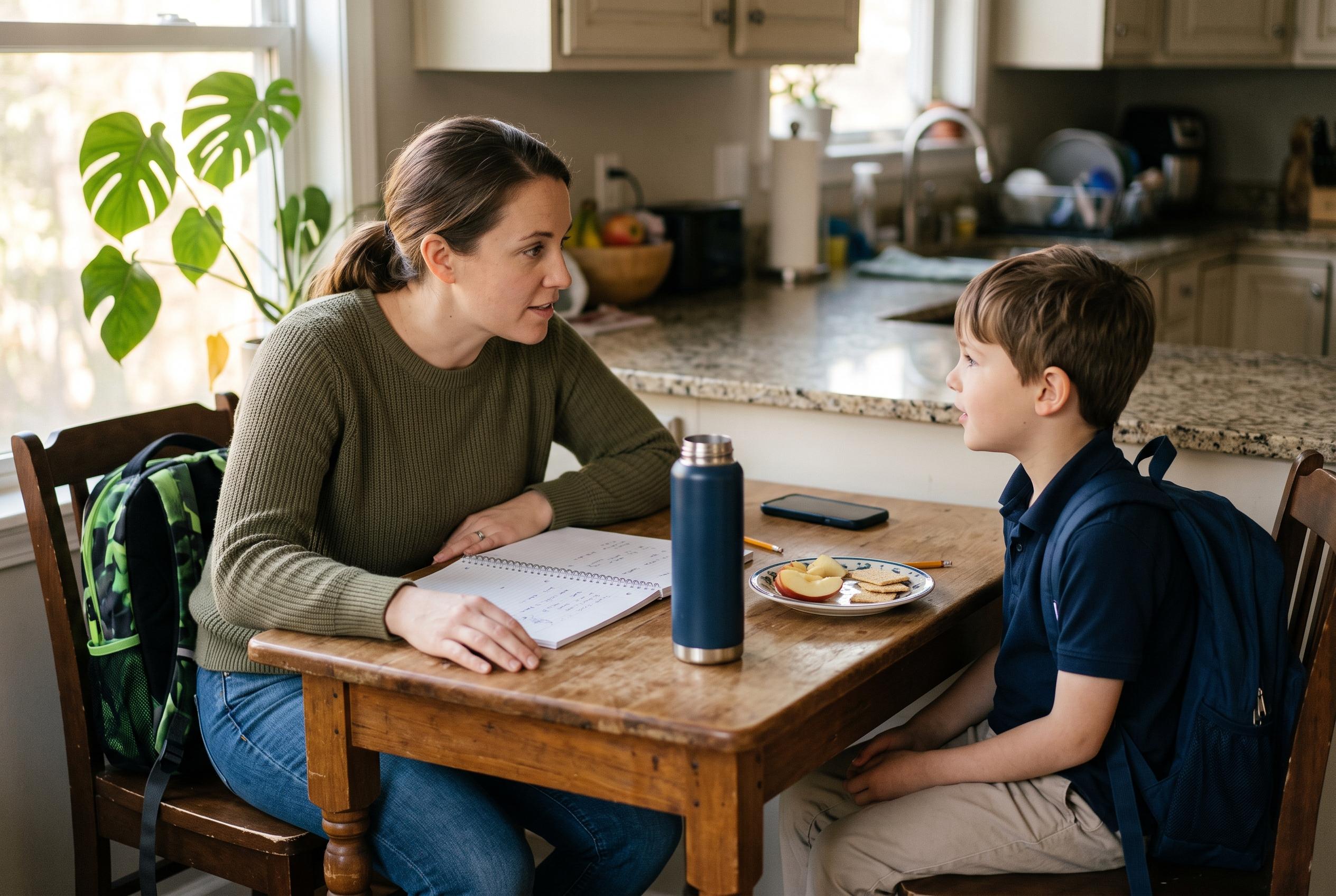

Experts recommend parents ask specific, manageable questions after school to encourage children to share their experiences more openly, with timing and phrasing tailored to each child’s needs.
A familiar question at the end of the school day can have an unexpectedly flat answer. Many children reply with a shrug, a “fine” or a “good”, not because they are hiding something but because the question is too large to answer easily. The parenting site 247ModernMom argues that a more useful approach is to ask something narrower, so a child has one clear starting point rather than being asked to summarise hours of learning, socialising and moving from one task to the next.
That idea is echoed by other parenting guides that recommend swapping broad prompts for more specific ones. A North Carolina therapist quoted by Fox Carolina suggested asking about the best part of the day or the hardest part, while DFWChild, Schola, Romper, Cooking Mummy and FirstCry Parenting all point parents towards questions that invite a more concrete memory, feeling or moment. The common thread is simple: children are more likely to talk when the question feels manageable.
The best prompt, according to 247ModernMom, often depends on timing as much as wording. Some children are ready to talk the moment they get home. Others need a snack, a bit of quiet, movement or a short break before they can explain anything at all. For children who need that pause, the article suggests easing into the evening first and saving the conversation for later, rather than treating the car ride or kitchen table like an interview.
Among the suggestions is a question that looks for one positive detail without forcing a child to label the whole day as good or bad: what made today easier? That could mean a helpful classmate, a teacher’s explanation, a better seat, a found pencil or simply the right snack. The same piece recommends a “redo” question for moments a child would handle differently, because it feels less accusatory than asking what went wrong.
Other prompts shift attention towards relationships, effort and observation. 247ModernMom suggests asking who helped the child today, or who the child helped in return, to notice ordinary acts of support that may otherwise pass unmentioned. It also recommends asking what took the most energy, which can reveal that a day was draining for reasons that have little to do with grades or behaviour. DFWChild and Schola make similar points with questions about laughter, surprises and favourite moments, while Romper and Cooking Mummy offer large lists of similar prompts aimed at drawing out specific memories.
The article also makes room for the possibility that a child may not want to talk at that moment. One of its most practical suggestions is to ask whether the child wants to share something now, later or not today. That small bit of choice can matter. 247ModernMom says the goal is not to extract a full report or force a conversation, but to build a habit in which children know they can return with their day when they are ready. In that sense, the most useful after-school question may be the one that leaves space for silence.
Disclaimer: This content is for informational purposes only and is not intended to be a substitute for professional medical judgment, advice, diagnosis, or treatment.



