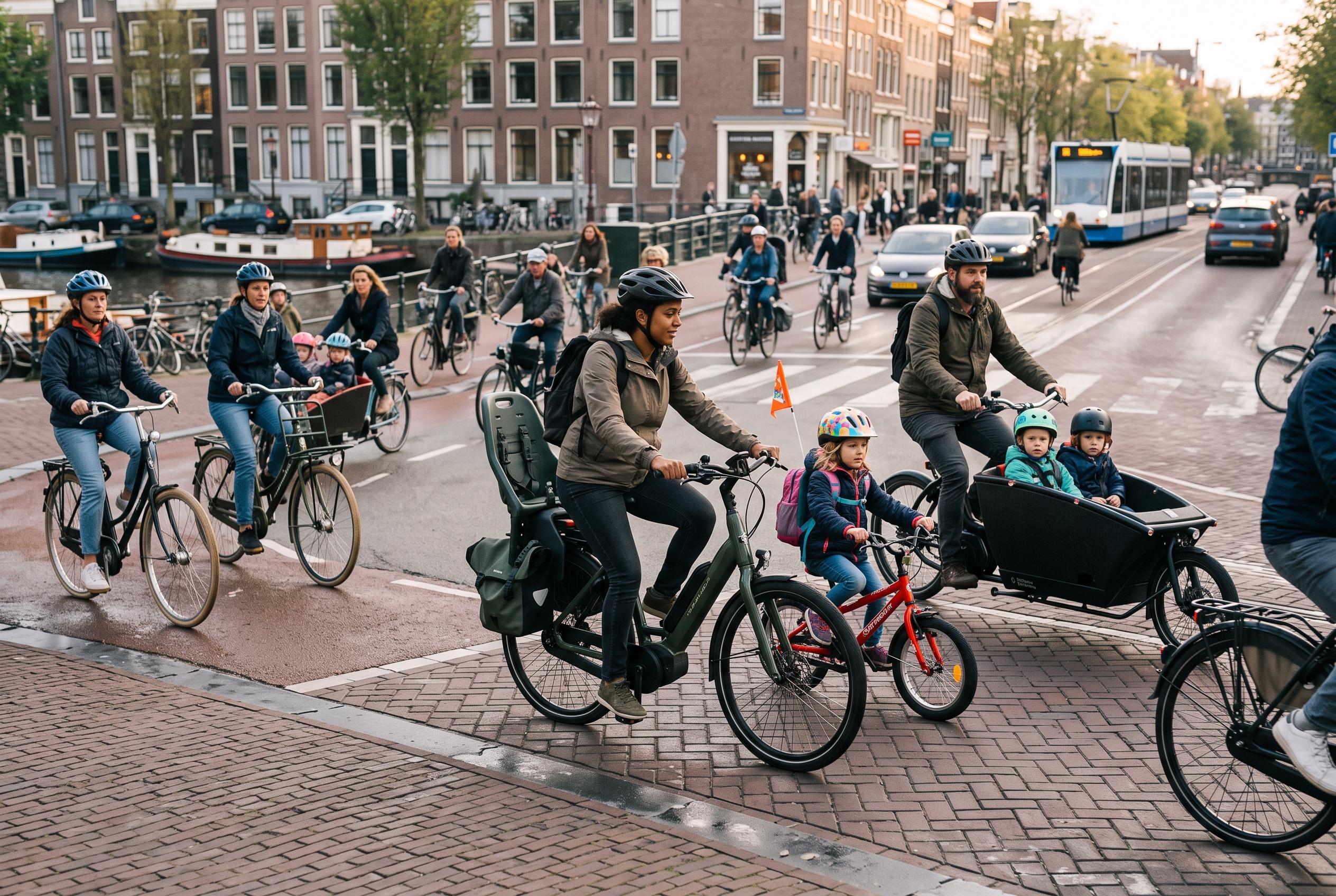

As Amsterdam’s streets grow busier and more complex, experts emphasise early training, responsible modelling, and practical habits to ensure children can navigate the city’s cycling culture safely.
Amsterdam’s children grow up on bicycles, but the city’s traffic leaves little room for complacency. Along busy routes such as the Ringvaart in Oost, where school traffic mixes with commuters and increasingly confident young riders, inexperience can quickly turn into wobbling, abrupt braking and minor crashes. The Parool says the challenge is not whether children should cycle, but how parents can prepare them for streets that are faster, fuller and less forgiving than they once were.
Road-safety specialists say the training should begin early. Vincent Briër of Verkeer & Meer, which works with municipalities and schools in the Amsterdam region, recommends starting with a balance bike and practising in quiet streets or schoolyards before moving into real traffic. Willemijn Pomper of Veilig Verkeer Nederland says children learn as much from example as from instruction, which is why parents should cycle with them, explain hazards repeatedly and model calm behaviour rather than cutting corners themselves. The message, she says, needs constant reinforcement until the basics become automatic.
That preparation matters because children do not yet process traffic the way adults do. Veilig Verkeer Nederland says complex actions such as balancing, signalling and scanning the road remain difficult for many children between the ages of seven and ten, and that judgement about risk develops only gradually from about age eight onwards. For that reason, parents are urged to ride behind younger children rather than in front, so they can watch for drifting, hesitation or unsafe choices. The same advice applies to route planning: start with short, familiar journeys, then widen the circle slowly.
The guidance also stresses practical habits that can prevent avoidable trouble. Children should learn a small number of essential signs first, including stop signs, cycle-route markers and warnings about entry restrictions. Their bikes should be in proper working order, with reliable brakes, lights and a bell. Veilig Verkeer Nederland also advises that children under 10 wear a helmet, while bright clothing and good lighting improve visibility. Perhaps the most important rule is the simplest one: never assume a truck driver can see you, and keep well clear of large vehicles, especially at junctions and red lights.
As children move on to secondary school, the risks change rather than disappear. Briër says the wider city suddenly becomes part of their daily routine, which makes speed, distraction and peer pressure more important concerns. Pomper says teenagers are more likely to cycle three abreast, drift into conversation or reach for a phone, even though using a handset while cycling remains dangerous and prohibited. Her advice is to put the phone out of easy reach and to practise regular routes together, including busier roads, so that young riders learn not just where to go, but how to read the traffic around them. According to the article, that gradual independence is the real goal: not sheltering children from Amsterdam’s cycling culture, but teaching them to survive it.
Disclaimer: This content is for informational purposes only and is not intended to be a substitute for professional medical judgment, advice, diagnosis, or treatment.