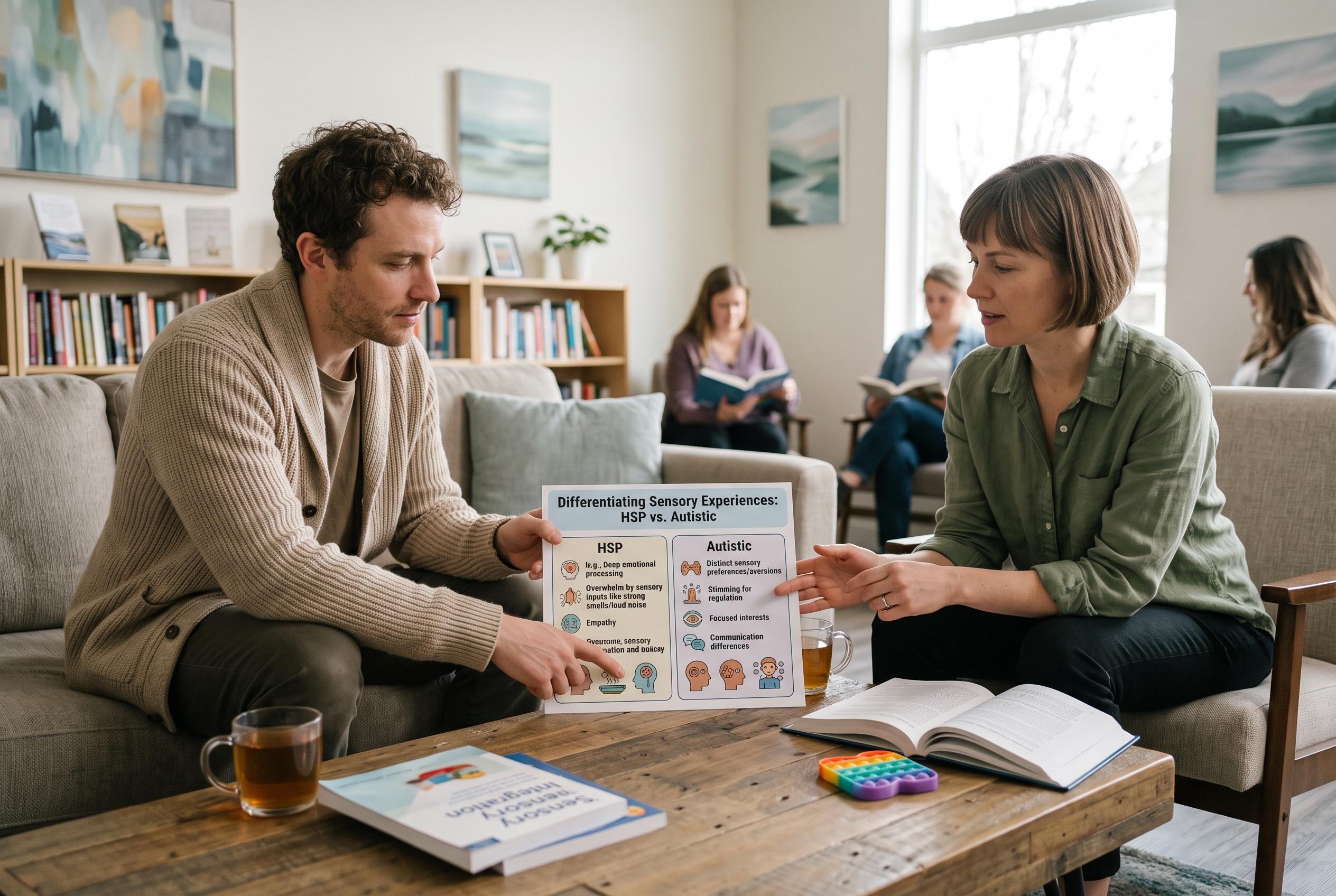

Despite overlapping behaviours in noisy or intense settings, highly sensitive persons and autistic individuals differ fundamentally in origins, traits and support needs , a crucial distinction for accurate understanding and effective support.
People who are described as highly sensitive and people who are autistic can both struggle in noisy, crowded or emotionally intense settings, but the two are not the same. According to Simply Psychology, All About Psychology and Psychology Today, high sensitivity is generally treated as a personality trait marked by deep processing and strong reactions to stimuli, while autism is a neurodevelopmental condition defined by differences in social communication, restricted or repetitive behaviours and sensory processing. That distinction matters, because overlap in surface behaviour can easily lead to confusion.
A highly sensitive person, or HSP, is usually understood as someone who notices and absorbs environmental and emotional detail more intensely than most people. The sources describe HSPs as often being deeply empathetic, reflective and easily overstimulated by noise, light, smell or conflict. By contrast, autism is a clinical diagnosis that can affect social understanding, communication, routines and sensory response in broader and more varied ways. Brain Matters and Rula both note that autistic people may be either over-sensitive or under-sensitive to input, while HSPs are more often described as having a heightened response rather than a wide sensory profile.
The differences also show up in communication and social life. HSPs typically communicate clearly, though they may pause to think carefully before responding and can be strongly affected by other people’s moods. Autism, however, can involve persistent difficulties reading facial expressions, body language and unspoken social rules, along with a preference for predictability or repetitive patterns. Several of the sources stress that these traits can look similar from the outside, but the underlying pattern is different: an HSP may withdraw because of overwhelm, while an autistic person may struggle because social and sensory information are processed in a fundamentally different way.
Context matters too. The lead article argues that childhood experiences and trauma can contribute to heightened sensitivity, whereas autism has developmental and genetic roots. That broad distinction is consistent with the external summaries, which present HSP as a non-clinical trait rather than a disorder and autism as a condition that may require formal assessment and tailored support. The practical point is that neither label should be used casually in place of a proper evaluation, especially when difficulties are affecting school, work or relationships.
There is also an important difference in support needs. The summaries from Simply Psychology, Brain Matters, Rula and iCanoNotes all emphasise that many HSPs cope well with adjustments such as rest, boundaries, counselling or stress-management techniques, while autistic people may need more structured help, including developmental, behavioural or occupational support. For families, teachers and employers, the challenge is not simply to choose a label, but to understand what kind of help will make daily life more manageable. In that sense, the distinction between high sensitivity and autism is not just technical; it shapes how people are seen, supported and protected.
Disclaimer: This content is for informational purposes only and is not intended to be a substitute for professional medical judgment, advice, diagnosis, or treatment.