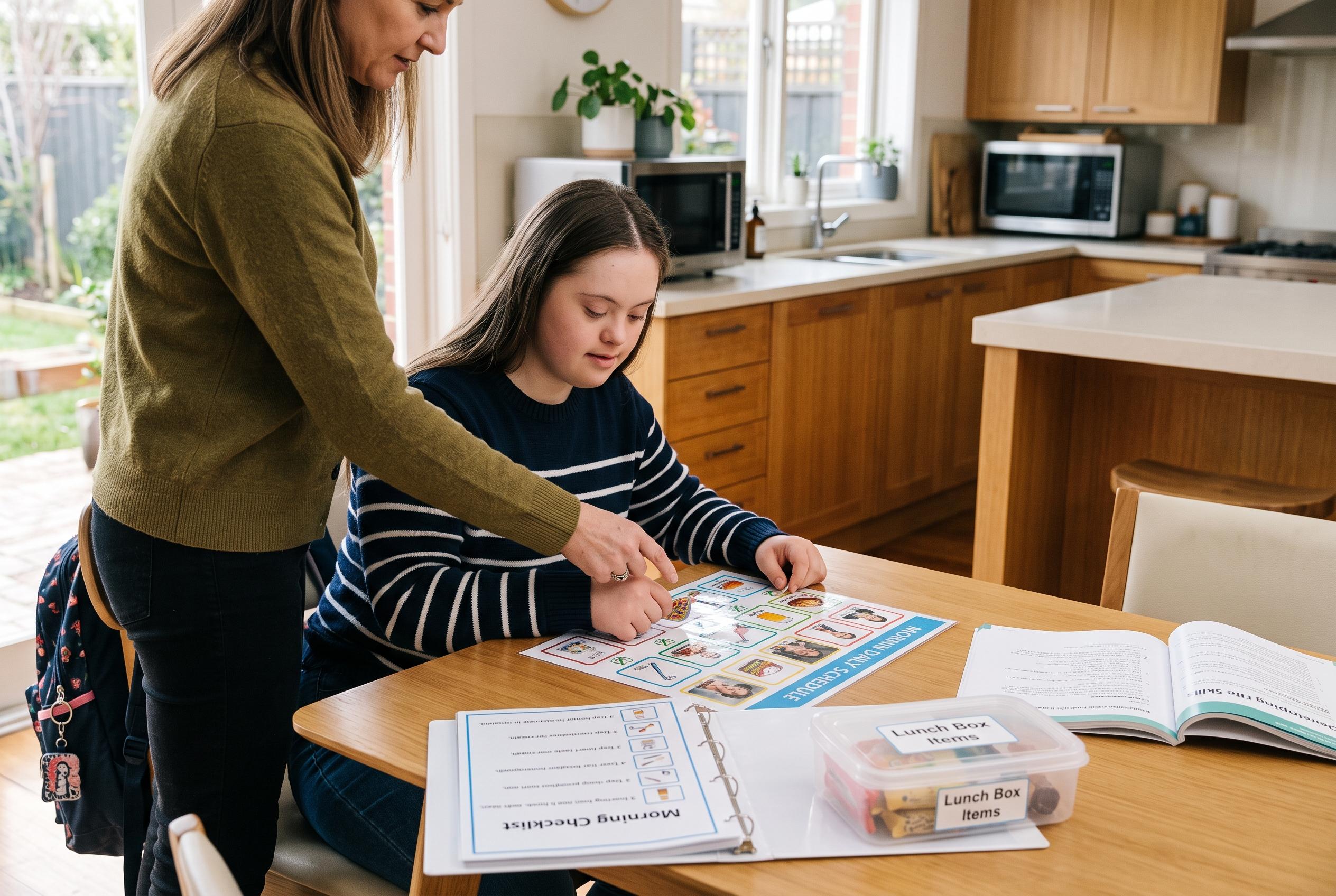

Guidance for caregivers highlights the importance of calm communication, routines, and gradual independence in supporting teenagers with Down syndrome through daily challenges and social integration.
Supporting a teenager with Down syndrome is often less about managing major crises than about navigating the small, repeated pressures of daily life. According to Dynseo, many of the hardest moments come during ordinary routines: getting dressed, leaving screens, coping with disappointment, or handling a change of plan. The common thread is not defiance, but a pace of processing that may be slower, more sensitive to noise or uncertainty, and more easily overwhelmed by too much information at once.
That is why calm, simple communication matters so much. Dynseo advises caregivers to slow down, give one instruction at a time and allow time for a response before repeating themselves. The article argues that raising your voice, piling on explanations or doing tasks for the teenager can make matters worse. Healthline similarly notes that adolescence brings emotional and hormonal change for teenagers with Down syndrome, alongside the usual push for independence and social belonging.
The practical answer, in many cases, is structure. Both Dynseo and WebMD emphasise routines, visual supports and breaking tasks into smaller steps. A morning that drags on may improve if clothing is laid out the night before, or if the sequence is shown in pictures. A household rule that is clear and predictable can reduce conflict, especially when the teenager is given real choices within safe limits rather than repeated orders.
Public meltdowns, refusals and abrupt transitions also tend to improve when the environment is made less demanding. Dynseo recommends stepping away from sensory overload, lowering the voice and returning to the issue later once calm has returned. The same principle applies to screen time, homework and unexpected changes. Kaiser Permanente advises parents to teach appropriate social behaviour through routine and direct instruction, while also remaining alert to stress, hygiene issues and the risk of mistreatment.
The article also stresses that autonomy should be built gradually rather than denied outright. Healthline says teenagers with Down syndrome benefit from support that extends functional and social skills as they move towards adulthood. Dynseo’s advice is to treat safety skills as something to practise step by step, using “not yet” rather than “never”. That approach allows a young person to gain independence without being rushed into situations they are not ready to handle.
Communication can be another pressure point. When speech is hard to understand, pretending to understand can shut a teenager down, Dynseo says. Better alternatives include asking them to show, draw or rephrase what they mean, and using picture-based tools when needed. WebMD also highlights the value of short instructions, clear language and consistent expectations in everyday life.
Social life brings its own difficulties. Healthline and Kaiser Permanente both note that teenagers with Down syndrome may struggle with peer relationships, teasing or exclusion, even when they are eager to connect. Dynseo recommends naming hurt feelings directly, avoiding minimising responses and helping the young person practise simple social scripts. It also says that belonging matters: clubs, adapted sports, family groups and other welcoming settings can reduce the impact of rejection elsewhere.
The broader message from the article is that behaviour is usually a signal, not simply a problem. Fatigue, confusion, fear of failure, embarrassment or a need to assert independence may sit beneath the surface. For parents and caregivers, the most useful response is often the simplest: slow the moment down, make the next step clear and keep the relationship intact while the challenge passes.
Disclaimer: This content is for informational purposes only and is not intended to be a substitute for professional medical judgment, advice, diagnosis, or treatment.