

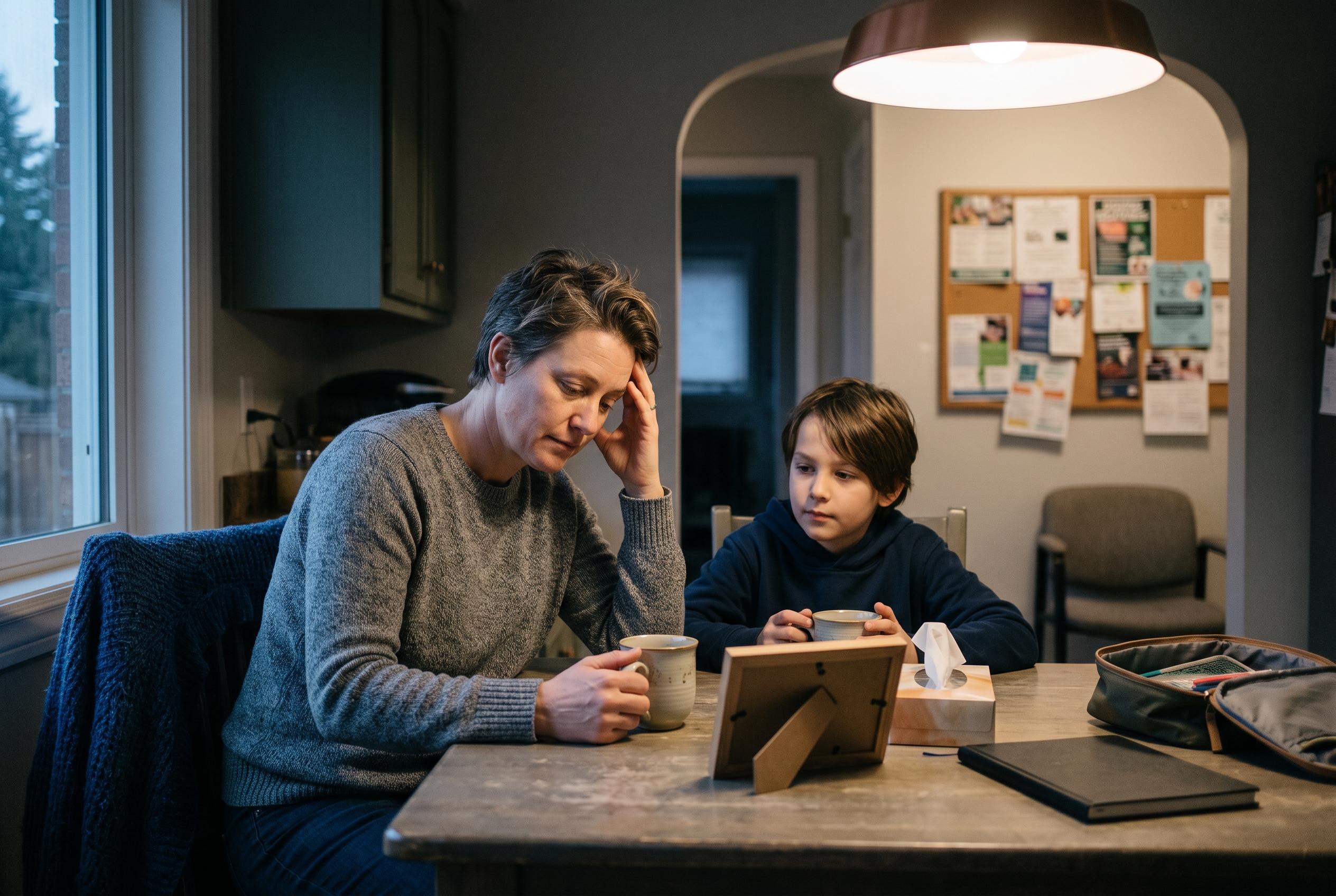

New research highlights the limitations of the traditional five-stage grief model, urging organisations to adopt more nuanced approaches that recognise individual and fluctuating emotional journeys after loss.
Grief is often treated as if it follows a tidy sequence, but real life is far messier than that. One person may cry in the morning, laugh at a memory later in the day and feel the loss hit again by evening. A child may not cry at all, instead becoming irritable, complaining of stomach aches or asking the same question again and again. None of that means the grief is finished; it simply shows that bereavement does not unfold in neat, predictable stages.
Yet the familiar five-stage model still turns up in public guidance, training materials and crisis plans. The framework is most closely associated with the psychiatrist Elisabeth Kübler-Ross, who developed it from work with dying patients in the late 1960s. As later critics have pointed out, that original context matters: it was never a simple description of how bereaved people move through loss, and modern scholarship has repeatedly warned against treating it as a universal map.
That warning is not confined to academic discussion. A systematic review of how grief is presented online found that many websites still describe bereavement as a linear journey through denial, anger, bargaining, depression and acceptance, even though the evidence for such a sequence is weak. Similar critiques have appeared in Psychology Today and Scientific American, both of which argue that the model oversimplifies a process that is often unstable, uneven and highly individual.
The problem is not that those emotions never arise. They do. The problem is that once those words are presented as mandatory checkpoints, people can begin to judge themselves against them. Someone who returns to work quickly may be seen as detached. Someone who laughs may feel guilty. Someone still struggling years later may be told it is time to move on. In that way, a descriptive idea can harden into an expectation, with painful consequences for people who do not recognise themselves in it.
Children are especially vulnerable to that misunderstanding. Their grief is often described by specialists as intermittent rather than continuous: they may dip into sorrow and then move back into play, conversation or distraction. That does not mean they are unaffected. It means they are coping in a way that suits their age and capacity. If adults insist on a fixed emotional sequence, they may miss the signs that a child needs reassurance, routine or help.
A more accurate picture comes from modern grief research, which often uses the dual process model. This approach, also reflected in Swedish guidance from 1177, suggests that bereaved people move back and forth between confronting the loss and managing ordinary life. A survey commissioned by Fonus points to the breadth of reactions people can feel after a death: some report hope, relief or gratitude, while others feel loneliness or anxiety. The range itself is the point. Grief is not one emotion, and it is not one timetable.
That is why public information needs to change. Schools, local authorities, health services and other organisations should review crisis plans, website text and training documents that still present the five-stage model as the normal path through bereavement. Materials should instead explain that grief can come and go, that children may respond differently from adults, and that support should include clear routes to help for anyone whose distress becomes overwhelming or disrupts daily life. The aim is not to replace one rigid model with another. It is to acknowledge that mourning has no standard shape, and that the most useful response is not to tell people where they ought to be, but to stay with them where they are.
Disclaimer: This content is for informational purposes only and is not intended to be a substitute for professional medical judgment, advice, diagnosis, or treatment.



