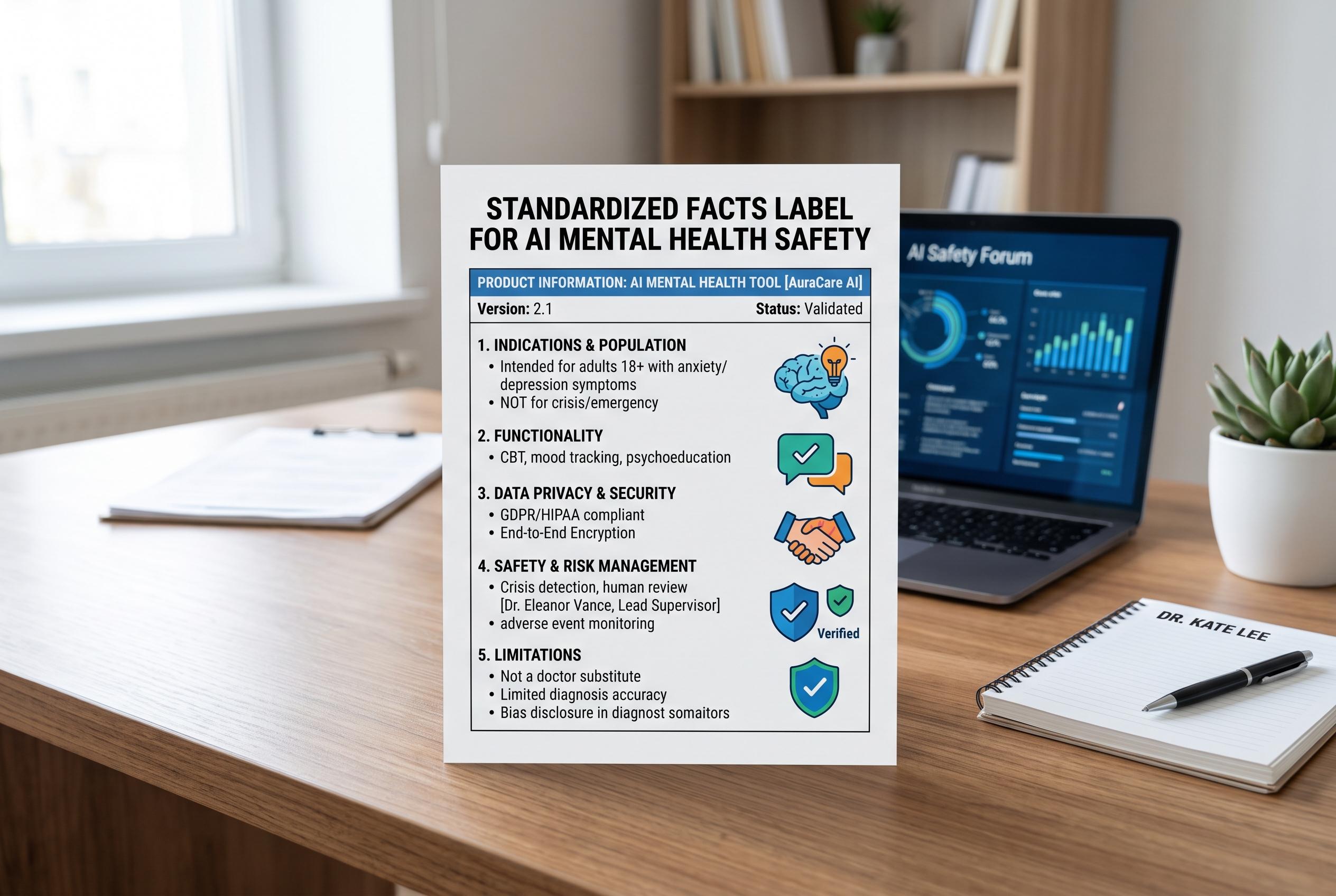

A multidisciplinary team has introduced a standardised facts label for AI-enabled mental health tools to enhance transparency, assess risks, and safeguard users amid the rapid adoption of AI chatbots and digital therapies.
As interest grows in artificial intelligence tools for mental health care, a team of psychiatrists, lawyers, engineers and public health specialists is arguing that clinicians need a clearer way to judge what these systems can, and cannot, do. In a paper published in Frontiers in Psychiatry, the American Psychiatric Association’s Committee on Mental Health Information Technology proposes a standardised facts label for AI-enabled digital mental health technologies, or AI-DMHTs, designed to make risks, limits and practical uses easier to understand for both clinicians and patients. The authors say the aim is to improve transparency at a time when people are increasingly turning to chatbots and other AI tools for emotional support, self-help and clinical guidance.
Their concern is that the rapid spread of AI in mental health is outpacing safeguards. The paper points to risks including misinformation, bias, privacy failures and unsafe recommendations, particularly for people in distress or crisis. The Agency for Healthcare Research and Quality has separately warned that AI can reproduce bias in training data, generate factually wrong outputs and obscure the reasoning behind its conclusions, making it harder for clinicians to challenge suspicious results. The Frontiers authors argue that these problems are especially serious in mental health, where misleading advice or poorly handled disclosures can have direct consequences for safety, informed consent and the therapeutic relationship.
The proposed label is meant to function as a concise, layered disclosure tool. It would cover eight areas: identifying information, intended use, warnings, risks and limitations, model information, clinical evidence, accessibility and usability, and privacy and security. The framework also aims to distinguish between information needed by patients and information needed by clinicians, while keeping the primary layer readable at roughly a sixth-grade level. More technical material would be set apart for users who need it, a design choice the authors say is intended to balance accessibility with depth. The paper says the label was developed through iterative review by a multidisciplinary group and informed by existing work on risk communication, informed consent and international AI governance.
The authors place the proposal within a broader push for stronger AI oversight in healthcare. They cite the U.S. Food and Drug Administration, Health Canada and the UK Medicines and Healthcare products Regulatory Agency’s joint principles for good machine learning practice, the European Union’s AI Act and the National Institute of Standards and Technology’s AI Risk Management Framework as evidence that transparency is becoming a regulatory expectation. But they also say those frameworks do not yet offer a practical, standard way to communicate risks directly to mental health users and clinicians. The label, they argue, could help fill that gap by making it easier to compare tools, identify missing evidence and spot dangerous uses, especially in crisis situations or for vulnerable populations.
The paper stops short of claiming the label is a finished solution. Its authors acknowledge that developers may be reluctant to disclose unfavourable information and that some technical fields may be difficult to populate consistently. They present the framework instead as a starting point for wider adoption, testing and refinement. Their broader argument is that AI in mental health will only earn trust if it is paired with clearer disclosure, stronger accountability and a better understanding of what the tools are, how they were built and where they may fail.
Disclaimer: This content is for informational purposes only and is not intended to be a substitute for professional medical judgment, advice, diagnosis, or treatment.