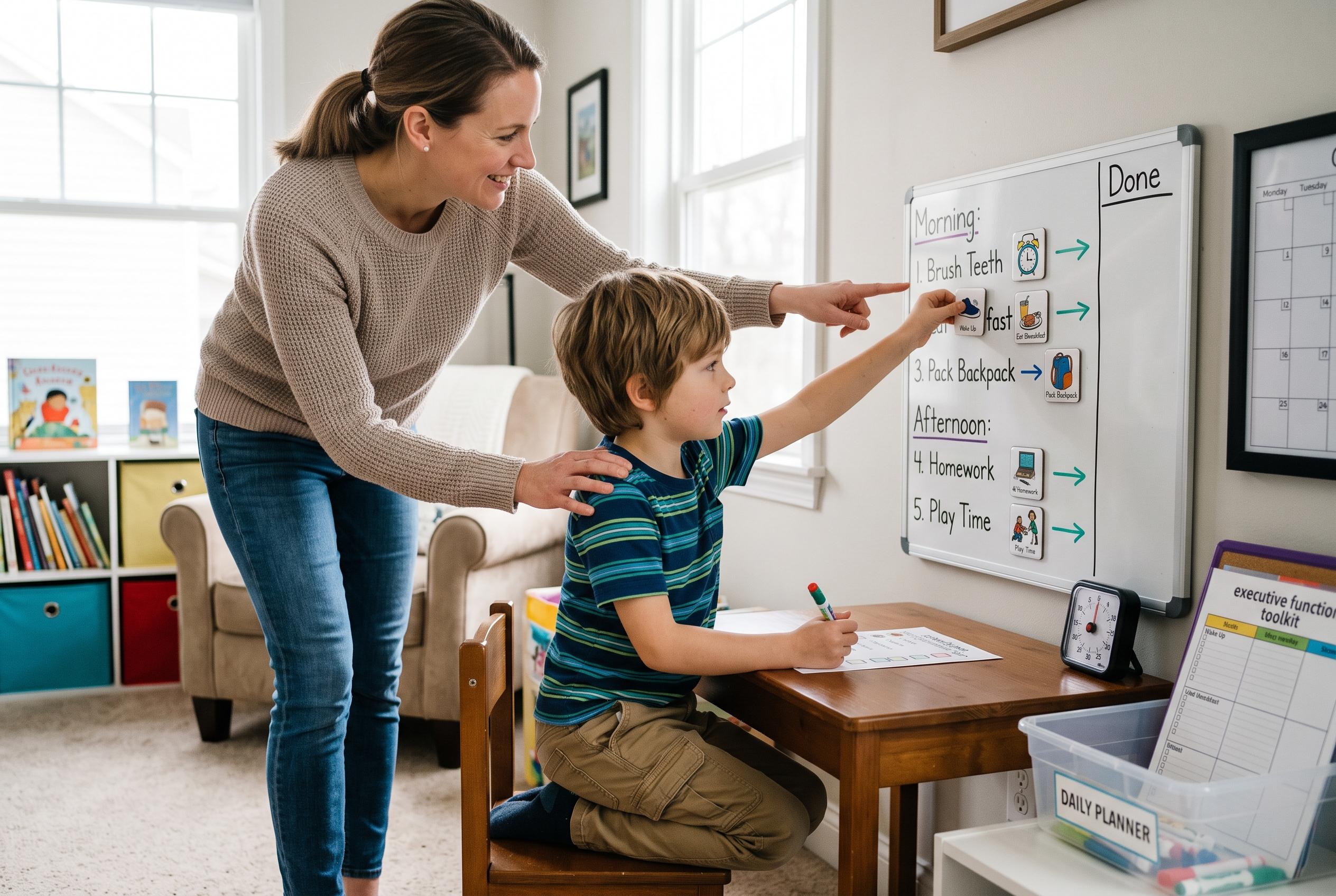

Practical and visual techniques are helping children, especially those with ADHD, develop vital mental skills that make daily tasks less overwhelming and foster independence.
Helping children build executive function skills can make everyday life feel less overwhelming and far more manageable. These are the mental processes that support planning, organisation, working memory, impulse control, time management and emotional regulation. Harvard Health says some children pick them up naturally, but others need deliberate teaching and repeated practice, and children with ADHD often need extra support because these skills can be harder for them.
A strong starting point is to make organisation visible and concrete. According to Harvard Health and Understood, that can mean using wall calendars, checklists and planners that stay in sight rather than assuming a child will keep everything in mind. Breaking larger jobs into smaller steps is also important: instead of telling a child to clean a room, it helps to spell out each task, from making the bed to putting toys away. The same approach works for routines, with regular check-ins to see what is finished and what still needs attention.
Working memory also improves when children have something to refer to. Sticky notes, cue cards, visual timers and other reminders can reduce the burden on a child’s short-term recall. Harvard Health recommends asking children to repeat instructions back, which helps confirm that they have understood and remembered what is being asked. The National Centre for Learning Disabilities says routines, checklists and time-management supports can be especially useful when children struggle to hold multiple steps in mind.
Impulse control is another area where practice matters. Parents and carers can teach a simple “stop and think” cue, then rehearse appropriate responses through role-play before difficult moments arise. Games that involve waiting, turn-taking or following signals, such as Red Light, Green Light or board games like Uno and Jenga, can make self-control feel less like a lecture and more like a skill children practise in play. That is especially helpful because, as Understood notes, children often learn focus best when adult expectations are broken into clear, manageable steps.
Time management becomes easier when children can see time, rather than just hearing about it. Visual timers, including countdown tools and Pomodoro-style focus timers, can help children understand how long a task should take and stay on track. Medical News Today says colour-coded calendars, homework routines and quiet workspaces can be particularly helpful for children with ADHD, who may need more structure to avoid distractions and complete tasks. Asking a child to estimate how long a chore will take, then comparing that estimate with the timer, can gradually improve their sense of pacing.
Emotional regulation deserves the same practical approach. Teaching children a feelings vocabulary, creating a calm-down space and using breathing or mindfulness exercises can help them move from upset to settled more quickly. The aim is not to punish emotion but to give children tools to recognise it and respond constructively. Over time, these habits can support not only better behaviour, but also greater independence, confidence and resilience.
Disclaimer: This content is for informational purposes only and is not intended to be a substitute for professional medical judgment, advice, diagnosis, or treatment.