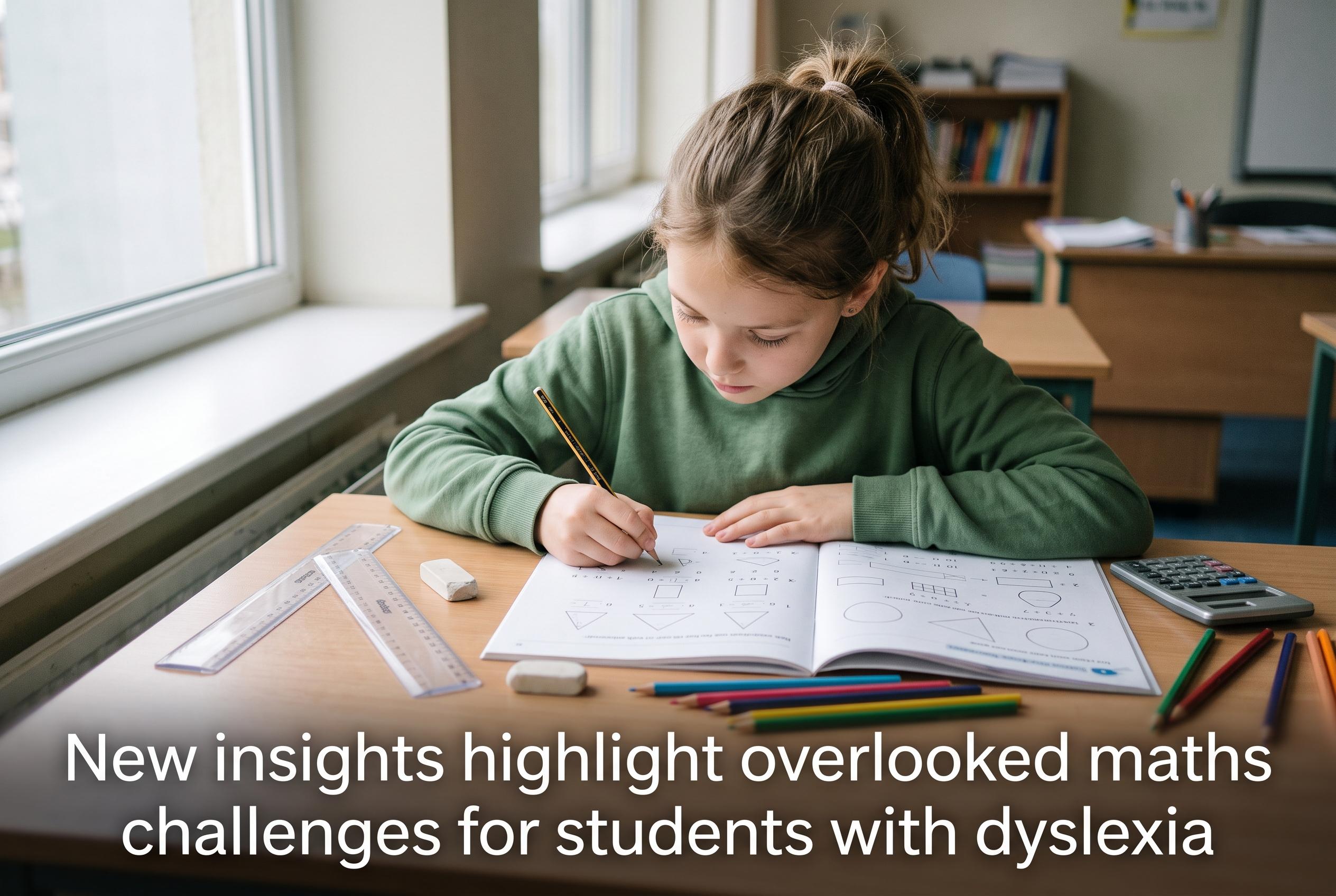

Recent research and expert organisations reveal that dyslexic students face significant, often under-identified, maths difficulties linked to processing speed, memory, and reasoning , prompting calls for more explicit teaching approaches and better support strategies.
Many dyslexic students also struggle with maths, yet that difficulty is often overlooked in schools and left out of individual education plans and accommodation documents. The result, according to Dyslexic Advantage, is that pupils who may reason well mathematically can still fall behind because of problems with handwriting fluency, working memory, processing speed and language. The organisation says that can affect everything from recalling number facts quickly to carrying out longer calculations and following standard procedures.
The British Dyslexia Association says these problems are especially common in areas that depend on secure foundations, such as multiplication tables, fractions, number sequences and mathematical vocabulary. It also notes that word problems can be particularly demanding because they require pupils to decode language and then work out the arithmetic at the same time. Recent research published in 2024 adds weight to that view, finding that children with dyslexia can show difficulties in number processing, arithmetic and mathematical reasoning, with executive function and visuospatial processing also playing a role.
For older students, the practical response is often less about simplifying content and more about making teaching more explicit. Dyslexic Advantage argues that general classroom teachers can help by breaking tasks into clear steps, reducing cognitive load and spelling out the reasoning behind each move in a problem. That approach matters because, as the British Dyslexia Association and recent studies suggest, maths learning can break down not only at the level of calculation but also at the level of memory, speed and symbol recognition.
The broader point is that maths difficulties linked to dyslexia are real, common and frequently under-identified. Nessy says slow processing can make timed recall tasks, such as multiplication drills, especially difficult, while other explanations of dyscalculia describe persistent problems with number sense, symbols and reasoning even when teaching is effective. For schools, that means looking beyond whether a pupil can follow a lesson on the day and asking whether the child has the support needed to retain, retrieve and use what has been taught.
Disclaimer: This content is for informational purposes only and is not intended to be a substitute for professional medical judgment, advice, diagnosis, or treatment.