

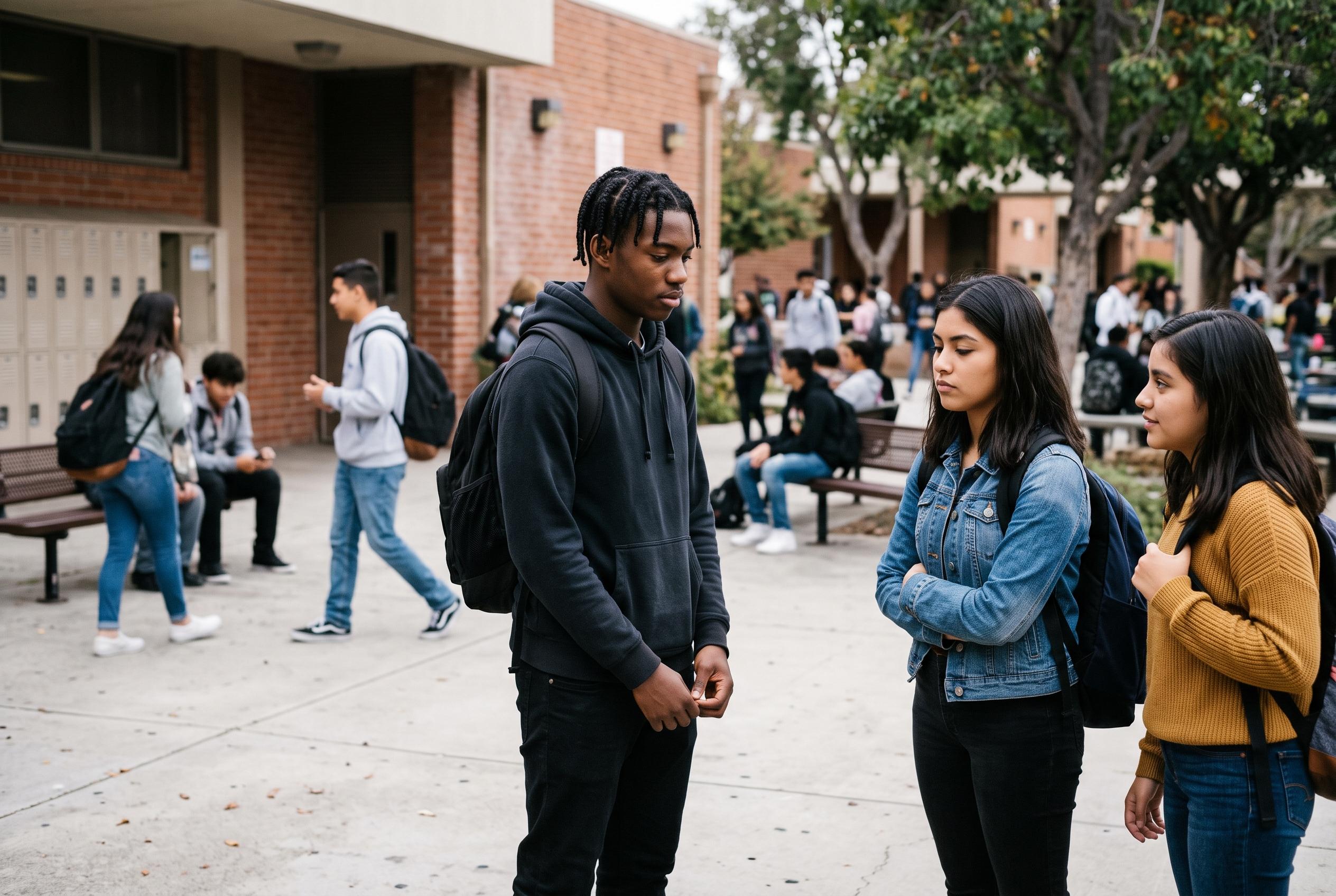

A study of Houston high school students found that those facing both food insecurity and commercial sexual exploitation exposure were less likely to say they would turn to parents or trusted adults for help.
A study of Houston high school students suggests that food insecurity and exposure to commercial sexual exploitation may both be linked to a reduced willingness to seek help, particularly from parents or trusted adults. Published in Frontiers in Psychiatry, the research looked at 169 students at one high school and found that those who met the study’s broad definition of exploitation exposure were far more likely to report skipping meals or eating less because their families could not afford food. The authors said the pattern points to immediate material hardship as a possible warning sign of deeper vulnerability.
The study’s sample came from a school where most students were from economically disadvantaged households, and the researchers used a wider definition of commercial sexual exploitation than a traditional trafficking case. They counted both direct experiences and indirect exposure, including knowing someone who exchanged sex for money or goods, considering such an exchange, being asked to do so, sharing sexual images for compensation, or actually trading sex. Because the measure captured a range of experiences, the authors said it helped describe a continuum of risk, although it could not show which forms of exposure mattered most.
Students who reported exposure also described less confidence in their ability to get help in difficult situations. On average, they were less certain that they would know where to turn if they felt unsafe at a party or were being pressured to trade sex. The clearest gap was in willingness to confide in a parent or other trusted adult if someone asked them for sex in exchange for money or something of value. The researchers cautioned that these figures reflect anticipated behaviour, not what the students would necessarily do in a real emergency.
When the team combined food insecurity and exploitation exposure into a broader risk measure, the strongest effect again centred on trust in adults. After accounting for age, gender, sexual orientation and grade level, neither food insecurity alone nor exploitation exposure alone predicted the likelihood of seeking help from a parent or trusted adult. But students who faced both conditions were significantly less likely to say they would do so, and the authors found a clear downward trend as the number of overlapping risks increased. They argued that this pattern fits a broader ecological view of youth vulnerability in which family conditions, community supports and social pressures interact.
The findings are consistent with other research showing that structural hardship can shape whether young people want help and whom they trust enough to ask. A separate August 2026 study in PubMed of 1,272 sexual and gender minority youth found that nearly all wanted help for at least one concern, but that unstable housing, food insecurity and poor home conditions were strongly tied to help-seeking around basic needs. A 2023 qualitative meta-synthesis also found that commercially sexually exploited youth do not always see themselves as victims, which can make outreach harder. Together, these studies suggest that schools, healthcare providers and youth programmes may need to look beyond awareness campaigns alone and create reliable, non-judgemental routes to support. The Houston authors said that teachers, counsellors, mentors, coaches and community advocates may be especially important for students who do not regard their home environment as safe or dependable.
The study has clear limits. It was based on a small convenience sample from a single school, relied on self-reported answers about sensitive topics and used a cross-sectional design, which means it cannot establish cause and effect. Even so, the researchers said the results identify a practical signal for youth-serving institutions: food insecurity, especially when it appears alongside exploitation exposure, may mark young people who are less likely to turn to parents or caregivers for help. They concluded that prevention work should not only raise awareness of exploitation, but also help adolescents identify trustworthy adults and ensure that any support they reach is meaningful.
Disclaimer: This content is for informational purposes only and is not intended to be a substitute for professional medical judgment, advice, diagnosis, or treatment.



