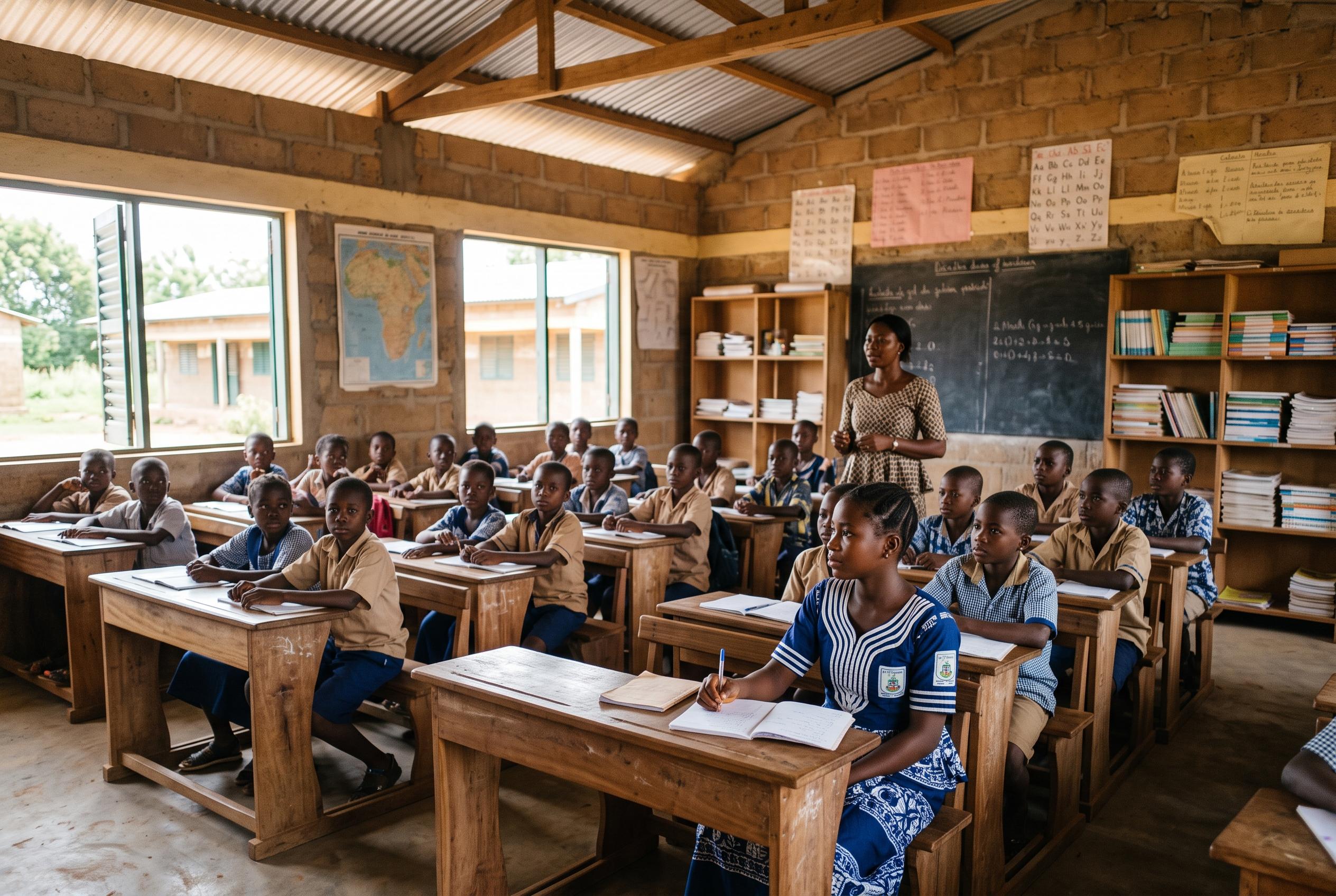

Benin gears up for the 2026-2027 academic year with tight organisational planning, government investments in educational materials, and a broader social policy on free schooling for girls, all amidst strict attendance enforcement and strategic timetable management.
With teachers already back for the pre-rentrée week that began on Monday 7 September, the scramble before Benin’s new school year is no longer only about uniforms and exercise books. Families now have a narrow window before classes resume on Monday 14 September to shift children out of holiday sleeping habits and back towards school mornings, while the state presses ahead with a tightly managed national timetable covering public and private nursery, primary, general secondary and technical schools. Les 4 Vérités reported that the calendar was set by an interministerial order signed in Cotonou on 23 July by the ministers responsible for primary, secondary and higher education, giving the reopening both administrative and political weight. (les4verites.bj)
That official urgency is most visible in the treatment of the preparatory week itself. La Nouvelle Tribune reported that the Ministry of Maternal and Primary Education warned teachers absent from duty between 7 and 11 September that they could face disciplinary proceedings. According to the outlet, a note dated 31 July and signed by cabinet director Déwanou Avodagbe told departmental directors, school district heads and head teachers to hold awareness meetings on the obligations linked to the return and to send preparation reports back by Friday 4 September. A monitoring mission was also due to check attendance on the ground throughout the week. (lanouvelletribune.info)
The reopening plan was shaped well before this week. On its official website, the Beninese government said the National Education Council held a two-day seminar in Cotonou on 20 and 21 July focused on how to lift performance across schools and training institutions in 2026-2027. Noël Ahonagnon Gbaguidi, president of the council, described the gathering as a “cadre privilégié de concertation” for anticipating the next term’s difficulties. The meeting brought together Armand Kuyema Natta, Sèdami Médegan Fagla and Clément Kouchadé, the three ministers overseeing the sector, and ended with 15 recommendations ranging from staffing and infrastructure to inclusion and governance. (gouv.bj)
Some of those preparations are financial as well as organisational. La Marina BJ reported that the government has committed 2.8bn CFA francs for French and mathematics activity books and early-reading booklets for children in CI and CP, the first two years of primary school. The contracts were awarded to LAHA Éditions, Point Haut, Imprimerie Papeterie Continentale du Bénin and Imprimerie Commerce Général, with the spending fully covered by the national budget. The outlet said the push was intended to avoid the delivery failures that have marred earlier openings, and noted that the issue had featured among the recommendations from the July seminar. (lamarina.bj)
Elsewhere in the system, Matin Libre said the authorities had already named principals, censors and senior supervisors for public secondary schools, allowing administrative teams to organise timetables and reception arrangements before pupils arrive. The paper also said recruitment competitions had opened for a string of public institutions, including Inmes, Ifsio, Enspd, Enstic, Eneam, Inspei, Injeps, Iuep-MA de Djougou, the ENS sites in Porto-Novo and Natitingou, and Enset in Lokossa. Candidate files were due by 17 August and the tests were scheduled for 10 and 11 September. Even so, Matin Libre identified one unresolved pressure point: teacher postings, which it said still needed to be published in time to prevent empty classrooms and last-minute timetable changes. (matinlibre.com)
The calendar also matters because this year’s return comes with a broader social policy change. Les 4 Vérités linked the 2026-2027 school year to the Council of Ministers decision of 3 June extending free schooling to all girls in public general and technical secondary education from this term onward. The same report said the school year would run across three trimesters and finish on 25 June 2027, with the long holiday ending on 12 September 2027. In other words, the reopening is not being presented simply as a date on the diary, but as the start of a more ambitious government promise on access and continuity. (les4verites.bj)
La Fiche du Jour added a legal detail that underlines how formalised the timetable has become: the new interministerial order cancels the previous calendar signed on 19 June 2025 for the 2025-2026 year. Its report said the first teaching stretch of the new year runs from Monday 14 September until after classes on Friday 18 December, a 14-week term. La Nouvelle Tribune, citing the ministry note on attendance, said the next sequence then resumes on 4 January 2027 after the year-end break, with a mid-term holiday from 19 to 28 February before the final run to late June. For parents, that degree of precision makes the practical advice on sleep all the more relevant: moving bedtime and waking time little by little, rather than in one jolt on the eve of reopening, gives children a better chance of reaching the first school morning rested rather than frazzled. (laffichedujour.bj)
Seen together, the different strands of preparation point to a return that is being choreographed at several levels at once: classrooms supplied, administrators appointed, attendance monitored, and policy commitments rolled into the new year. That leaves households with a task that is less spectacular but just as consequential in the final days before Monday 14 September: re-establishing regular wake-up times, calmer evenings and predictable routines so that the first week of lessons does not begin with exhaustion. The state’s message is that the 2026-2027 year should start on time; the quieter challenge for families is making sure children are ready when it does. (les4verites.bj)
Disclaimer: This content is for informational purposes only and is not intended to be a substitute for professional medical judgment, advice, diagnosis, or treatment.