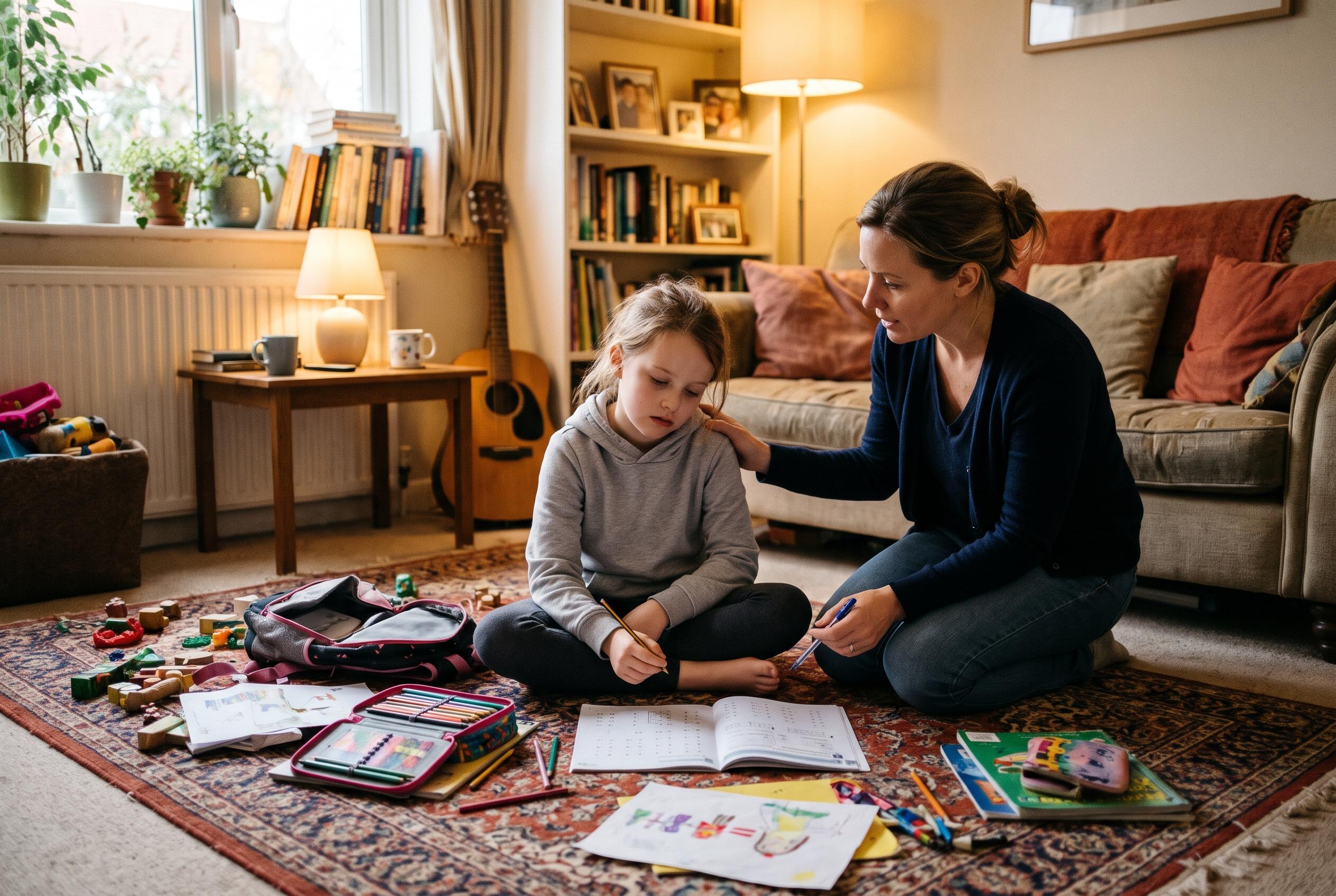

The contrast between a child’s classroom composure and home-time meltdowns often reflects spent self-control, emotional safety and the pressures of daily routines.
It is a familiar scene for many parents: a teacher praises a child as courteous, cooperative and easy to manage, then that same child arrives home and unravels within minutes. The gap between classroom composure and domestic chaos can feel baffling, but researchers have long noted that children often behave differently across settings, and the contrast is usually more revealing than alarming. According to a 1966 study in the British Journal of Educational Psychology, some children show more conduct problems at home than at school, suggesting that environment and expectation play a major role in how behaviour appears.
One of the simplest explanations is that school demands a great deal of self-control. Children spend hours sitting still, taking turns, following instructions and monitoring how they are seen by adults and peers. Child development experts say that by the time they get home, that effort can be largely spent. The result is often the so-called after-school crash: tears, irritability, refusal and sudden exhaustion. This is not necessarily a sign of disrespect; it may simply be the moment when a child no longer has to keep performing.
That pattern fits with what psychologists call executive function, the mental system that governs impulse control, attention and flexible thinking. Those abilities develop gradually, and younger children in particular have limited reserves. Attachment theory helps explain why the breakdown so often happens with parents rather than teachers. John Bowlby’s work suggested that children use a trusted caregiver as a secure base. In practice, that means a child is more likely to save their biggest feelings for the person they trust most to absorb them.
The structure of the setting matters too. Schools usually offer clear routines, visible rules and consistent consequences. Home life is often less predictable, with boundaries that can shift depending on fatigue, time pressure or competing demands. Child Mind Institute has noted that teachers also tend to have a built-in authority that is different from a parent’s role, while peer pressure in the classroom can reinforce good behaviour. At home, by contrast, children know exactly where they can push, and they are often most willing to test the limits with the adult most likely to hold them.
Daily rhythms add another layer. The period after school or childcare is often a perfect storm of hunger, tiredness and overstimulation, and transitions are hard for young children. Sleep matters as well. The American Academy of Sleep Medicine recommends nine to 12 hours a night for school-age children, and too little sleep can make mood and behaviour harder to manage. A snack, a quieter environment and a little time to decompress can do more than an immediate lecture.
There is also a learning effect at work. Children quickly notice which behaviours produce results with which adults, and they adapt accordingly. If whining or stalling sometimes works at home, they will try it again. That does not mean they are scheming in any sinister sense; it means they are learning. The good news is that consistent boundaries can change the pattern over time. And when children feel emotionally safe, they are more able to practise the very skill many parents are hoping to teach: calming down with help, then eventually doing more of it on their own.
Disclaimer: This content is for informational purposes only and is not intended to be a substitute for professional medical judgment, advice, diagnosis, or treatment.