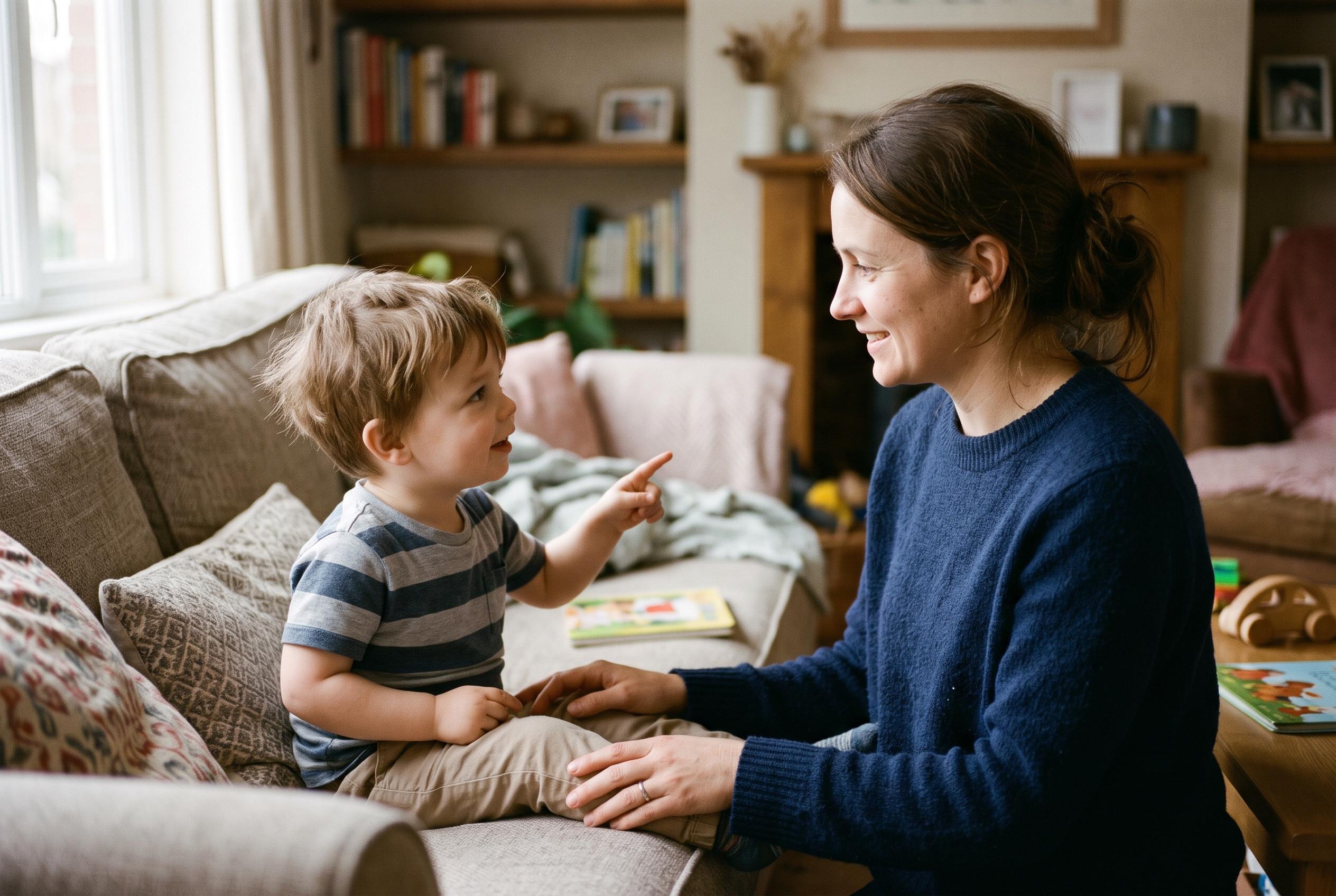

Pointing, following a gaze and checking that an adult has noticed can be among a toddler’s earliest forms of communication, supporting language learning and social connection.
Before toddlers can hold a conversation, they are already practising a quieter kind of communication. A child may point at a dog, glance back at a parent and then look again at the animal, effectively inviting someone else to notice what has caught their eye. That shared focus is known as joint attention, and child-development specialists say it is one of the early building blocks of social communication.
The American Academy of Pediatrics says these skills begin to emerge in infancy and become more established through the first 18 months of life. Developmental research also places joint attention in roughly the 6-to-12-month window, when babies begin to coordinate their focus with another person. In practical terms, that can mean following a parent’s gaze, responding to a point, or trying to direct an adult’s attention towards something interesting. The behaviour is simple on the surface, but it reflects an important ability to recognise another person’s perspective and share an experience with them.
That matters because joint attention supports language learning, social learning and the early rhythm of back-and-forth communication. The National Institute of Child Health and Human Development says it is closely tied to communication and language development, while research published in the Journal of Autism and Developmental Disorders has linked basic joint attention behaviours with both expressive and receptive language. A toddler who looks at a cat while hearing a parent say, “That cat is fluffy,” is not just hearing words; the child is seeing and hearing those words in the context of something already meaningful. That gives language a clearer foothold.
It also helps children practise social connection long before they can manage full conversations. The Centres for Disease Control and Prevention says young children often communicate nonverbally, and that eye contact and body language can help them feel secure and understood. Joint attention builds on that idea. A child who brings a toy to show a parent, glances up after hearing a strange noise, or follows a pointing finger is taking part in an early exchange. These moments can happen with parents, siblings, grandparents or other familiar adults, and they do not need to be elaborate to matter.
In everyday family life, joint attention often appears during ordinary routines rather than during special teaching moments. It may show up at breakfast, in the bath or on a walk to the park: a toddler points at a bird, an adult follows the gesture, and the child checks whether the bird has been noticed too. The key is not to turn every interaction into a test. Parents can support shared attention by following their child’s interests, joining play without taking over, leaving room for a response and using picture books as a natural way to look at something together.
Differences in joint attention can sometimes be worth discussing with a health professional, especially if they are persistent or appear alongside broader communication concerns. The National Institute of Child Health and Human Development says many autistic people have difficulty with joint attention, including following gaze or a pointed finger, and that therapy can focus on skills such as pointing, showing and coordinating looks between a person and an object. But one behaviour alone does not tell the whole story. Development varies widely, and parents are usually best served by looking at patterns over time rather than drawing conclusions from a single moment.
For caregivers, the main takeaway is reassuring: a brief glance, point or shared look can carry real developmental weight. These tiny exchanges are often the first signs that a toddler is not only noticing the world, but wanting to share it.
Disclaimer: This content is for informational purposes only and is not intended to be a substitute for professional medical judgment, advice, diagnosis, or treatment.