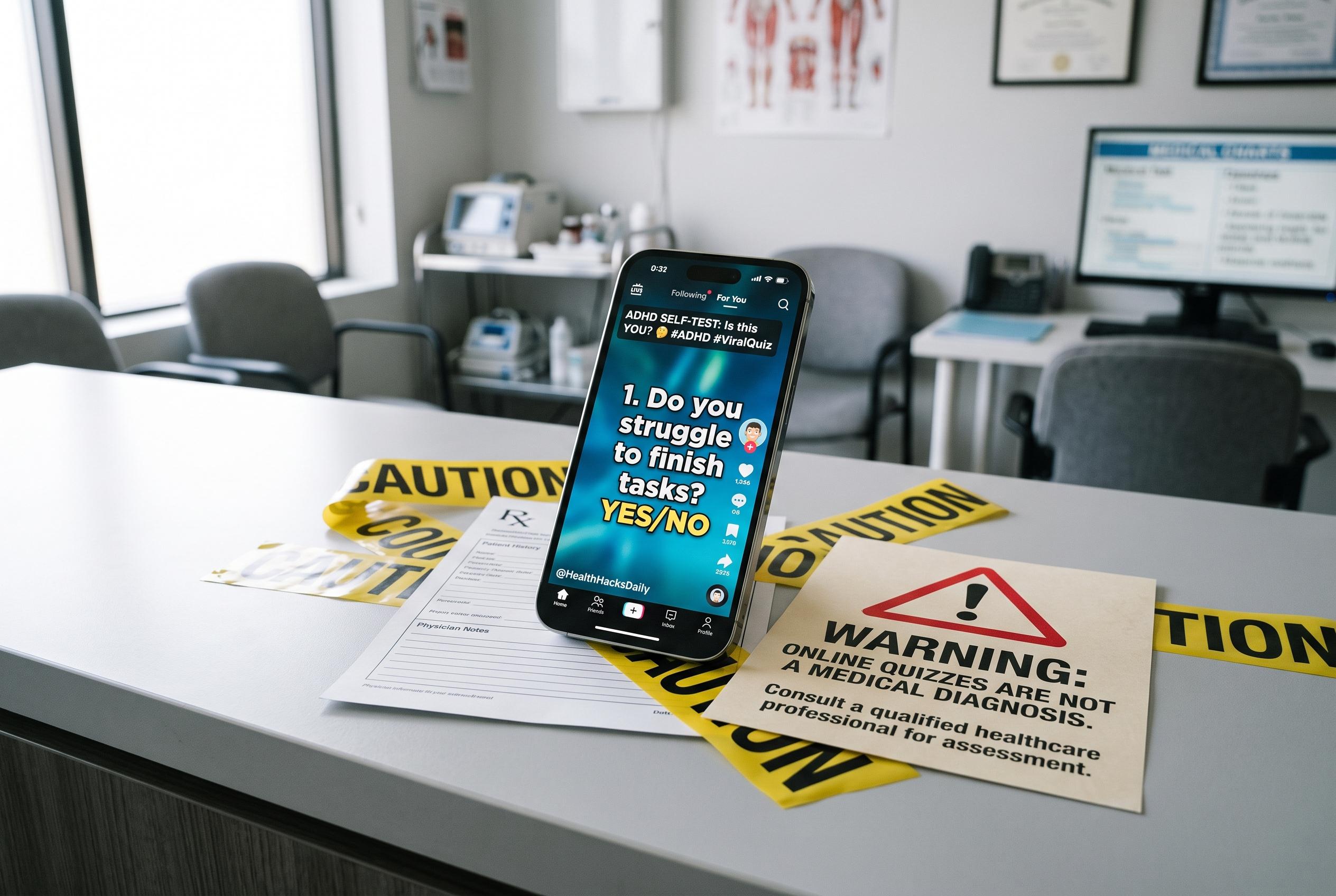

A trending ADHD self-test on TikTok is raising concerns among doctors who warn that relying on quick online quizzes can lead to misdiagnosis, risking harm for children and adults alike amid ongoing debates over accuracy and broadened diagnostic criteria.
A viral ADHD self-test on TikTok may feel revealing, but doctors say it can be dangerously misleading. The appeal is obvious: many ADHD traits, such as distractibility, impulsiveness and restlessness, overlap with ordinary stresses, poor sleep and developmental differences. That makes self-diagnosis easy, but not reliable.
Recent debate over diagnosis has sharpened the issue rather than settled it. In March 2026, Samuele Cortese and colleagues argued in The British Journal of Psychiatry that the worldwide prevalence of ADHD in children and teenagers is about 5.4%, while Anita Thapar has written that underdiagnosis may still be more of a problem than overdiagnosis in some settings. At the same time, other reviews have found convincing evidence that ADHD is overdiagnosed among children with milder symptoms, showing how unsettled the field remains.
Part of the confusion comes from the way diagnostic rules have changed. The DSM-5 relaxed the age at which symptoms must first appear from seven to 12, and for adults reduced the number of symptoms needed for a diagnosis. That broader definition may help identify people who were previously missed, but it also increases the risk that normal variation, school pressure or temporary distress is mistaken for a neurodevelopmental disorder.
The danger is greater when assessment is rushed. Research indexed by PubMed has warned that both underdiagnosis and overdiagnosis can seriously affect adults, while a systematic review of child cases found that a diagnosis can bring harm when symptoms are mild or borderline. In practice, that matters because children can be labelled on the basis of questionnaires and brief consultations, even though similar behaviour may be driven by sleep problems, family stress, hearing or vision difficulties, or an unrelated learning disorder.
Experts also caution against assuming that ADHD looks the same in every child. Younger pupils in a class can seem less mature simply because they are several months behind their classmates developmentally, and girls are still more likely to be missed because their symptoms are often quieter or masked. The safer approach, clinicians say, is careful assessment across home, school and other settings, with a specialist if needed, rather than trusting a social media quiz to make a lifelong diagnosis.
Disclaimer: This content is for informational purposes only and is not intended to be a substitute for professional medical judgment, advice, diagnosis, or treatment.