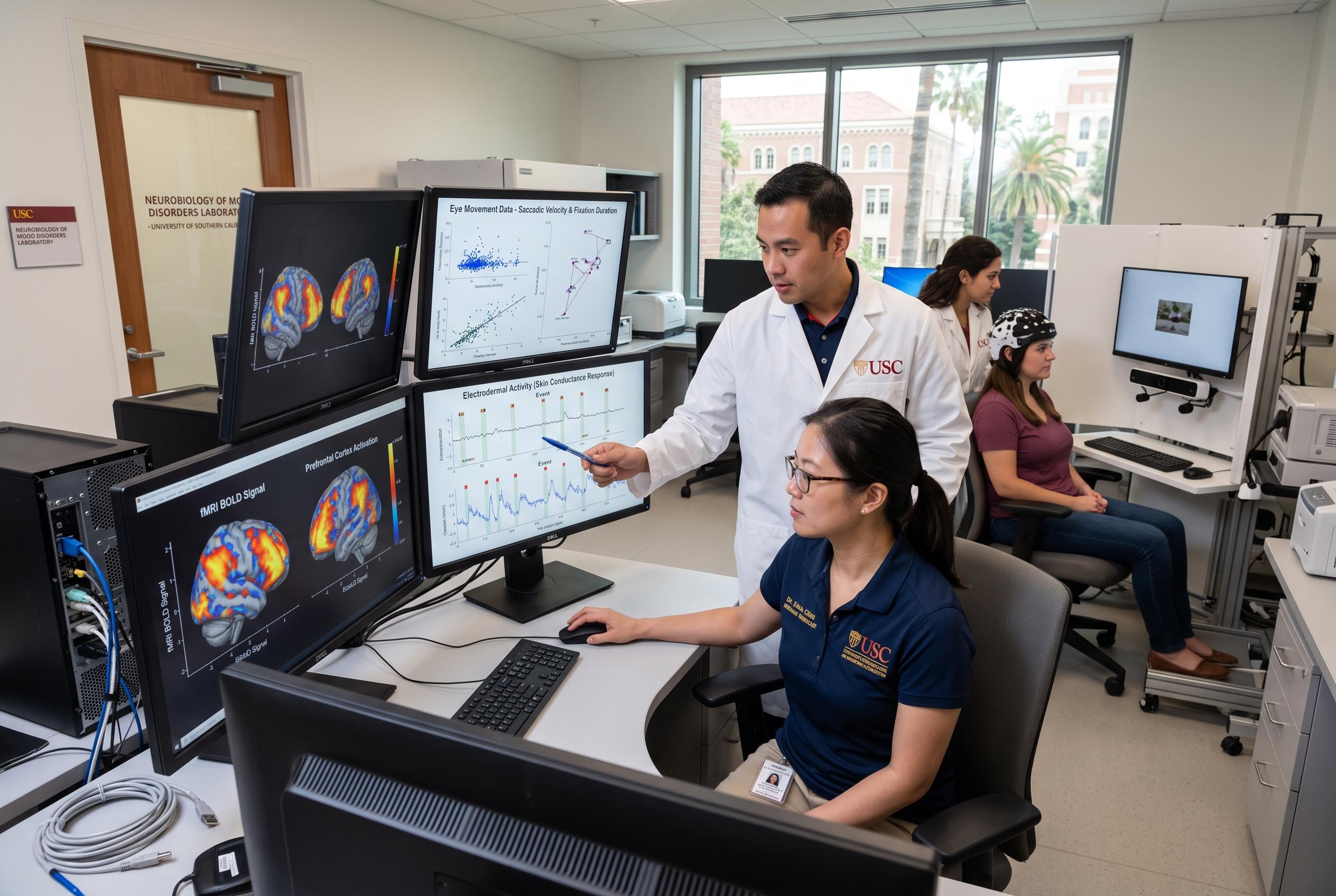

Researchers at the University of Southern California are investigating how brain activity, eye movements, and skin responses could offer objective insights into depression and suicidal thoughts, supplementing traditional assessments with innovative biological markers.
Mental health assessments still begin with conversation, but researchers at the University of Southern California are testing whether the body can add objective clues that words alone may miss. Their work, part of the PRECOG project, combines brain activity, eye movements, skin responses and artificial intelligence to look for patterns linked to depression and suicidal thoughts, according to USC.
The study focused on automatic reactions to emotionally charged statements. Participants read 160 sentences and indicated whether they agreed or disagreed while EEG recorded brain activity, cameras tracked gaze and sensors measured skin conductance, a marker of sweating linked to the body’s stress system. Researchers said responses to negative language were especially revealing, with differences appearing within fractions of a second after a word was shown.
USC said the project found group-level differences between healthy participants, people with depression and those reporting suicidal ideation. In some analyses, the most useful brain signals emerged about 300 to 600 milliseconds after stimulus presentation, a window when the brain is processing meaning and emotional content. Eye-tracking patterns also varied, with more organised viewing among healthy participants and more scattered attention in the suicidal group, while sweat responses changed in ways that may help distinguish broader depression from suicide-related risk.
The work has been published across several venues rather than in a single paper. USC said the eye-tracking findings appeared in npj Digital Medicine, EEG results were reported in the Journal of Affective Disorders, Communications Biology and Translational Psychiatry, and skin-conductance findings were posted on arXiv before formal peer review. The project fits into a broader push in psychiatry to search for biomarkers, or measurable biological signals, that could supplement interviews and symptom checklists.
Researchers, however, stressed that this is not a mind-reading test or a way to predict an individual suicide attempt. The findings describe patterns seen across groups, not a clinic-ready tool for one person. The team also acknowledged practical limits, including the need for specialised equipment and the risk that AI models may perform unevenly unless they are trained on larger, more diverse populations. For now, the clearest message is that the brain, eyes and skin may hold useful clues, but human judgement remains central to assessing mental health risk.
Disclaimer: This content is for informational purposes only and is not intended to be a substitute for professional medical judgment, advice, diagnosis, or treatment.