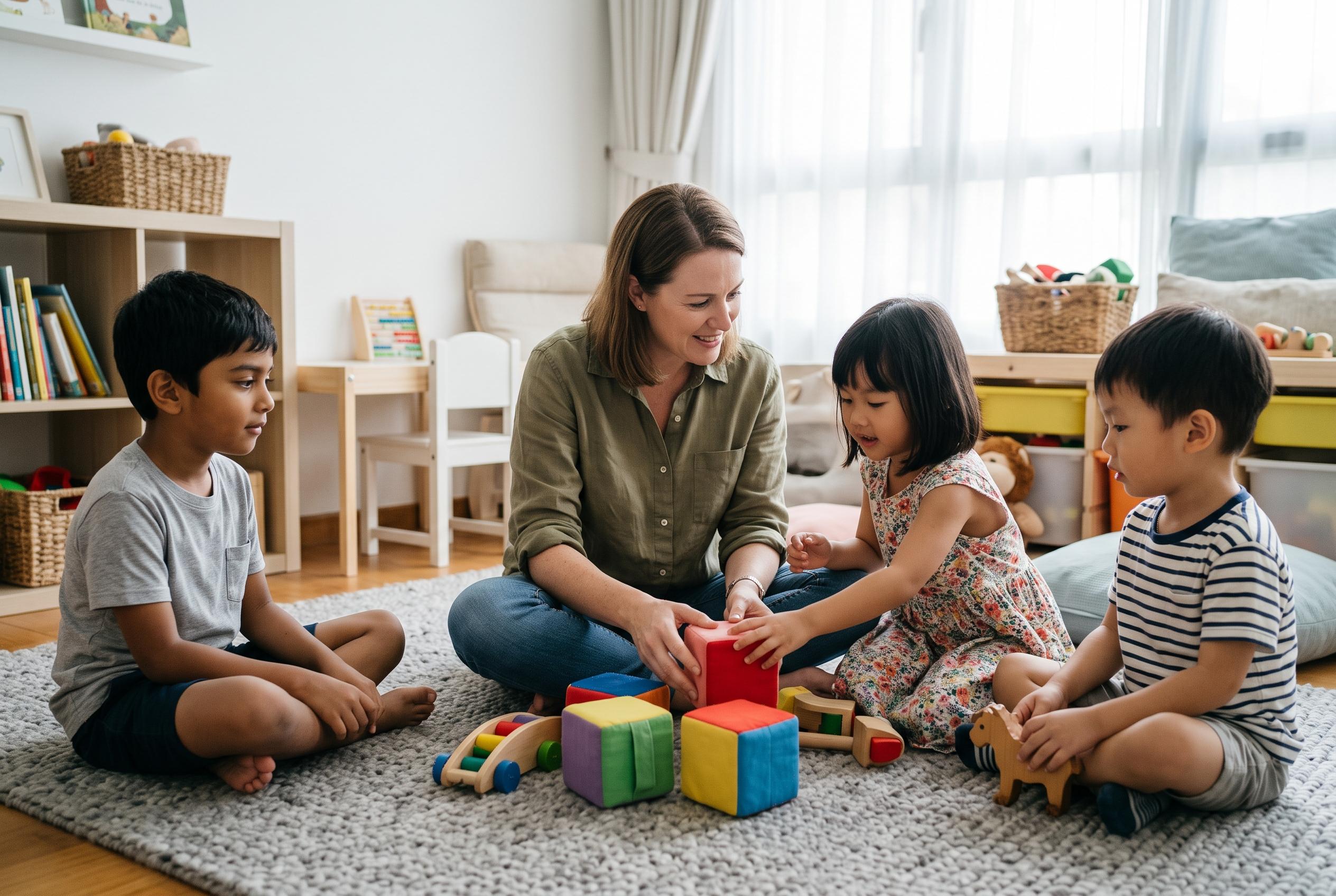

Parents often mistake children’s quietness around peers for shyness, but specialists in Singapore highlight that difficulties with social communication, such as reading cues and joining group play, may require targeted support to help children connect and participate fully.
A child who chats freely at home but goes quiet around other children is not necessarily being difficult, and the contrast can leave parents unsure whether to worry. In Singapore, speech and language specialists say the gap often reflects a specific set of social communication skills rather than simple shyness or a lack of vocabulary. Talking is only one part of communication; knowing how to join play, take turns, read cues and keep an interaction moving are different abilities altogether.
Home is a familiar setting. Children usually know the people, the routines and the likely responses, and parents often understand unfinished sentences, gestures and familiar habits. A playground or classroom asks for far more. Children may need to approach a group, work out what another child wants, respond to unspoken expectations, handle disagreement and adjust their language to the moment. According to the American Speech-Language-Hearing Association, social communication is the use of verbal and non-verbal language for social purposes, including conversation, turn-taking and understanding other people’s signals.
Signs of difficulty are often clearer when parents look across situations rather than focusing on one quiet day. A child may speak comfortably with adults but rarely start conversations with peers, play beside other children without really joining in, or miss facial expressions, tone and body language. Singapore-based therapy services say some children can speak clearly yet still struggle to hold a conversation, repair misunderstandings or understand jokes and implied meanings. The Singapore General Hospital paediatric speech therapy team also assesses children with communication concerns such as poor eye contact, unclear speech and difficulty expressing ideas.
ASHA says social communication disorder involves persistent difficulty using verbal and non-verbal language for social purposes and that the issue can affect relationships and school participation. It can appear alongside other developmental conditions, although it is not diagnosed together with autism spectrum disorder. For parents, the key point is that a child who seems talkative in one setting and withdrawn in another may still need help with pragmatics, the social rules of language, or with understanding how communication works in groups.
Specialists also caution against assuming a child is simply shy. Some children only need time to warm up; others want to join in but do not know how. That distinction matters. Speech therapists say children can learn skills such as entering play, asking for clarification, reading social cues and recovering after misunderstandings, often through practice in real-life settings with peers. The aim is not to make children behave exactly like everyone else, but to give them more ways to connect, participate and feel understood.
Disclaimer: This content is for informational purposes only and is not intended to be a substitute for professional medical judgment, advice, diagnosis, or treatment.