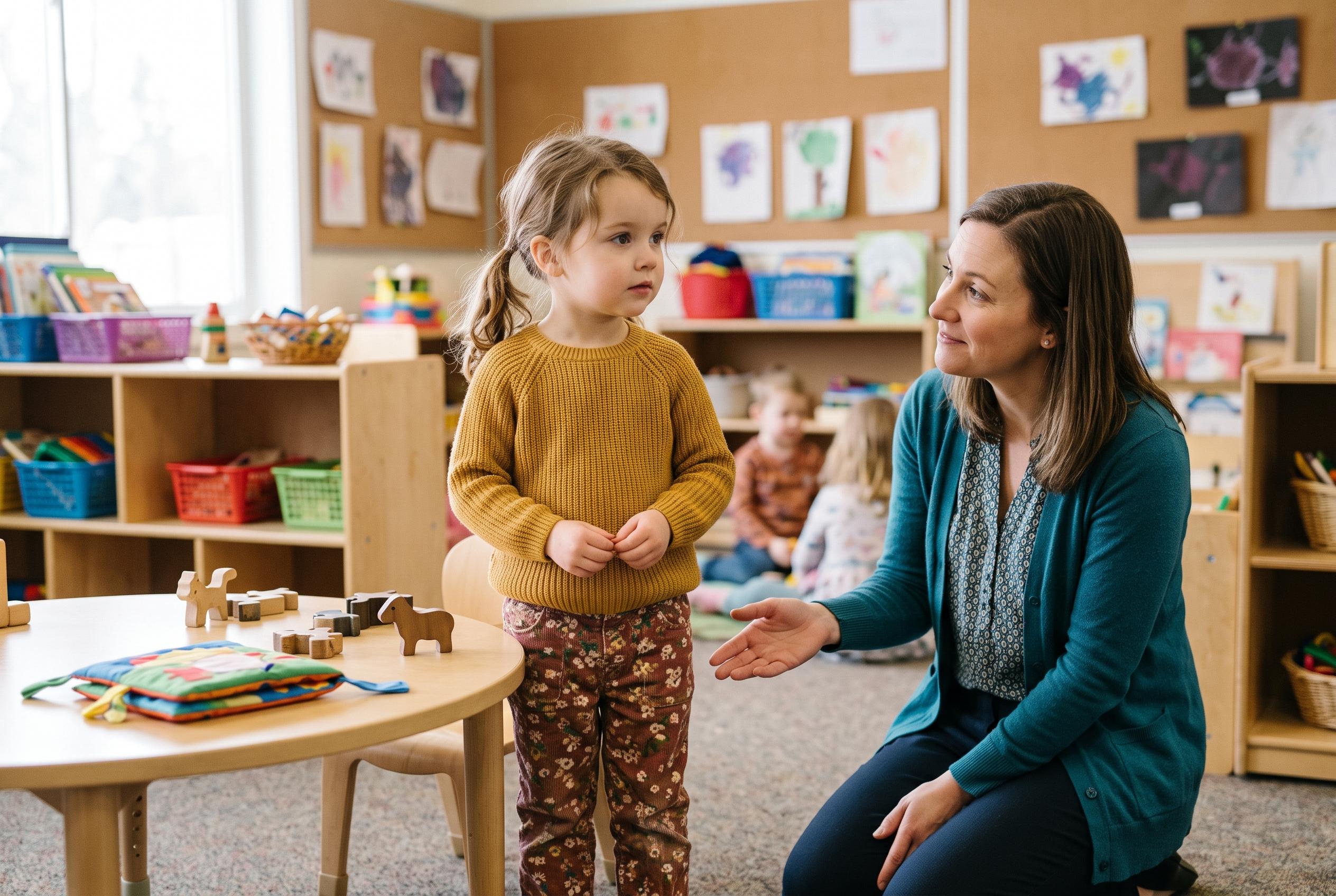

New guidance reassures parents that tears at daycare are a normal developmental phase, offering practical strategies to help children cope with separation and foster healthy attachments.
For many families, the hardest moment in the first weeks of childcare is not the day itself but the handover at the door. Paediatric guidance suggests that a child who cries when a parent leaves is often showing something ordinary rather than alarming: a normal stage of development and, in many cases, a strong bond with the person walking away. UNICEF describes tears at daycare drop off as a common sign of separation anxiety, while John T. Parkhurst, a child and adolescent psychologist writing for Lurie Children’s, says this kind of hesitation is frequently evidence of healthy attachment rather than a sign that childcare is going badly.
The age pattern helps explain why the reaction can feel sudden. UNICEF says separation anxiety is most common between 6 months and 3 years, while Lurie Children’s says it can begin as early as 8 months and may start easing around 15 to 18 months, though preschoolers can still struggle, especially in unfamiliar settings or at bedtime. Lurie’s clinical guidance adds that some children do not hit this phase until 18 months to 2½ years. Triggers can include a new childcare arrangement, a new sibling, a house move or tension at home. HealthyChildren.org, the American Academy of Pediatrics’ parenting site, notes that wide variation is normal, but says it is unusual for this to persist as a daily pattern after the preschool years.
What helps most often starts before the official first drop-off. HealthyChildren.org recommends practising time apart in advance, whether through a short visit with relatives, a playdate or an hour with another trusted carer. Child Mind Institute makes the same point more broadly, advising parents to prepare children ahead of separations rather than treating the goodbye itself as the only challenge. Cleveland Clinic also recommends familiarising a child with a new setting before they are left there, so the room, the adults and the routine are not all brand new at once. In practice, that can mean visiting together, walking through what will happen and rehearsing the same short farewell each time.
Parents are also encouraged to give children something concrete to hold on to, both emotionally and sometimes literally. UNICEF suggests talking clearly about when the parent will return, because very young children are still learning that time apart is temporary. Its example is simple and specific: “After I’m finished work, I’ll come and pick you up and we can go to the playground and play on the swings together.” The same guidance says a soft toy or blanket can help, and Cleveland Clinic similarly suggests a small token that reminds the child of home. The aim is not to argue a child out of distress, but to pair the separation with a predictable return.
Once the moment of parting arrives, the clearest advice from paediatric and mental health experts is also the advice many parents find most counter-intuitive: keep it brief. Lurie Children’s says routine matters, whether that is a hug, a kiss on the cheek or another simple ritual, and Parkhurst puts it bluntly: “Once you’ve done your routine, you’ve got to go.” Lurie’s broader clinical advice says goodbyes should be loving but firm, without lingering. Cleveland Clinic warns that repeated check-ins can restart the distress rather than soothe it. As Dr Sever explains, “When you continue to check in on the child or you prolong your goodbyes, it starts the cycle of separation over again and the child has to separate, not once, but two or three times.”
That advice depends partly on something else experts stress: children read the parent’s emotional cues closely. Parkhurst says parents’ words matter less than how they respond and act, and both Lurie Children’s and Cleveland Clinic advise staying calm and confident. UNICEF goes further by telling parents not to feel guilty about short separations, arguing that the goal is to help children learn to manage difficult feelings without always needing a parent beside them. Cleveland Clinic frames that as a longer-term gain in independence, even if the first few mornings are painful.
It is also worth remembering that the behaviour does not stop at the nursery gate. Child Mind Institute says crying, clinging and tantrums can show up across everyday separations, at home, at school and with other caregivers, even though anxiety often fades as children grow older. Lurie Children’s says some children who are shy or slow to warm up may bury their face in a parent, refuse to engage straight away or hover behind a leg when meeting someone new. That can make progress look uneven: a child may cope well for days and then falter again in a new room, after a family change or simply when overtired.
Where parents should pause is when the pattern is unusually intense, prolonged or disruptive. HealthyChildren.org says families should speak to a paediatrician if a child is not adapting to being without a parent, and Child Mind Institute says extra help may be needed if the anxiety happens with every separation or begins to interfere with daily life. Cleveland Clinic offers a practical benchmark, saying that if severe symptoms continue consistently for more than four weeks, it may be worth discussing treatment options with a paediatrician, including cognitive behavioural therapy, family therapy, talk therapy or, in the most serious cases, medication. Lurie’s clinical guidance similarly warns that in older children, persistent separation anxiety can point to a deeper anxiety disorder.
For most parents, though, the message from these sources is reassuring. Tears at drop-off are often developmentally ordinary, especially in the first months and years, and they do not mean a child dislikes childcare or that a parent has mishandled the transition. The most useful response is usually steady rather than elaborate: prepare ahead, create a simple routine, say goodbye clearly, and come back when you said you would. Over time, that repetition teaches the lesson young children are still trying to master , that separation is hard, but temporary, and that the trusted adult always returns.
Disclaimer: This content is for informational purposes only and is not intended to be a substitute for professional medical judgment, advice, diagnosis, or treatment.