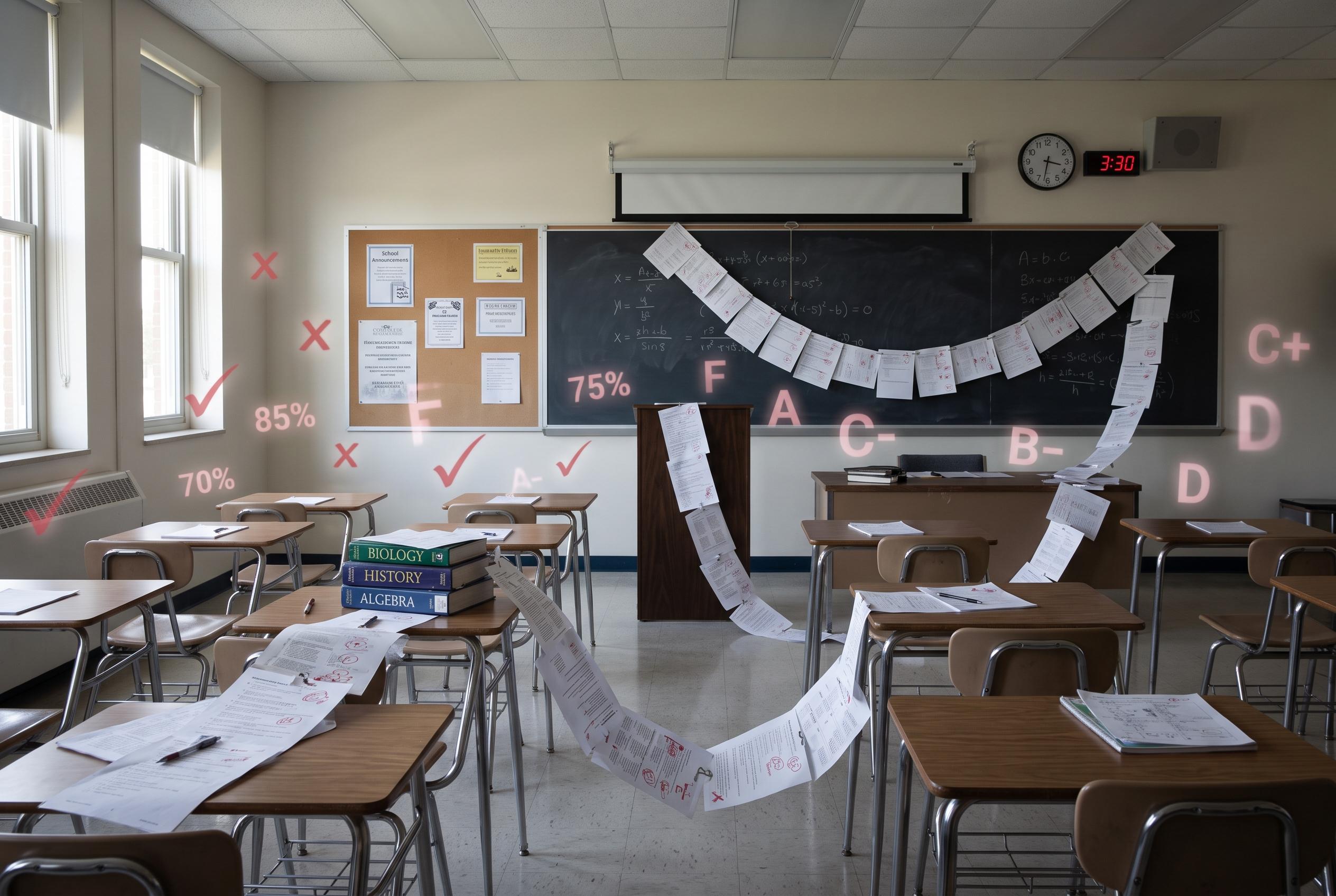

A new perspective suggests that the pressures embedded within schooling, such as grades and constant evaluation, may be central to the rise of anxiety and depression among students, with potential long-term effects on mental health and learning.
Temporary anxiety before the first day of school can be useful. It can sharpen attention and help children prepare. But when worry becomes a daily condition, it does not end when the bell rings. It can follow students into adulthood, shaping how they study, work and cope long after they leave school.
That is the argument made by a biology and neuroscience teacher who sees the problem not as a personal weakness but as a by-product of schooling that prizes performance over curiosity. In the lead article, the educator points to a survey of more than 84,000 college students in which about one-third reported moderate or severe anxiety, with a similar share reporting depression. The article also describes a student who said high school felt less like learning and more like a race for a scholarship, leaving her feeling like “a complete robot”.
The wider research picture is broadly consistent with that concern. A longitudinal study published in 2025 found that academic stress can affect university students’ psychological well-being, health behaviours and academic performance over time. Other research indexed by PubMed links stress to weaker working memory and poorer cognitive performance, especially when pressure affects the prefrontal cortex and hippocampus, the brain regions most important for attention and memory. Reviews of test anxiety likewise describe the body’s stress response as a physiological system that can be activated during assessments, raising cortisol and interfering with performance.
That matters because the brain does not treat constant pressure as neutral. Neuroscience research has shown that anxiety can heighten sensitivity to threat and make it harder to think clearly, while prolonged stress can sap motivation and disrupt the mental flexibility students need to learn well. In the classroom, that can encourage a narrow focus on avoiding mistakes rather than exploring ideas, asking questions and tolerating uncertainty.
The article also challenges the assumption that grades are a clean measure of learning. Supporters say grades provide accountability and a common standard. Critics counter that they often reward compliance, fuel comparison and teach students to stay silent unless they are certain. Once that habit takes hold, curiosity can shrink into cautious performance.
Seen that way, the issue is larger than exam season or a single anxious student. The article suggests that an education system organised around fear of failure, pressure from parents and peers and constant evaluation may be training young people to see learning as something to endure rather than enjoy. If that is what the system reliably produces, the piece argues, then anxiety is not an accident of schooling but one of its outcomes.
Disclaimer: This content is for informational purposes only and is not intended to be a substitute for professional medical judgment, advice, diagnosis, or treatment.