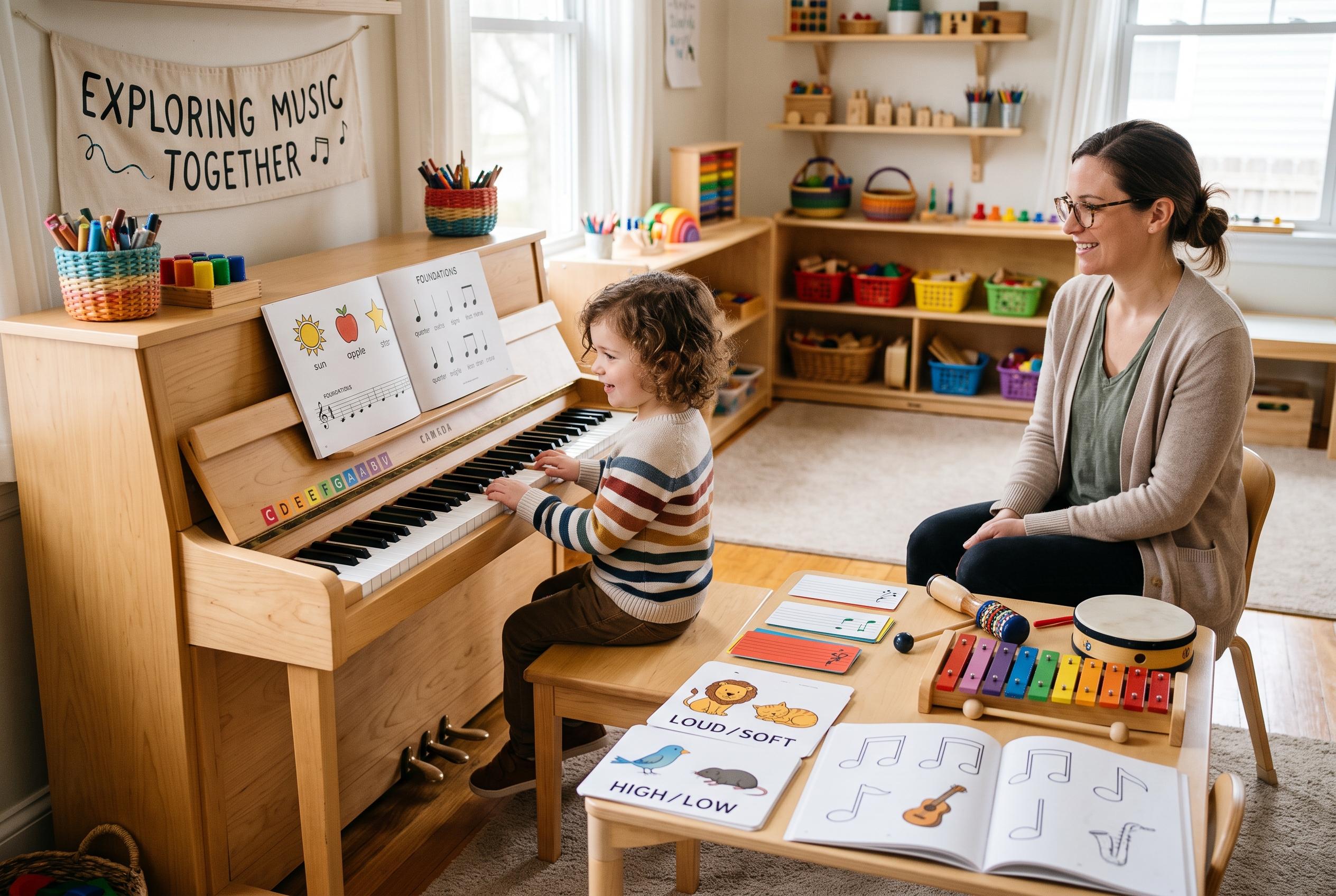

A new approach to preschool piano lessons prioritises sound exploration and foundational skills, challenging traditional emphasis on quick reading and performance.
When teachers first start working with preschool pianists, the hardest part is often not the children but the expectations. The Colourful Keys article argues that the real challenge is finding a middle ground between asking too much and settling for too little. Its message is that progress at ages three to five should be judged by foundations, not by how quickly a child can produce a recognisable tune.
In the opening month, the focus is on settling in, building trust and learning how lessons work. Rather than pushing reading or performance, the article says teachers should look for basic musical language, the ability to identify and chant simple rhythm values, early awareness of the groups of black keys, growing finger control and, above all, a willingness to imitate sounds. That emphasis on imitation and exploration is echoed by other preschool programmes, which also prioritise movement, listening, keyboard patterns and confidence before formal technique or reading.
Over a full first year, the picture broadens. The article says teachers should expect children to know the keyboard far better, including finding named notes, describing what comes before or after a note, and reciting the music alphabet. It also argues that preschool pupils do not need fluent staff reading by the end of year one. Instead, they should begin to understand treble and bass clefs, the difference between line and space notes, and basic steps and skips. This slower approach matches other early-years piano methods, which treat keyboard geography as a long-term understanding rather than a quick memorisation exercise.
Aural development gets equal weight. The article recommends that young pupils learn to hear and identify contrasts such as same and different, short and long, loud and soft, and high and low. It also introduces solfa in a simple sequence, beginning with do, re and mi before adding so and la. Other preschool programmes place similar importance on listening, pitch awareness and ear training, suggesting that early musicianship is built as much through sound, movement and repetition as through note reading.
Rhythm is treated as another core skill rather than a separate technical hurdle. The article suggests that young children can handle quavers and dotted crotchets much earlier than many method books assume, provided the teaching stays practical and playful instead of becoming a maths lesson. That idea fits with other preschool approaches that use clapping, movement, percussion and repetition to make rhythm part of a child’s natural musical vocabulary. Technique, by contrast, is kept deliberately low-profile at first: the article recommends careful work on finger numbers, posture and non-legato playing, but only in small doses and over time.
Taken together, the article makes a clear case that preschool piano teaching succeeds when it values readiness over speed. The goal is not to hurry children into reading or polished playing, but to give them enough musical language, coordination, listening skill and keyboard familiarity that later progress feels natural. For parents and teachers, the lesson is simple: in the preschool years, strong foundations matter more than visible flash.
Disclaimer: This content is for informational purposes only and is not intended to be a substitute for professional medical judgment, advice, diagnosis, or treatment.