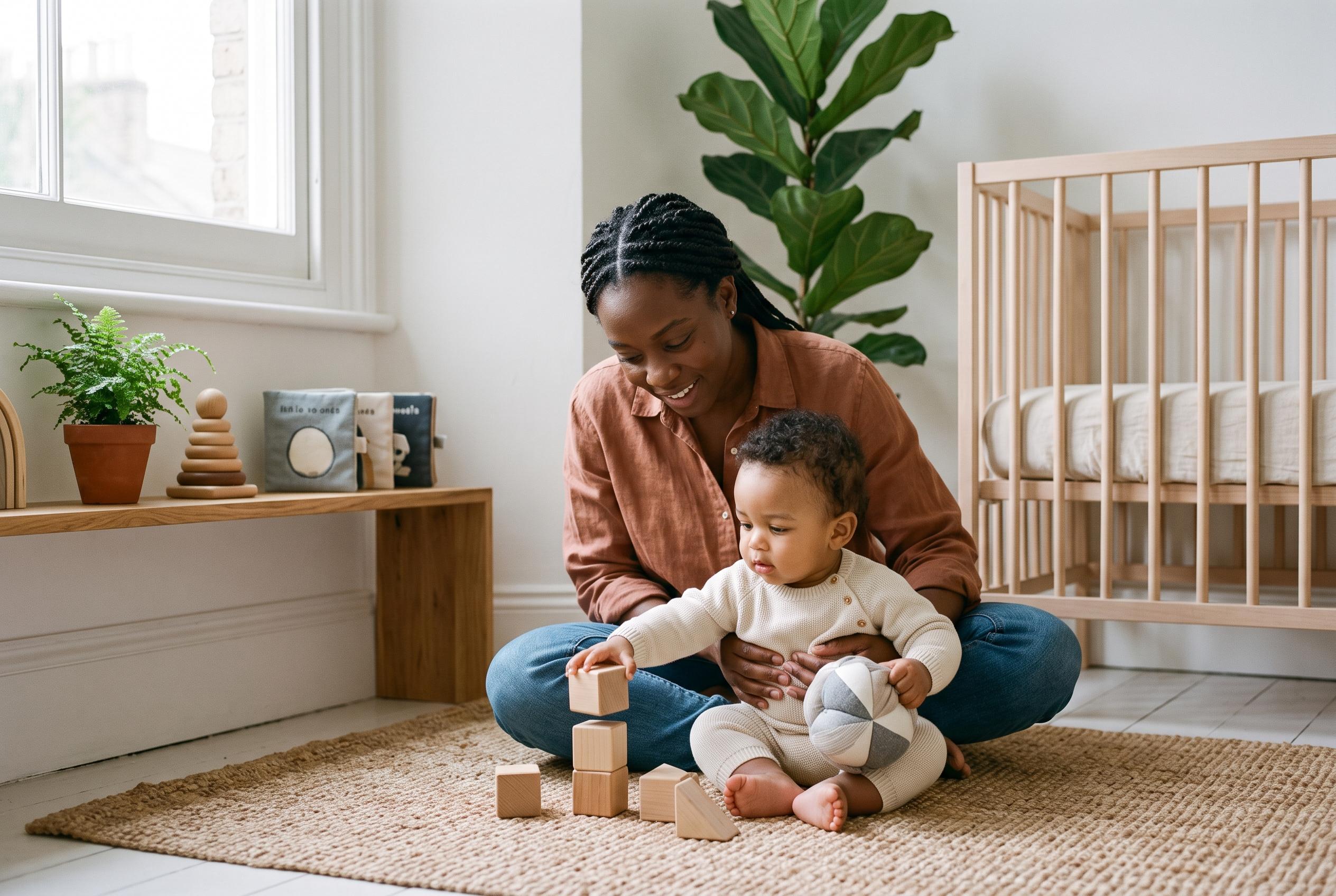

Expert advice emphasises that a small selection of safe, purposeful toys and shared play are more beneficial for a baby’s rapid brain growth than an abundance of complex gadgets, with safety and purpose taking centre stage.
Parents filling a nursery do not need a shelf full of flashing gadgets to give a baby a strong start. Guidance from UNICEF says the first 1,000 days are a period of exceptional brain growth, with babies forming up to 1,000 new connections every second, and clinicians and child-development specialists broadly point in the same direction: a small stock of safe, simple toys, used well, can do more than a larger pile of complicated ones. (unicef.org)
That is partly because play begins long before a child can stack blocks or sort shapes. In UNICEF’s transcript on early play, Adriana Friedman says, “Babies play from the moment they’re born,” adding that “their first toy is their own bodies.” Raising Children Network makes a similar point, arguing that babies learn best when they are interested in what they are doing and that, at this stage, the most useful toys are often the ones adults use with them rather than anything designed to entertain them alone. (unicef.org)
For the early months, that usually means choosing for contrast, texture, sound and reach rather than novelty. Raising Children Network suggests a brightly coloured mobile, a wind-up musical toy, a rattle to reach for and objects with different textures. Mayo Clinic’s advice for four- to six-month-olds is to keep the selection narrow enough for a baby to focus, putting out only one or two toys at a time and placing one just beyond reach to encourage stretching and creeping. It also recommends supervised tummy time, using a colourful toy or a sound to prompt head lifting and early rolling practice. (raisingchildren.net.au)
Books belong in that mix earlier than many parents assume. The NHS says sharing books from an early age supports future learning, bonding and emotional wellbeing, and notes that even very small babies enjoy the sounds, rhythms and rhymes of language as well as looking at picture books. Mayo Clinic likewise recommends large, brightly coloured pictures and reading as part of a bedtime routine. In other words, a fabric book or sturdy picture book can be as useful in a nursery basket as any rattle or mirror. (nhs.uk)
Safety guidance is more specific than many nursery shopping lists suggest. HealthyChildren.org, which carries American Academy of Pediatrics advice, says hanging crib toys such as mobiles and crib gyms should stay out of reach and be removed when a baby first starts to push up on hands and knees, or by five months, whichever comes first. The US Consumer Product Safety Commission says age guidance on packaging should be followed and notes that toys have to carry age labels if they are a choking hazard for children under three. Its advice is blunt on smaller risks that are easy to overlook: keep toys with small parts and small balls away from children younger than three, keep deflated balloons away from children younger than eight, and throw away plastic wrapping as soon as gifts are opened. (healthychildren.org)
Battery-powered toys need particular care. The NHS warns that button batteries can cause choking and severe internal burns if swallowed or lodged in a child’s ear or nose, and says toy battery compartments should be secured with a screw. HealthyChildren.org also cautions against toys with button or lithium coin batteries and high-powered magnets, saying loose parts can end up in mouths, noses or ears and cause serious injury. If a toy is recalled, the paediatric guidance says it should be removed straight away, while the CPSC directs consumers to its reporting and recall systems for unsafe products. (nhs.uk)
For UK families, there is also a local filter to apply. The NHS advises buyers to look for the British Standard kitemark, the lion mark or the CE mark, and warns that second-hand toys or toys bought from market stalls may not meet safety standards. It also says anything labelled “Not suitable for children under 36 months” should not be given to a baby or toddler under three. The same page adds an important reminder for children with additional needs: toys should match developmental age and ability, and some children may benefit from different textures or toys that stimulate language more directly. (nhs.uk)
The upshot is that building a nursery toy collection is less about buying more and more about buying with purpose. Mayo Clinic says expensive educational toys are not necessary, and Raising Children Network points parents towards toy libraries, homemade toys and everyday household objects as low-cost ways to keep play fresh. Rotating a few well-chosen items, watching what actually holds a child’s attention and making time for shared play will usually do more for early development than any attempt to stock a nursery as if quantity itself were the goal. (mayoclinic.org)
Disclaimer: This content is for informational purposes only and is not intended to be a substitute for professional medical judgment, advice, diagnosis, or treatment.