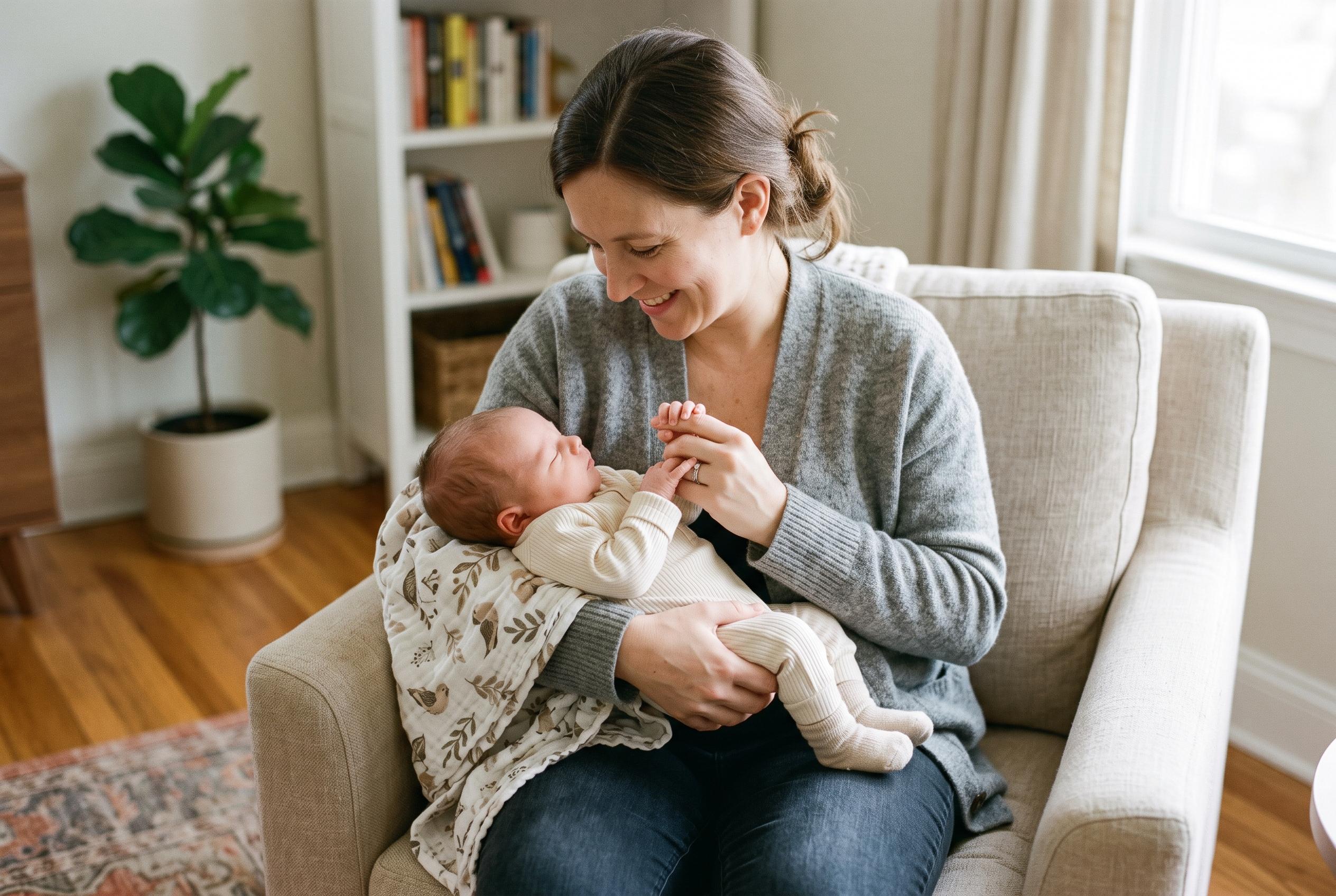

Understanding a newborn’s early sensory experiences underscores the need for calm, measured environments that foster healthy brain development through responsive caregiving.
A newborn’s first weeks outside the womb are a crash course in adaptation. The quiet, buffered environment of pregnancy gives way to light, noise, touch and movement all at once, and that shift places heavy demands on an infant’s still-maturing nervous system. According to MedlinePlus and Stanford Medicine Children’s Health, babies are born with all five senses, but those senses are far from fully developed, and early growth depends on a gradual process of sensory organisation as the brain learns to sort, filter and respond to the world.
Vision is among the least mature systems at birth. Stanford Medicine Children’s Health says newborns see best at close range, roughly the distance to a caregiver’s face during feeding or holding, and they are drawn to strong contrast rather than soft, muted colour. Lumen Learning notes that high-contrast patterns are especially effective because visual processing is still developing, while bright light can be uncomfortable. Hearing arrives earlier in development, but it is not a licence for constant background noise: MedlinePlus and Stanford both note that babies react strongly to sudden sounds and can recognise a mother’s voice.
Touch and body position matter just as much. The Newborn Care Solutions Agency says touch is one of the most developed senses at birth, which helps explain why steady holding, skin-to-skin contact and snug wrapping can be so calming. The article also points to proprioception, the body’s sense of where it is in space, as a key part of that early security. In the womb, the baby is held in continuous, contained pressure; outside, that same sense of support can be recreated through firm but gentle containment, especially when a baby is startled by abrupt movement or loud noise.
That is why the difference between engagement and overload is so important. A calm, alert baby may hold a gaze, move smoothly and keep a relaxed face and open hands. When stimulation becomes too much, the cues change: turning away, closing the eyes, yawning, squirming, arching the back or escalating into a high-pitched cry can all signal that the infant needs a pause. MedlinePlus notes that primitive reflexes such as the Moro reflex can be triggered by sudden sound or movement, reinforcing the need for a low-drama environment in the early months.
For parents, the practical lesson is not to entertain a newborn, but to steady one. Warm, dim lighting, predictable routines and a quieter soundscape can help reduce sensory strain. So can taking things slowly: moving a baby between positions with care, offering one stimulus at a time and allowing enough stillness for the infant to process what is happening. The broader message from the child-development sources is consistent: healthy sensory growth is supported less by stimulation than by responsiveness, closeness and a measured environment that gives the brain room to organise experience.
Disclaimer: This content is for informational purposes only and is not intended to be a substitute for professional medical judgment, advice, diagnosis, or treatment.