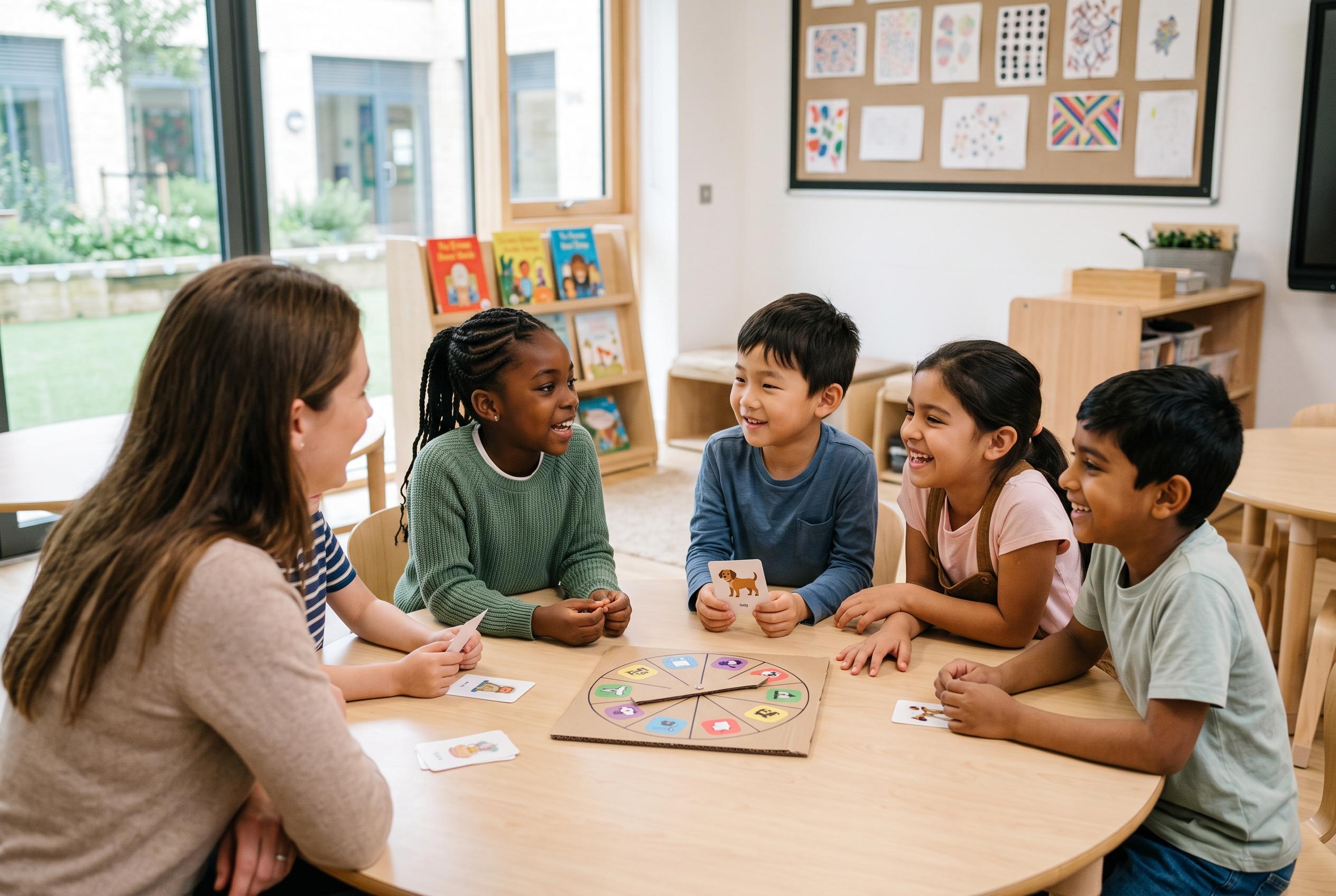

Expert guidance highlights innovative approaches, from visual scripts to conversational routines, to help children with social challenges build more meaningful connections and navigate social situations with confidence.
A set of conversation prompts can get a child talking, but specialists say the real work begins before the first answer. For children who find social interaction difficult, the challenge is often less about inventing a topic than about reading the moment: noticing whether a group is open, choosing something the other person cares about, staying with the exchange and leaving it without awkwardness.
That broader picture sits behind A Day in Our Shoes’ latest collection of age-banded conversation starters. Its split between younger children and teenagers mirrors guidance from the Kids Mental Health Foundation, which says younger pupils often do better when questions come with two or three clear options, while older students can cope with prompts about feelings, motivation and the way they prefer to learn.
Understood, in a guide written by Amanda Morin and expert reviewed by Rayma Griffin, breaks the task into four parts: joining, starting, maintaining and ending a conversation. The site says children who struggle socially may miss body language, tone of voice or the right moment to speak. Its practical advice is to show them how to wait for a lull, ask “Is it OK if I join you?” and use who, what, when, where and why questions to work out what a group is already discussing.
That matters because getting into a conversation is only the first hurdle. Understood notes that some children interrupt, talk continuously, drift off topic or stay fixed on a narrow interest without noticing that the other person is losing patience. ASDNext, a Pennsylvania autism resource aimed at teens and adults, offers similar coaching for endings: wait for a natural pause, leave “on a positive note” and say something like “It was nice talking to you” rather than disappearing mid-conversation. It also makes the useful point that if somebody clearly does not want to talk, excusing yourself politely is a social skill too.
In the classroom, the emphasis shifts from correcting deficits to creating belonging. The Kids Mental Health Foundation says open-ended questions can help a class get to know one another, but warns teachers not to push a pupil into answering something they do not want to share. Its sample prompts move beyond simple favourites to questions such as what describes you, what you are good at, what you find challenging and what makes you feel nervous. For older students, the foundation suggests asking whether they prefer large groups, small groups, one other person or working alone, giving teachers a window into social comfort as well as conversation style.
Several autism-focused organisations go further and treat conversation as something that can be planned almost like a short routine. The Nebraska Autism Spectrum Disorders Network highlights a “Conversation Map”, citing Bellini’s 2006 framework, which asks a child to choose a conversation partner, decide why they want to approach that person, identify the other child’s interests, pick a topic and rehearse an opening. The same resource says cue cards and visual scripts can be especially effective. The Watson Institute describes conversation starters as “Visual or auditory” prompts with scripted questions and answers, and classifies both the planning effort and the difficulty as moderate across age bands running from 3-5 through to 18-plus.
What links those approaches is the stress on shared interests. Watson advises adults to begin by finding out what the other child likes, spotting overlap and building topics around familiar territory such as current music, favourite games or films. Its process then moves through practice, role play and the gradual fading of prompts, even suggesting a file of starter cards that can be sorted by person, age group and gender. Nebraska’s guidance adds another overlooked detail: the setting matters. A well-chosen place can make an opening feel more natural and less pressured.
For older students and young adults, ASDNext broadens the list of usable topics beyond school ice-breakers. It recommends starting with the surroundings, the weather, television, books, plans, school, work or a recent news item, all of them low-risk subjects that can reveal common ground. The organisation adds one note of caution: politics can become intense quickly if opinions differ, so not every current event is a wise first step.
Model Me Kids argues that some learners benefit from seeing conversation performed, not just described. Its Conversation Library uses video modelling scripts across PBIS Tiers 1, 2 and 3, from general practice in everyday peer interactions to more tailored scenarios for students who need extra support. The company says the value lies in breaking exchanges into smaller pieces, such as greeting somebody, maintaining eye contact and asking questions, then using repeated viewing and rehearsal to build confidence. That approach is framed as a response to the sheer complexity of real-time talk, where tone, facial expression, topic shifts and emotional content can otherwise feel overwhelming and lead to misunderstanding, isolation or frustration.
Taken together, the sources make a strong case that conversation starters work best when they are treated as flexible tools rather than scripts to be recited. A playful question about recess may be enough for one child; another may need a visual map, a practised goodbye, a bank of shared-interest topics or a modelled example to watch first. The point is not to produce the neatest answer. It is to make social interaction more manageable, more meaningful and more likely to lead to a genuine connection.
Disclaimer: This content is for informational purposes only and is not intended to be a substitute for professional medical judgment, advice, diagnosis, or treatment.