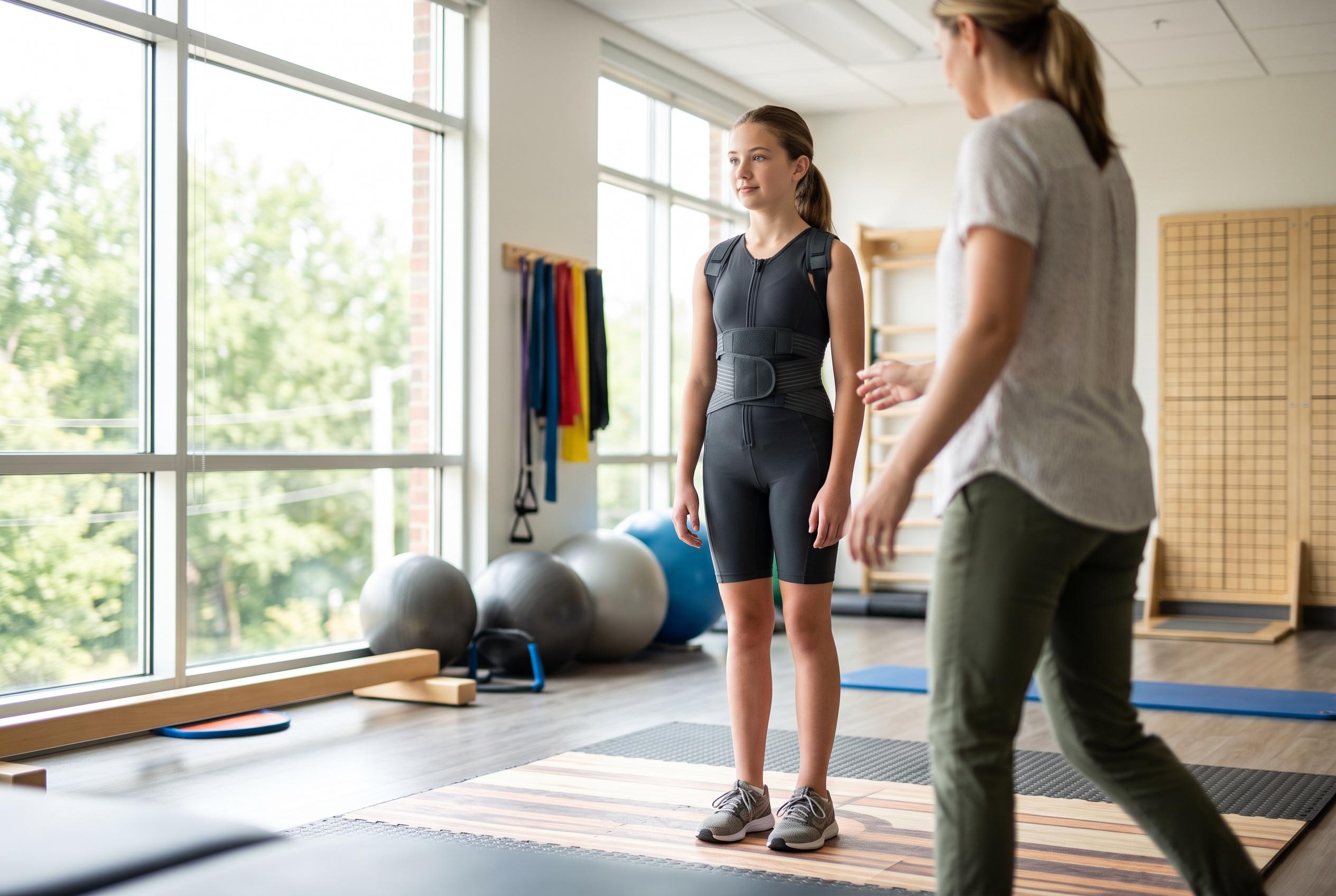

Emerging research underscores the importance of early detection and active management of adolescent idiopathic scoliosis during rapid growth phases, with new options like the ScoliSMART Activity Suit offering promising alternatives to traditional bracing.
Rapid growth can make adolescent idiopathic scoliosis more likely to worsen quickly, which is why doctors pay close attention to children and teenagers during puberty. The lead article argues that a curve may seem to appear suddenly, but in many cases it has been developing quietly and becomes more obvious as the child grows taller. Healthline similarly notes that scoliosis in children is usually monitored closely because progression can speed up while the skeleton is still maturing.
That concern is rooted in the biology of growth itself. Research indexed in PubMed suggests that, during the growth spurt, the disc portion of the spinal curve can change more than the vertebral portion, offering one explanation for why curves may accelerate in adolescence. A separate review in PMC says the main predictor of progression is how much growth remains, with puberty marking a major turning point. Clinicians therefore look at indicators such as bone age, remaining height potential and curve size rather than age alone.
The article also reflects a wider clinical view that growth does not affect every patient in the same way. The Allwell Scoliosis piece says rapid growth raises the risk of progression but does not cause scoliosis by itself, and that doctors may use markers such as peak height velocity, the Risser sign and menarche timing to estimate risk. That fits with the broader message from scoliosis specialists: early detection gives families more options while the child is still growing and before a curve has had time to become more fixed.
Physical changes are often what prompt the first appointment. Uneven shoulders, a more prominent shoulder blade, a tilted waist or a rib hump can become easier to spot during a growth spurt, even if the child has no pain. The article urges parents not to dismiss these signs, because a curve that appears mild in one visit can change substantially over a few months when growth is rapid. Once a child reaches skeletal maturity, the pace of change often slows, but it does not always stop entirely.
For treatment, the article leans towards active management rather than simply watching and waiting. It points to bracing for some children, alongside physical therapy, scoliosis-specific exercises and supportive routines at home. It also highlights the ScoliSMART Activity Suit as an alternative to a rigid brace, describing it as a movement-friendly option meant to reinforce posture and muscle memory during daily life. The article presents this approach as part of a broader push to intervene earlier, especially when growth is still ongoing.
That message is consistent with the overall evidence: the most important window for preventing a curve from becoming more severe is often the years of fastest growth. Families are encouraged to keep up with regular review visits, understand the role of skeletal maturity and act quickly if posture, shoulder height or clothing fit begins to change. In that sense, rapid growth is not the cause of scoliosis, but it is often the period when the condition becomes most difficult to ignore and most important to manage well.
Disclaimer: This content is for informational purposes only and is not intended to be a substitute for professional medical judgment, advice, diagnosis, or treatment.