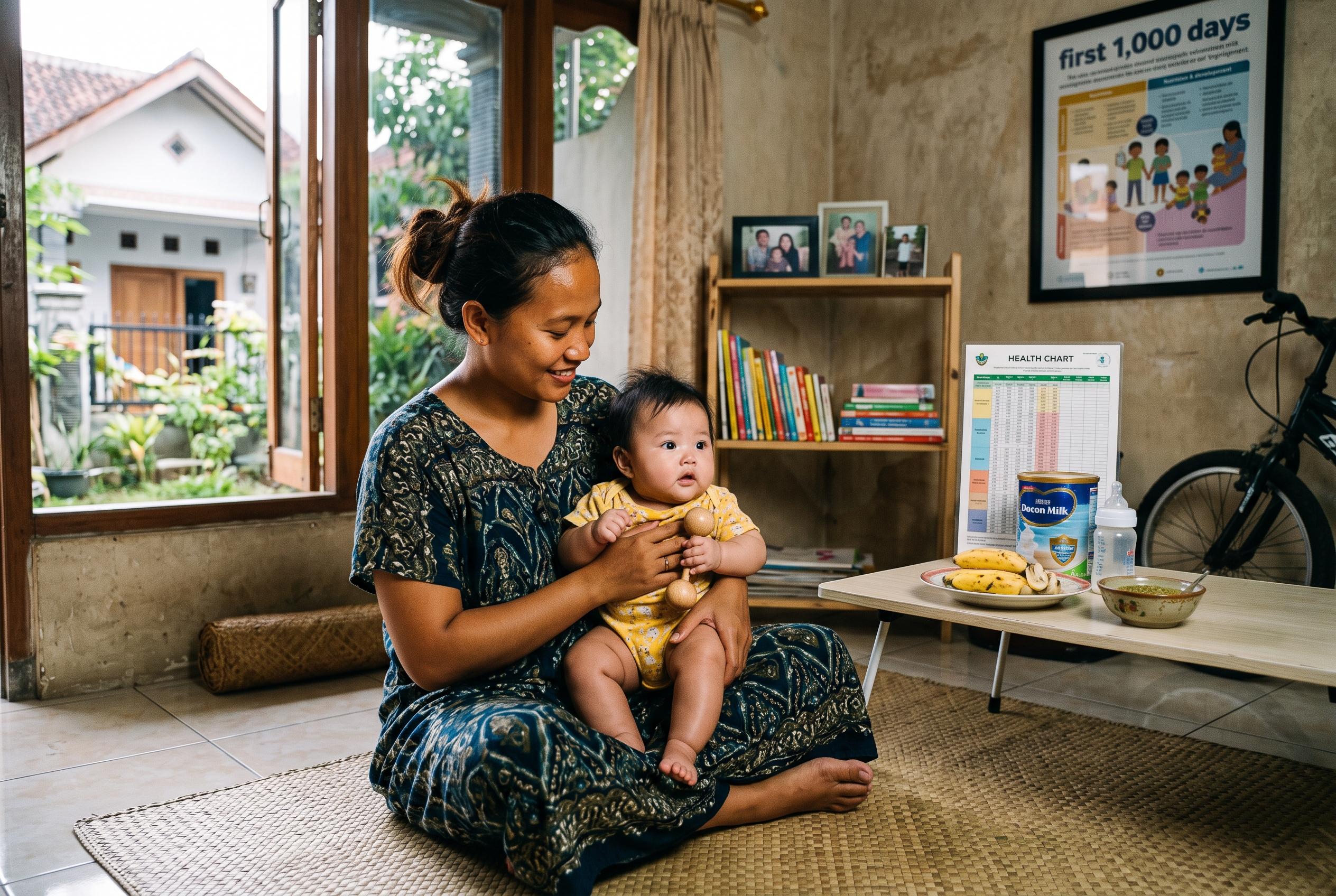

Indonesia is increasingly framing its fight against stunting as a race against time, focusing on urgent interventions during the first 1,000 days of a child’s life. Despite progress, millions of children remain affected, prompting calls for sharper targeting and cross-sector collaboration to secure the nation’s future health and development.
Indonesia’s push to cut stunting is increasingly being framed as a race against time, with the decisive window running from conception to a child’s second birthday. In an analysis published by Republika, Michael Susanto of Tanoto Foundation argued that nutrition in the first 1,000 days shapes not only physical growth but also learning, productivity and long-term health. That view is consistent with Tanoto Foundation’s own stunting materials, which describe the period as critical to brain development and to preventing growth failure that can echo across generations. According to the foundation, about 83% of brain volume is formed in those early years.
The urgency is underscored by Indonesia’s progress and its remaining gaps. Republika cited government data showing stunting prevalence has fallen from 37.2% in 2013 to 19.8% in 2024, just below the World Health Organisation’s 20% threshold. Tanoto Foundation says the latest figure still means roughly one in five children remains affected, or about 4.5 million lives, while maternal undernutrition continues to feed the problem. The foundation cites national rates of 27.7% for maternal anaemia and 17% for chronic energy deficiency, conditions that can increase the risk of low birth weight and later child malnutrition.
A major concern is what happens after infancy begins. Republika highlighted survey findings showing the sharpest rise in stunting appears between six and 18 months, pointing to weaknesses in infant and young child feeding, including the quality of complementary foods given after exclusive breastfeeding. Tanoto Foundation’s guidance says nutrition action should begin earlier, including for adolescents and couples of reproductive age, because poor maternal nutrition can begin a cycle that is passed from mother to child.
The policy response has broadened beyond health clinics. Republika reported that Indonesia has rolled out teams to accelerate stunting reduction, food supplements for young children, iron tablets for adolescent girls and wider maternal and child health programmes. Tanoto Foundation says it supports the government through its SIGAP programme, working both nationally and with provincial and district authorities on cross-sector co-ordination, behaviour-change communication and monitoring. In 2022, the foundation and UNICEF Indonesia also extended a partnership focused on behaviour change in nutrition, showing how non-state actors are being drawn into the effort.
Susanto’s argument is that the next phase must be less about launching more schemes and more about making existing ones work better. He called for tighter targeting of support for pregnant women and young children, stronger rules on food marketing and composition, and more research into the behaviour of caregivers. That broader approach reflects a growing consensus in the sector: if Indonesia is to reach its longer-term stunting ambitions, it will need not only public spending, but also sustained co-ordination among government, foundations, business, researchers and communities.
Disclaimer: This content is for informational purposes only and is not intended to be a substitute for professional medical judgment, advice, diagnosis, or treatment.