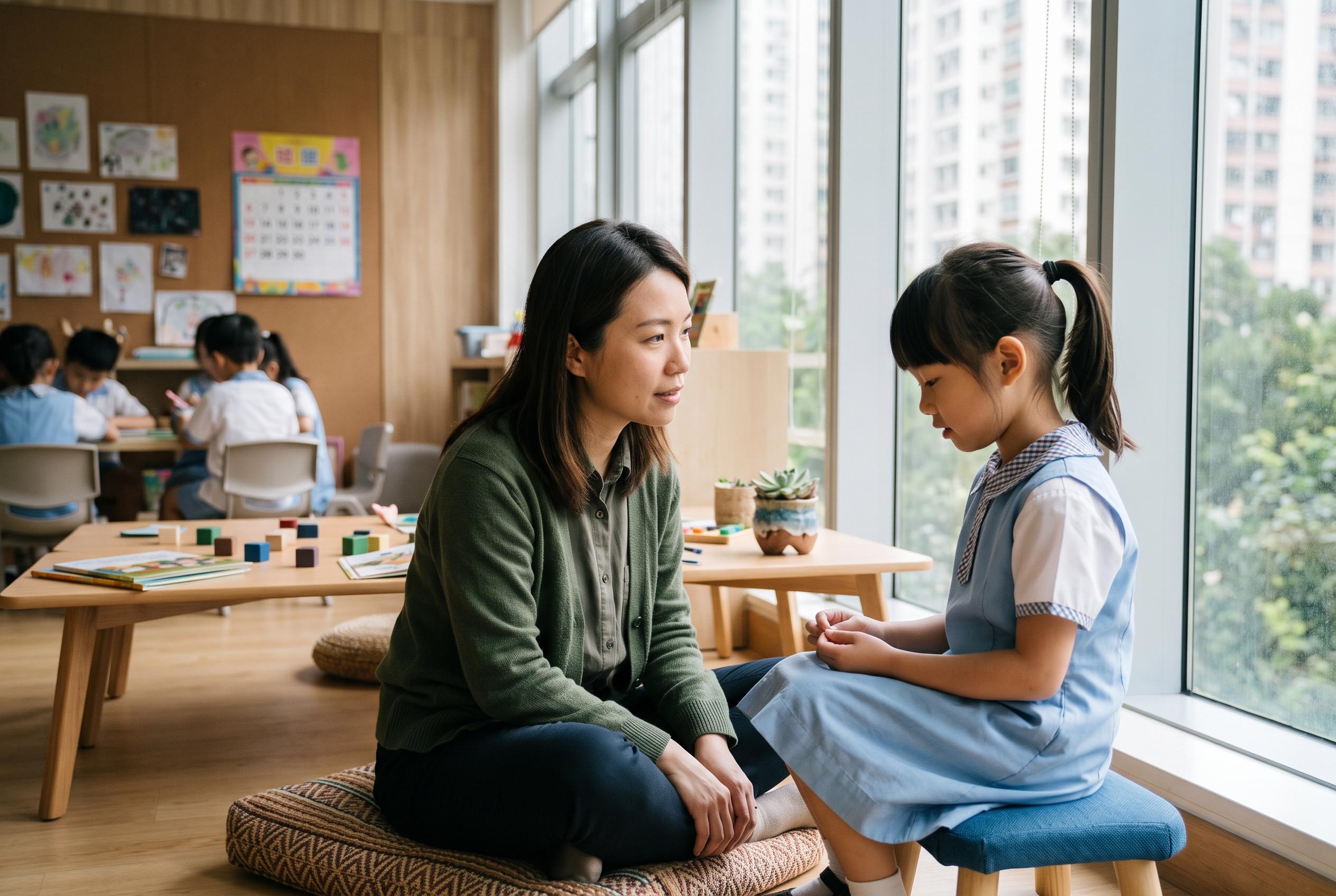

As the 2026/27 academic year begins, Hong Kong introduces a dual-track mental health strategy in schools, emphasising early intervention, cross-sector collaboration, and support for younger pupils amid rising mental health concerns.
As Hong Kong settles into the first week of the 2026/27 academic year, officials are trying to recast school mental-health policy as something broader than emergency response alone. The Education Bureau has launched a territory-wide wellbeing campaign for the new term, while still reviewing what comes next for the three-tier emergency mechanism for upper-primary pupils after that trial reached its scheduled end on 31 August 2026.
That leaves schools beginning September with two overlapping strands of policy. The emergency mechanism was first introduced for secondary schools in late 2023, then strengthened in 2024, before Chief Executive John Lee Ka-chiu announced in his September 2025 policy address that it would become a regular arrangement in secondary schools and be extended on a trial basis to Primary Four to Six pupils. An Education Bureau circular later set that upper-primary trial to run from 1 December 2025 to 31 August 2026.
The numbers gathered during that period help explain why the review matters. The South China Morning Post reported that, between November 2024 and June 2025, the Hospital Authority received more than 100 referrals from principals under the mechanism, with 60 per cent classed as semi-urgent and fewer than 10 per cent as urgent, while the Social Welfare Department handled 243 referrals from schools to non-governmental organisations. More recent figures cited by RTHK said that, over the previous six months, the second tier had provided about 220 services, more than 90 of them involving upper-primary pupils. Choi also said there had been more than 90 third-tier referrals, including more than 10 from primary schools. TVB, citing Social Welfare Department figures for the upper-primary pilot from December to the end of June, said an external support network run by five NGOs had received 95 referrals from primary schools, while 14 cases had been sent by primary school heads to Hospital Authority psychiatric services.
Those figures have fed a growing sense among education and mental-health officials that younger pupils can no longer be treated as a peripheral concern. TVB reported that Lam Ching-choi, chairman of the Advisory Committee on Mental Health, said the review came against an “increasingly younger trend” among children with mental-health difficulties and younger cases of child suicide. Choi told RTHK that principals had informed the bureau that the plan had been very helpful for both schools and students. She also said that, until new measures were announced, support services would continue under the existing arrangement, and suggested the model was more likely to be fine-tuned than rewritten.
At the same time, the bureau has been careful to present the start-of-term response as preventive rather than purely reactive. At a launch ceremony and professional exchange session held on 29 August 2026 and attended by nearly 400 principals, teachers and student-guidance staff, Choi said the new campaign was intended to deepen cross-professional and cross-sector collaboration, sharpen awareness of anti-bullying work and strengthen campus mental health. During a school visit on 1 September, she described the initiative in plainer terms: “This initiative encourages students to support and care for one another to prevent campus bullying.” She added: “Through our collective efforts, we hope to create an environment where students can develop healthily in body, mind, and spirit.”
The wider package attached to that campaign shows how far the bureau wants the discussion to reach beyond formal referrals. HK01 reported that all primary and secondary schools had been sent a circular explaining the initiative and the 4Rs Mental Health Charter, while teachers and parents would be offered training on mental health, resilience, relationships, parent-child communication and home-school cooperation. The same report said swimmer Stephanie Au Hoi-shun would serve as a 4Rs mental-health ambassador, and that the period from October 2026 to January 2027 would be designated “4Rs Mental Health Month” around World Mental Health Day. The atmosphere behind those measures was captured in the South China Morning Post’s first-day reporting, where 11-year-old Prabhleen Kaur said she was glad to be back at school but already felt pressure over forthcoming examinations.
The emergency mechanism itself is more layered than the shorthand often suggests. According to the government’s November 2024 explanation, the first tier focuses on training school staff and educating parents so that pupils at higher suicidal risk can be identified earlier. The second allows schools to contact district off-campus support networks directly, so students and families can be matched with community services and followed up more consistently. The third gives schools clearer guidance on which cases should be referred to Hospital Authority psychiatric specialist services. That structure was expanded after concern over suspected student suicides, and the policy shift announced in 2025 came after a government source told the South China Morning Post that the Education Bureau had recorded 23 suspected suicide cases among students in the first eight months of that year.
Choi has also stressed that the cases arriving at the most serious end of the system do not fit a single pattern. Speaking to RTHK in late August, she said some involved emotional or mental-health difficulties, while others were linked to relationship problems, self-imposed expectations, adjustment to a new environment or pressure over schoolwork. That matters because it points to the limits of a system built only around crisis referral. The bureau’s newer messaging, with its emphasis on relationships, bullying prevention and adaptation to the new term, appears designed to catch distress earlier and in less clinical settings.
What remains unsettled at the beginning of September 2026 is whether upper-primary pupils will retain this extra emergency pathway in a permanent form, or under a revised trial, once the review is complete. For now, Hong Kong’s approach is moving on two tracks at once: preserving a high-intensity referral route for children judged to be at immediate risk, while trying to build a more ordinary school culture in which classmates, parents and teachers are better prepared to listen, notice changes and act before anxiety or despair becomes acute.
Disclaimer: This content is for informational purposes only and is not intended to be a substitute for professional medical judgment, advice, diagnosis, or treatment.