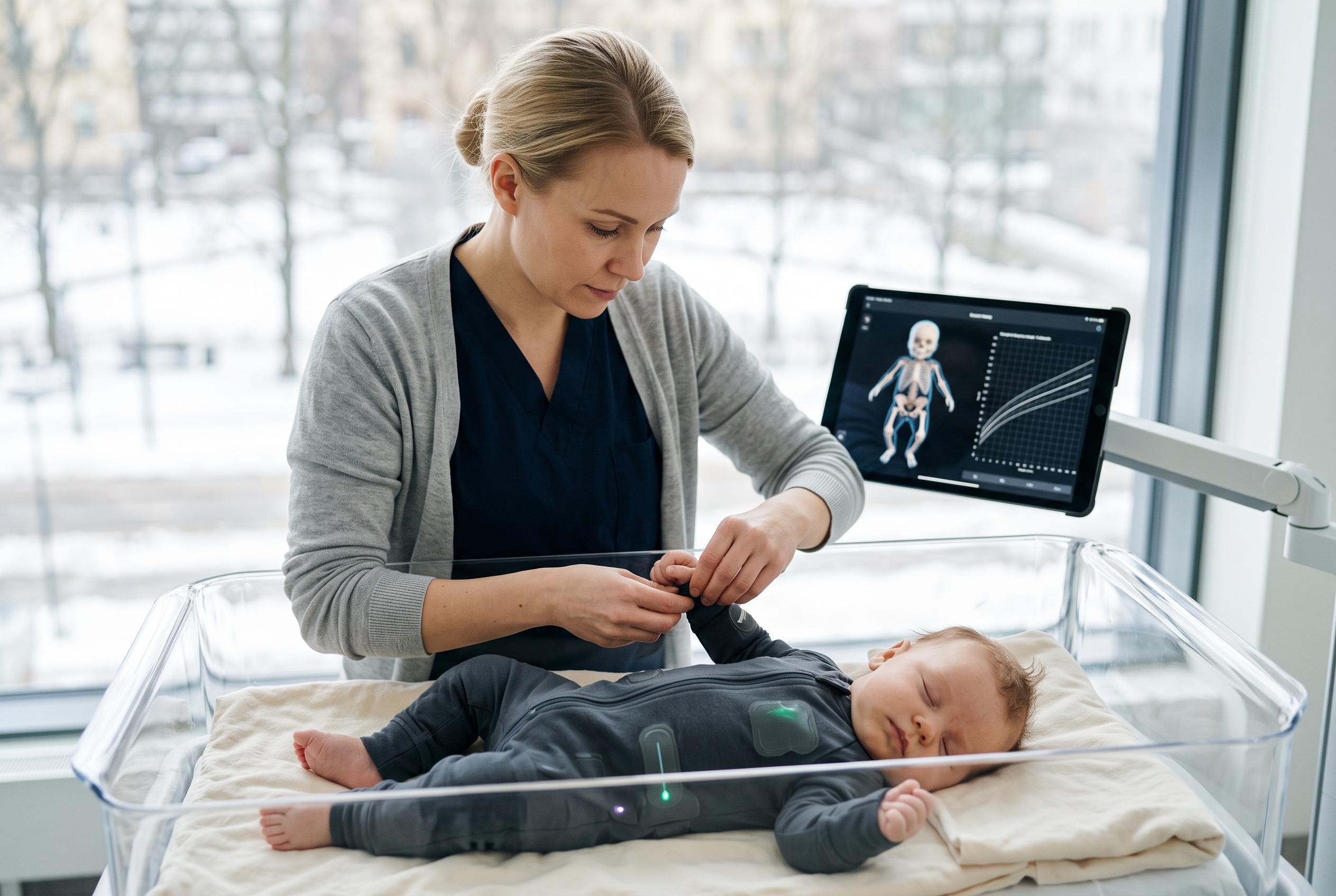

A groundbreaking study in Finland utilises a smart jumpsuit and artificial intelligence to produce detailed growth charts for infants’ gross motor skills, promising to enhance early detection of neurological issues and improve international assessments.
Researchers in Finland have used a smart jumpsuit and artificial intelligence to produce normative growth charts for infants’ gross motor development, offering what they say is a more objective way to track how babies move in everyday life. The work, led by the University of Helsinki and HUS Helsinki University Hospital, followed 92 typically developing infants aged four to 19 months at home and collected 580 measurements over 1,227 hours of free play.
The MAIJU jumpsuit contains four motion sensors, one in each limb, and a fully automated deep-learning system analyses the data second by second to identify posture and movement. From that, the researchers derived 220 motor metrics and built a separate growth chart for each one, creating what they describe as functional charts to sit alongside traditional height, weight and head-circumference measures.
When the charts were tested on 39 children already under neurological developmental follow-up, 121 of the 220 metrics differed significantly in infants with abnormal neurological development. The researchers say the findings suggest early motor development is more gradual than milestone checklists imply, with skills emerging as part of a wider neurocognitive and social process.
The team also says the approach could make comparisons between countries more straightforward because the measurements are taken in a child’s own home and analysed automatically. Professor Leena Haataja said functional growth charts had long been hoped for, while Professor Sampsa Vanhatalo argued the method could help set measurable goals for therapy and track progress more clearly. Associate Professor Manu Airaksinen said the system is unusual because it can assess infant motor performance in this level of detail, but the MAIJU jumpsuit is still a research tool and is not yet available as a medical device.
Disclaimer: This content is for informational purposes only and is not intended to be a substitute for professional medical judgment, advice, diagnosis, or treatment.