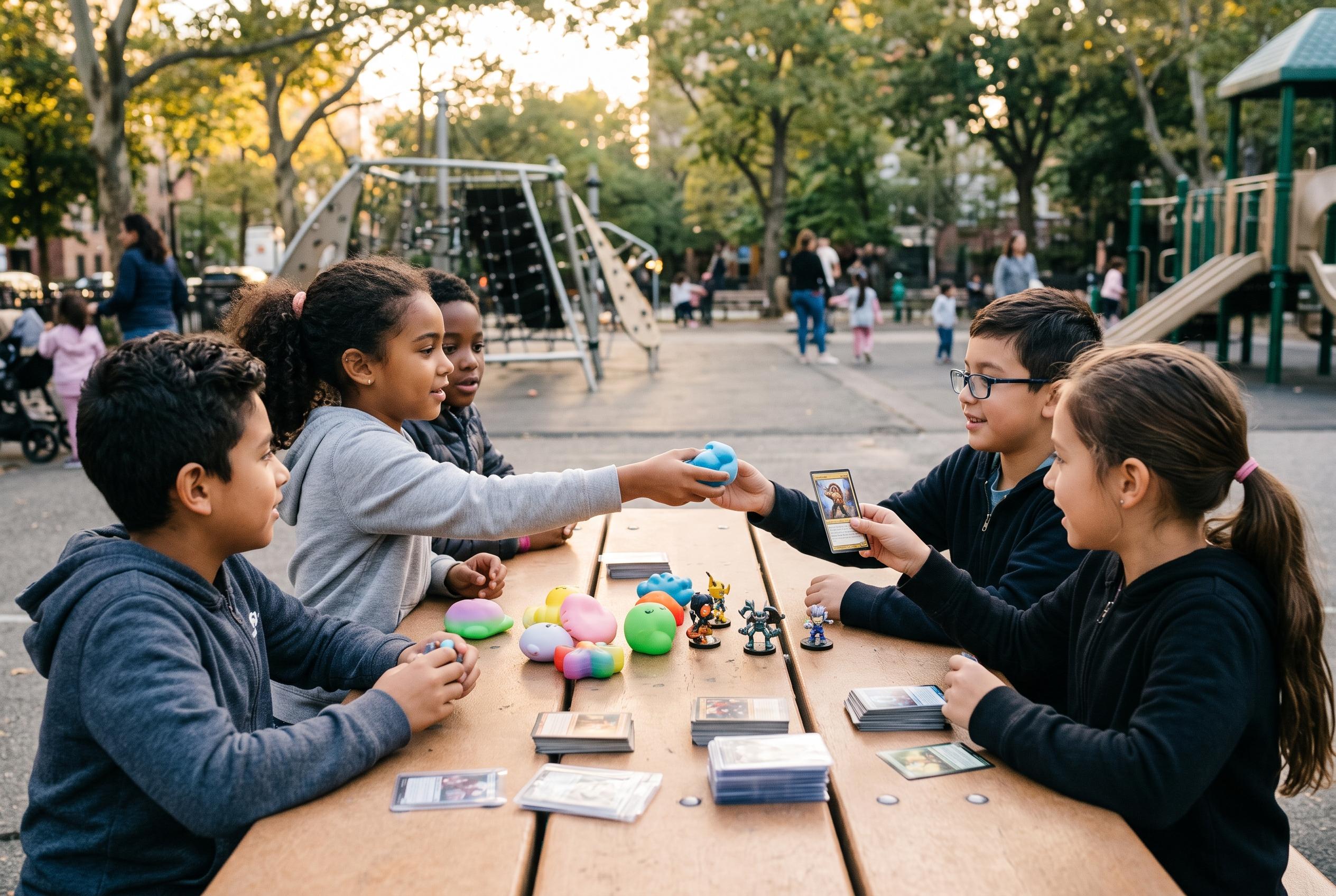

Children’s latest playground obsessions, from squishies to Pokémon cards, are more than fleeting fads, they serve as vital tools for social learning, negotiation, and identity formation, prompting a reevaluation of their developmental value amid rapid trend cycles.
Elementary school playgrounds have always had their own economy of must-have objects, but the latest craze is moving faster than ever. One week it is squishies, the next it is Pokémon cards, Beyblades or miniature collectible toys. For adults, the appeal can look baffling. For children, these items often function as far more than playthings: they are signals of belonging, tools for conversation and small tokens that can confer status in the social world of school.
The speed of the cycle is new, but the underlying impulse is not. According to educators cited in the lead article, children are using these objects to practise negotiation, compromise and conflict resolution in real time. The American Academy of Pediatrics has long argued that toys are most valuable when they support interaction, imagination and problem-solving rather than passive use, and that the best play objects encourage language, social engagement and physical activity. In that sense, the latest playground obsession may be less about the object itself than the social work happening around it.
That is especially true because today’s trends are designed to spread quickly. Many begin with older children on social media, then filter down through siblings and classmates until they are suddenly everywhere. The toys that catch on tend to share three traits: they are collectible, they are social and they are scarce. That combination creates a powerful mix of anticipation and competition, much like limited sneaker drops or other adult consumer frenzies.
Experts say that mix can be useful, even if it is occasionally maddening for parents. Kristen Miller, an educator quoted in the lead article, said children trading cards or staging battles are learning to advocate for themselves, handle disappointment and navigate group dynamics. The Genius of Play, a toy-industry initiative, has made a similar point, arguing that disagreements over rules, sharing and inclusion can help children build communication and perspective-taking skills. Even simple or inexpensive objects can do this work, Catholic Relief Services notes, because play itself is what matters most.
The emotional charge also makes developmental sense. Angela Narayan, a clinical child psychology professor at the University of Denver, said these trends help children build identities separate from their parents and create a shared language with peers. Yolanda Carlos of Pacific Oaks College added that children have always used accessories, shoes and lunchboxes to express who they are and to find their place in a group. What looks like a fad from the outside can feel to a child like a passport into friendship.
That does not mean every craze is harmless. Scarcity can leave some children out, and status toys can become awkward markers of who belongs and who does not. But the article’s parents and educators suggest that the better response is not panic, but guidance: asking why an item matters, how a trade works and whether a friend without the toy can still be included. Those are lessons in money, patience and fairness as much as they are lessons in play.
In the end, the toy may be disposable, but the developmental value is not. Whether children are collecting squishies, swapping cards or battling spinning tops, they are learning how to join a group, manage rivalry and define themselves among peers. That is why the latest fad can look so trivial to adults and so important to children: for them, it is often the first draft of social life.
Disclaimer: This content is for informational purposes only and is not intended to be a substitute for professional medical judgment, advice, diagnosis, or treatment.