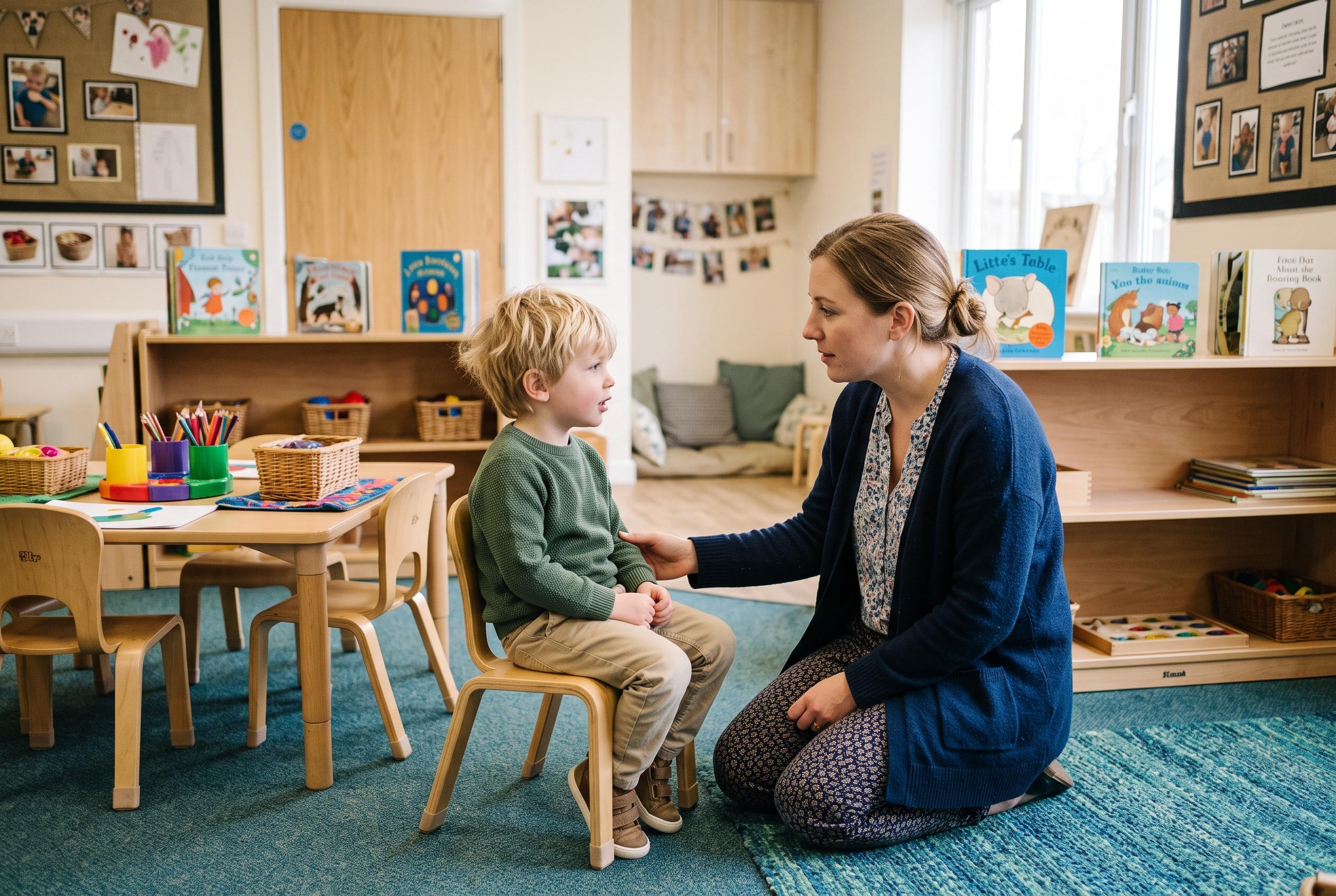

Supporting children with social, emotional, and mental health needs in early years settings is vital, emphasising that behaviour often signals underlying overwhelm. Consistent relationships, tailored environments, and early intervention can make a significant difference for vulnerable young children.
Supporting children with social, emotional and mental health needs in early years settings often begins with one simple truth: behaviour is communication. For nurseries and pre-schools, that means a child who clings, lashes out, withdraws or struggles with change is usually not being difficult. More often, they are showing that they feel overwhelmed and need help to feel safe.
The issue is significant. Parenta says SEMH is the second most common type of special educational need in England, accounting for about 23% of identified SEN. It also points to wider concern about child mental health, noting that around one in six children and young people now experience a mental health problem, compared with roughly one in nine in 2017. Early childhood is especially important, because the years before age five help shape emotional development for life.
In practice, the first and most important support is often the key person. The EYFS statutory framework requires every child to have one, and Parenta argues that this relationship is central for children with SEMH needs. Consistency, calmness and predictable routines can make a major difference, helping children settle, regulate stress and engage more confidently with play. Local authority guidance from Leicestershire, West Sussex and Oxfordshire makes the same point, stressing warm relationships, clear communication and secure routines.
The physical environment matters too. A noisy, cluttered or visually busy room can be hard for a child already coping with anxiety or emotional strain. Simple adjustments can help: a quiet calm corner, a visual timetable at child height, advance warnings before transitions and reduced sensory input where possible. Bury Council’s graduated approach toolkit also groups support into levels of adjustment, targeted help and more specialist intervention, reflecting the idea that needs should be matched with increasingly tailored support.
Helping children name their feelings is another important step. Parenta recommends feelings boards, emotion coaching, picture books and tools such as the Zones of Regulation, which give adults and children a shared language for emotions. That can be especially useful for very young children who cannot yet explain what is wrong. Once feelings are named, they are easier to understand, and sometimes easier to manage.
Daily regulation strategies can also be built into the routine. Breathing games, rhythmic movement, heavy work such as carrying or pushing objects, and open-ended sensory play can all help children settle. Parenta also suggests focusing praise on effort rather than performance, especially for children with fragile self-esteem. A quiet acknowledgement of progress can be more effective than public praise that feels pressurising.
When difficulties continue despite consistent support, the next step is the graduated approach: assess, plan, do and review. Parenta says practitioners should involve the SENCo or SEND lead first and consider referrals to speech and language therapy, inclusion teams or CAMHS where appropriate. Careful records are essential, both for referrals and for conversations with families.
Working with parents and carers is just as important as supporting the child. Parenta notes that families are often tired, anxious and defensive, particularly when a child’s behaviour looks different at home and in the setting. Trust, shared strategies and steady communication can help bridge that gap. The message across the guidance is clear: early years staff do not need to solve everything alone, but with the right relationships, environment and early intervention, they can make a real difference.
Disclaimer: This content is for informational purposes only and is not intended to be a substitute for professional medical judgment, advice, diagnosis, or treatment.