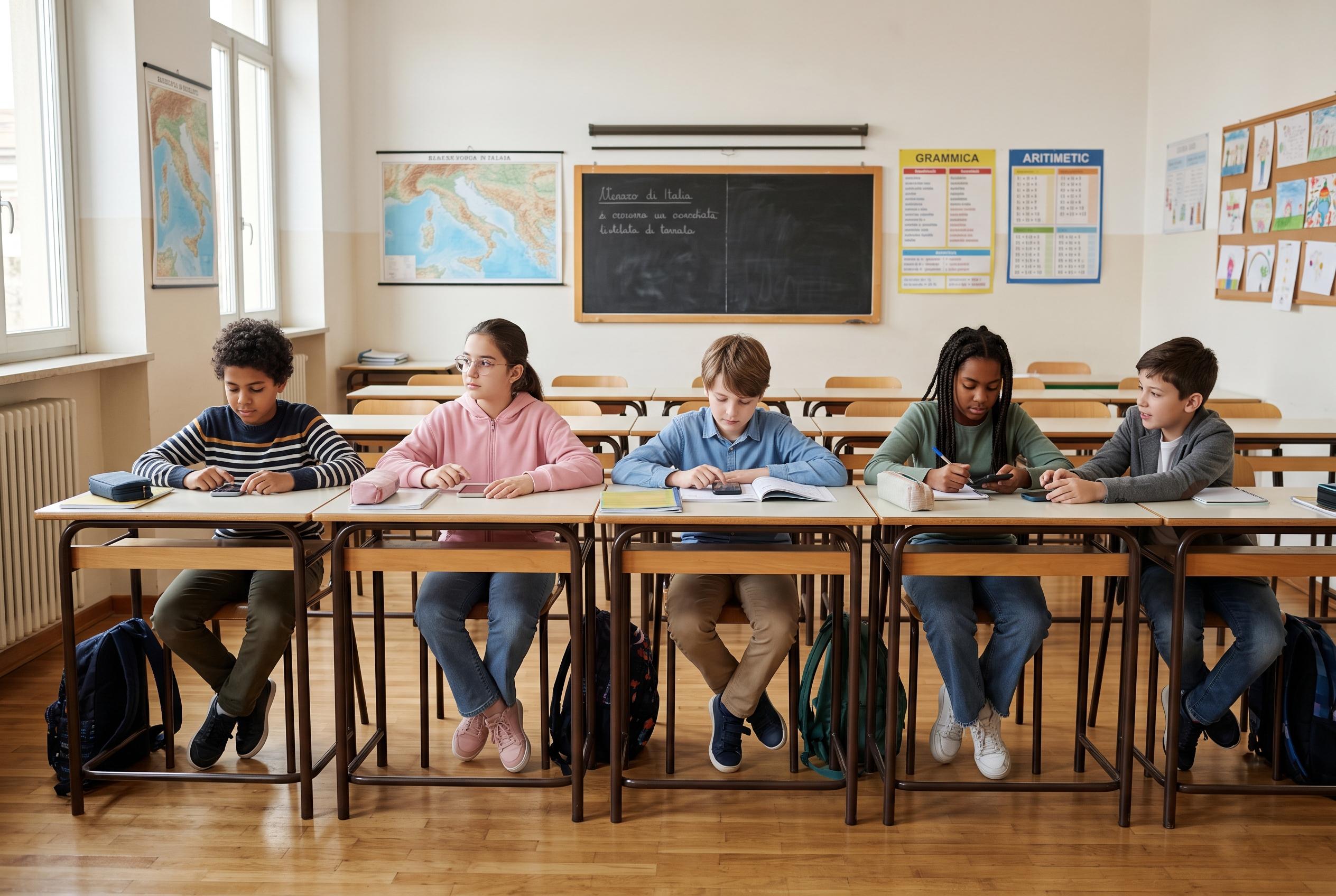

A new study suggests that children in Italy who start using social media at age 11 or 12 tend to perform worse in reading and maths by secondary school, raising concerns about digital media’s impact on learning.
A new Italian study suggests that children who begin using social media at 11 or 12 tend to enter secondary school with weaker results in reading and maths than classmates who wait until they are older. Published in Nature Human Behaviour, the research followed 5,227 pupils at 28 schools in northern Italy and linked earlier social media sign-up with lower academic performance by high school.
Chiara Respi, the study’s lead author at the University of Milano-Bicocca, and her colleagues found that pupils who joined in sixth form equivalent years, around ages 11 to 12, scored 0.22 standard deviations lower in Italian and as much as 0.27 standard deviations lower in maths than those who waited until ninth grade or later. English scores did not differ significantly. The pattern was not limited to the youngest users: children who joined in seventh or eighth grade generally fell between the earliest and latest adopters, suggesting a gradual relationship between earlier use and poorer results.
The researchers say the difference amounts to about half a year of schooling, and they argued that social media may be part of a wider shift in how children spend their time. Kirsty Ross, a professor in Massey University’s School of Psychology, said that online time can crowd out sleep, exercise, reading, play and face-to-face interaction. Respi said waiting until about 13 or 14 could be helpful, though she cautioned that age limits alone would not solve the wider problem.
The findings fit a broader body of research on screen exposure and child development. A separate study in the journal Children reported that screen exposure at age 4 was linked to persistent dysregulation through age 12, which in turn was associated with weaker academic achievement and less ability to be alone. Other studies, including one in PLOS ONE, have also tied heavier screen use in late childhood to lower reading scores. Together, the research points to a consistent concern: excessive digital media use may displace the habits that support learning, attention and self-regulation.
Not all experts think the answer is as simple as raising the minimum age for social media. Eoin Whelan of the University of Galway said some children benefit from social media, some are unaffected and others have negative experiences. Cara Swit of the University of Canterbury made a similar point, noting that messaging friends, watching short videos, using educational content and facing harassment may each have very different effects. That suggests the challenge is not just when children go online, but how they use these platforms and what support families and schools give them.
Disclaimer: This content is for informational purposes only and is not intended to be a substitute for professional medical judgment, advice, diagnosis, or treatment.