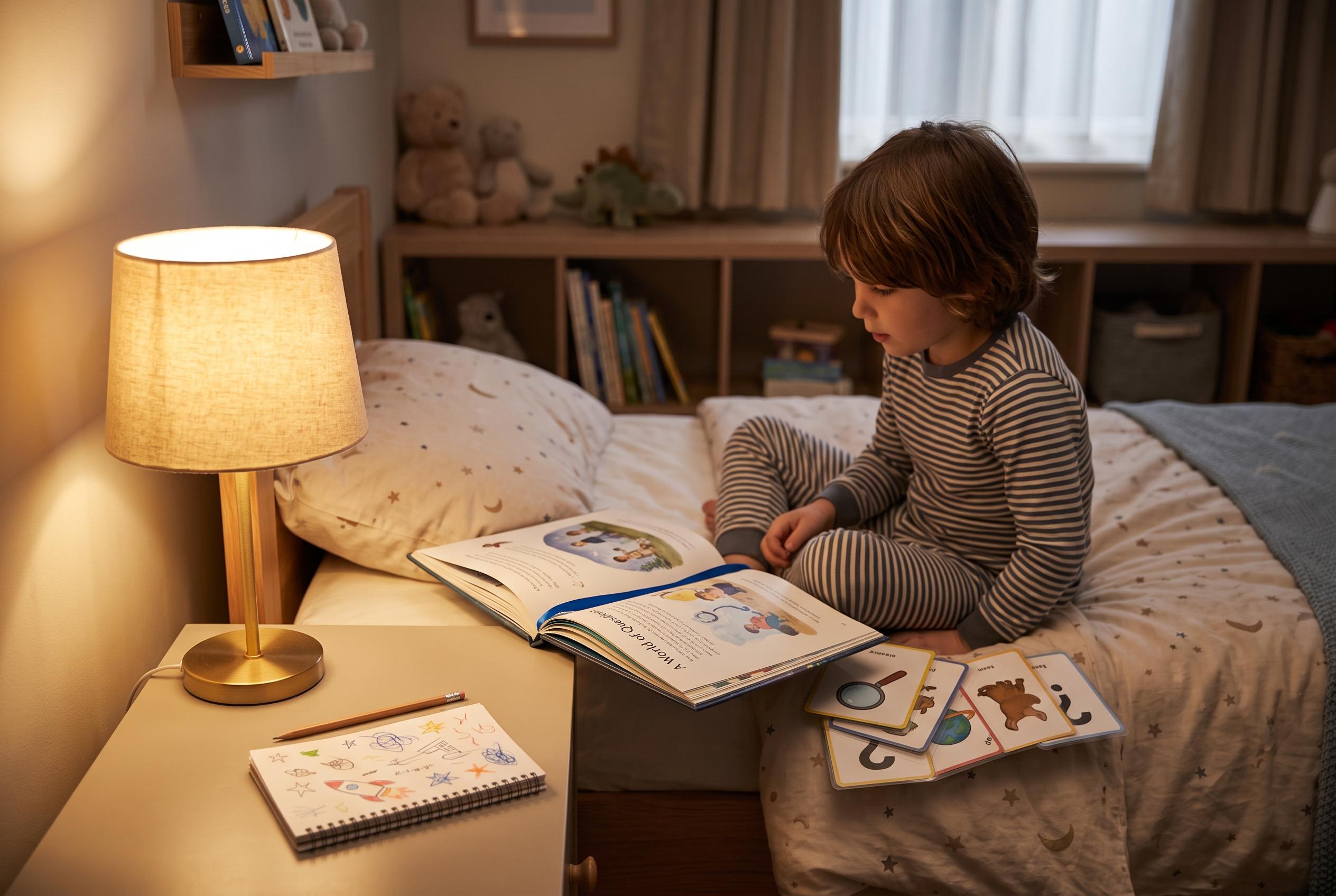

New research reveals that a child’s questions, especially those clustered before naps and bedtime, play a crucial role in consolidating memories and reinforcing learning, challenging the impact of screen time in early years.
A four-year-old may ask close to 300 questions a day, according to a British study of preschool language logs, with one older UK survey of 1,000 mothers and children putting the figure nearer 400 questions for girls of that age. The exact number matters less than the pattern it reveals: in early childhood, curiosity arrives in bursts, and those bursts often gather before naps and bedtime, when a child’s attention turns back over the day. That is where researchers think the brain may be doing some of its most important sorting work.
Studies of sleep and memory suggest that this late-day questioning is not just noise. Research published in Scientific Reports found that post-learning slow-wave sleep improved declarative memory consolidation in children, while earlier work showed that sleep after learning helped children retain facts better than wakefulness. A review in the journal Sleep Medicine Reviews also concluded that children and infants appear to consolidate memories efficiently during sleep, likely because they spend more time in deep slow-wave sleep than adults do. In other words, the brain seems to use sleep to lock in what it has just encountered.
That helps explain why questions often come in clusters. A child who noticed a snail after preschool may not ask about it immediately, but the topic can reappear at bath time or while brushing teeth, just as sleep approaches. The questioning looks scattered from the outside, yet it may actually be part of the same process as rehearsal: the child is revisiting the day’s material before the brain sets it down for the night. The question itself may help determine what gets remembered.
Curiosity is not only a by-product of learning, but a force that shapes it. Work on child curiosity has shown that when children are given structured chances to ask questions, they begin to value new information more highly, suggesting that questioning can strengthen engagement as well as memory. That makes the adult response important. A patient reply, a follow-up, or even an honest admission that the answer is not known can keep the exchange alive long enough for the child to think a little further.
The timing of that conversation also matters in a home full of screens. A cohort study from Singapore reported through EurekAlert found that more screen time in early childhood was linked with small but measurable differences in later academic performance and working memory. Researchers have not pinned down a single cause, but one possibility is that screens crowd out the back-and-forth talk that often fills the pre-sleep window. For a young child, that window is not idle time. It may be the last chance to turn experience into memory before sleep does the rest.
Disclaimer: This content is for informational purposes only and is not intended to be a substitute for professional medical judgment, advice, diagnosis, or treatment.